How Many Ounces Is 750?
Type “how many ounces is 750?” into a search bar and you usually get a bare number back. Here’s the number plus the context: 750 ml is 25.
36 US fluid ounces, though most bottles labeled 750 ml print anywhere from 24 to 26 oz depending on how the brand rounded. My take is that the decimal matters less than being able to picture the volume in a real container.
Below I’ll walk through the conversion, explain why labels disagree, and point out which 750 ml bottles actually hold the figure you’re asking about.
What 750 ml Actually Means In Ounces
Recommended Products

Before picking a bottle, it helps to know why 750 ml shows up on so many labels , and why the ounce figure seems to shift depending on who did the math.
The math itself is straightforward. A milliliter is a metric unit of volume; a fluid ounce is the US customary unit most of us use for drinks. One US fluid ounce equals about 29. 5735 milliliters, so 750 divided by that gives 25. 3605 fluid ounces. That’s the precise figure.
The confusion creeps in because the UK uses a different fluid ounce , about 28. 4131 milliliters , which makes 750 ml roughly 26. 4 imperial ounces. So if one label says 25 oz, another says 25.
4, and a third says 26 for the same bottle, nobody is lying; they’re rounding, or working from a different ounce standard.
My advice is to work out which system a label uses before you buy, because that’s the difference between the size you planned for and one that’s an ounce off.
750 ml Converted Across Common Ounce Standards
| Ounce Standard | Milliliters Per Ounce | 750 ml Equals |
|---|---|---|
| US fluid ounce | 29.5735 ml | 25.36 oz |
| US nutrition label ounce | 30 ml | 25.00 oz |
| Imperial (UK) fluid ounce | 28.4131 ml | 26.40 oz |
| US customary rounded | , | About 25.4 oz |
Why Bottle Labels Round 750 ml Differently
The number printed on a bottle isn’t pure math. Marketing, labeling habits, and the target market all nudge the ounce figure one way or another.
- Treat 25.36 oz as the true US fluid ounce equivalent of 750 ml.
- Expect US nutrition panels to round to 25 oz because they divide by 30 ml per ounce.
- Expect UK or EU labels to show closer to 26.4 oz using imperial fluid ounces.
- Watch for bottles sold as 24 oz that hold 710 ml, not a true 750 ml.
- Check the milliliter figure first if you need an exact match for a recipe or plan.
- Remember that fill lines sit below the rim, so usable volume runs slightly under the stated capacity.
Brands pick whichever number reads best where they sell. A US cycling brand will often print 25 oz because 25. 36 rounds down cleanly and matches how nutrition labels handle rounding. A European brand may skip ounces entirely and print 750 ml alone. Others split the difference with 25.
4 oz. None of that is an error. Here’s the framing I find more useful than the decimal: a 750 ml bottle holds a little over three standard 8 oz glasses of water. If your goal is eight glasses a day, one fill covers roughly a third of it.
That’s the number you can actually act on.
750 ml Bottles That Match The Ounce Math
If you want a bottle that actually holds 750 ml , or sits close enough for the difference to matter , these ten are where I’d start looking.
Some print 750 ml right on the label, others land near 25 oz, and a few sit deliberately above or below the mark. Each one shows how the conversion plays out on a product you can buy today.
|
1
|
GEMFUL Bike Water Bottle BPA Free 750 ml 2 Pack | BPA Free, Leakproof, Squeeze Design For |

Two 750 ml bottles per pack, so the ounce math doubles to roughly 50.7 oz combined.
The GEMFUL Bike Water Bottle comes as a two pack, each bottle holding 750 ml , about 25. 36 US fluid ounces , which works out to roughly 50. 7 oz for the pair.
The body is shatter-resistant polypropylene with a threaded lid and an up/down valve that seals water in. The round shape slots into standard bike cages and backpack pockets, and since it’s a squeeze bottle you never unscrew anything mid-ride. If your question is literally “how many ounces is 750?”
, this is about as direct a one-to-one example as you’ll find.
My read is that this suits cyclists and gym goers who want an inexpensive pair to rotate between bags. The squeeze design makes fast sips easy, and the BPA-free plastic keeps it food safe.
The trade-offs are real, though: there’s no insulation, so water warms up on hot days, and there are no measurement markings, so you can’t track ounces by eye. If all you need is the 750 ml figure confirmed in a physical bottle, this pair does exactly that.
|
2
|
CamelBak Chute Mag Water Bottle 25oz, Charcoal | Magnetic Cap System, Durable Tritan Bottl |

A 25 oz bottle that sits right next to the 25.36 oz figure 750 ml converts to.
The CamelBak Chute Mag holds 25 oz, which lands just 0. 36 oz shy of the 25. 36 oz that 750 ml converts to. That near match makes it a handy reference point if you’re shopping by ounce and wondering how close retail bottles get to 750 ml.
You get a magnetic cap that stows out of the way while you drink, a Tritan body that resists odors and stains, and an integrated carry handle. Both cap and bottle are dishwasher safe, which keeps daily cleaning painless.
I would shortlist this for commuters, gym users, and travelers who want one-handed hydration without fuss , the magnetic cap is the standout, since it stays out of your face while you drink.
The honest caveat is capacity: it holds slightly less than a true 750 ml, so it isn’t an exact match for recipe or hydration math. If you want the closest common bottle size to 750 ml, 25 oz is about as near as retail gets.
|
3
|
Sahara Sailor Water Bottle 32oz, Tritan Sports Bottle with Time Marker | Bpa Free, Leakpro |

A 32 oz bottle that overshoots 750 ml by about 6.6 oz, useful for bigger goals.
The Sahara Sailor holds 32 oz , roughly 946 ml , so it overshoots 750 ml by about 6. 6 oz. That makes it the pick if you ran the math and decided 750 ml isn’t enough for your day.
There’s a time marker down the side for tracking intake, a leakproof flip-lock lid, and a fast-flow air hole for quicker drinking. The Tritan body is BPA free, and a cleaning brush comes in the box.
This fits students, office workers, and gym goers who want a full day of water in one fill. In my view the time marker is genuinely useful if you struggle to drink enough , it turns a vague goal into visible progress.
The limitations: it’s not dishwasher safe, so plan on hand washing, and the larger body gets bulky in a cup holder. If 750 ml felt too small once you did the conversion, this is the natural step up.
|
4
|
Bambaw Stainless Steel Single Wall Water Bottle, 24 oz, 750 ml, Reusable, Leakproof, Dishw |

Lists both 24 oz and 750 ml on the label, showing the rounding in plain sight.
The Bambaw stainless steel bottle is sold as both 24 oz and 750 ml in the same listing, which is the rounding debate playing out in plain sight. Strictly speaking, 750 ml is 25. 36 oz, so the 24 oz figure is a marketing simplification.
The bottle itself is single-wall 18/8 stainless steel with no paint, a wide opening that fits ice or fruit, and a leakproof close. It’s dishwasher safe and BPA free.
I’d point hikers, yoga regulars, and travelers who prefer metal toward this one. Because the steel is uninsulated, it stays light and is camp-boiling proof, so it can go over a fire in a pinch.
The honest limitation is taste , water in bare stainless steel tastes different than it does from plastic, and Bambaw says so outright, which I respect. If you want a durable bottle that puts the 750 ml label and a rounded ounce figure side by side, this is it.
|
5
|
ELITE Jet Cycling Water Bottle – 750ml – Clear with Red Logo – High-Flow, Biodegradable, B |
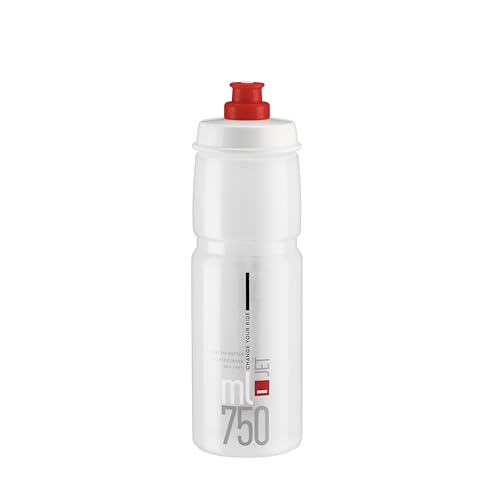
A true 750 ml racing bottle with a high flow valve for fast hydration.
The ELITE Jet is labeled 750 ml , the exact figure in your question, equal to about 25. 36 US fluid ounces. Its wide-mouth, high-flow valve moves fluid nearly twice as fast as standard bottles, and an integrated blow-off cap reduces drop risk during races, sports, and group rides.
The body is made from 100 percent biodegradable corn-based plastic, is BPA free, and handles dishwasher cycles up to 40 C. It’s thicker than the Fly model but still easy to squeeze.
This is the bottle I’d flag for competitive cyclists and anyone training hard who needs water fast mid-effort , the high-flow valve is the whole reason to pick it over a standard squeeze bottle.
The caveats: biodegradable plastic may not hold up as long as conventional bottles if left in heat, and there’s no insulation. If you want a 750 ml bottle built for speed, this one matches your number exactly.
|
6
|
POWCAN 26 oz Insulated Water Bottle with 2-in-1 Straw and Spout Lid, Keep Cold 24H, Leak-P |

A 26 oz insulated bottle that rounds 750 ml up to the nearest whole ounce.
The POWCAN holds 26 oz, a touch more than the 25. 36 oz that 750 ml equals , essentially the conversion rounded up.
Double-wall vacuum insulation keeps drinks cold for 24 hours and warm for 12 without a sweaty exterior, and the 2-in-1 lid gives you both a straw for sipping and a spout for pouring or chugging.
The 18/8 stainless steel is BPA free and taste-free, and the body fits most car cup holders.
I’d shortlist this for road trippers, students, and anyone who wants temperature control alongside the capacity. The dual lid is the feature I’d call genuinely useful , you can sip a cold drink or chug, or carry hot coffee in the same bottle.
The limitation: the cup itself is hand wash only, though the lid can go in the dishwasher. If you want a 750 ml equivalent that also keeps water cold all day, this is the pick.
|
7
|
ELITE Fly Tex Cycling Water Bottle 750ml – Clear – Ultra-Lightweight, BPA-Free,Easy-Squeez |

An ultra light 750 ml bottle, 57 g, for riders counting every gram.
The ELITE Fly Tex is labeled 750 ml, matching your question exactly at about 25. 36 oz, and it weighs just 57 g , which the brand says is 30 percent lighter than standard models.
The textured surface adds grip in wet or muddy conditions, and the wide push-pull nozzle plus a squeezable body moves fluid quickly. The food-grade plastic is BPA free and resists picking up tastes.
My read is that this suits road, MTB, and gravel riders who count grams and ride in weather. The textured surface is the standout , it stays secure when your hands are wet or gloved.
The trade-off is structural: no insulation, and the thin walls give up some durability to hit that weight. If you want a 750 ml bottle that confirms the conversion while staying featherlight, this is it.
|
8
|
CamelBak Chute Mag Water Bottle 20oz, Black | Magnetic Cap System, Vacuum Insulated Steel, |

A 20 oz insulated steel bottle, well under 750 ml, for smaller sips.
The 20 oz version of the CamelBak Chute Mag holds about 591 ml, noticeably less than 750 ml. It’s the smaller sibling of the 25 oz model and uses the same magnetic cap system.
Here the body is vacuum-insulated stainless steel, so it keeps drinks cold through workouts and commutes, the cap is leak-resistant, and both bottle and cap are dishwasher safe.
This fits gym users, commuters, and travelers who want a compact insulated bottle rather than maximum capacity , the steel build and magnetic cap make it an easy daily carry. The honest limitation is volume: at 20 oz it falls about 5.
4 oz short of 750 ml, so it won’t cover a full 750 ml pour. If your question was really about where smaller bottles sit relative to 750 ml, this shows you exactly that.
|
9
|
adidas Stadium Plastic Water Bottle 750 mL | Double-Wall Insulated, 750 ML Hydration, Easy |

The label itself states 750 ml equals about 25 oz, answering your question directly.
The adidas Stadium bottle is the most on-the-nose answer here, because its own description states that a 750 ml capacity is about 25 oz , the rounded version of the 25. 36 oz true figure.
You get double-wall insulation, an easy-squeeze ergonomic grip, and a locking spout top that stays sealed inside a gym bag. It’s made from BPA-free LDPE plastic with both ounce and milliliter markings printed on the side.
I’d steer athletes, students, and active adults who want a squeezable training bottle toward this one. The measurement markings are the standout, since they let you track intake through a workout without guessing.
The limitations: it’s hand wash only, and LDPE won’t shrug off abuse the way steel or Tritan will. If you want a bottle whose own label confirms the 750 ml to 25 oz conversion, this is the most literal proof you’ll find.
|
10
|
CamelBak Podium Water Bottle 24oz, Navy Blue |

A 24 oz cycling bottle, about 710 ml, just under the 750 ml mark.
The CamelBak Podium holds 24 oz , roughly 710 ml , so it falls about 1. 36 oz short of 750 ml, which makes it a useful lower bound when you’re comparing sizes.
The squeeze body is optimized to deliver more fluid with less effort, the high-flow self-sealing cap cuts down on splashes, and the shape is engineered to sit securely in bike cages. Bottle and cap separate for easy cleaning.
This is the one I’d point cyclists and everyday riders toward who want a reliable cage bottle , the self-sealing cap is the reason to pick it, since it cuts spills on bumpy stretches.
The limitation is the math: at 710 ml it doesn’t quite reach 750 ml, so it’s not an exact match for the conversion. If you’re eyeing a 24 oz bottle and want to know how far it sits from 750 ml, this is your reference point.
Across these ten bottles, 750 ml shows up as 25 oz, 25. 4 oz, or a straight 750 ml label , the 24 oz and 20 oz options sit below the mark, and the 32 oz option sits above it. That spread is the whole point.
The conversion itself is simple; it’s the rounding habits of different brands that make the labels disagree.
Matching 750 ml To Your Daily Water Goal
Once you know 750 ml is about 25.36 oz, the next question is how many of those fills a day actually requires. That depends on your body weight, how active you are, and the climate you’re in.
Start with your body weight in pounds and divide it in half to get a rough daily ounce target.
Divide that target by 25.36 to see how many 750 ml bottles you need each day.
For a 160 pound adult, the target is about 80 oz, or roughly three 750 ml bottles.
Add one extra 750 ml bottle for every hour of intense exercise or hot weather.
Track fills rather than sips, since counting bottles is easier than counting ounces.
Adjust downward if you eat water rich foods like fruit and soup during the day.
A common rule of thumb is half your body weight in ounces. A 150-pound person would aim for roughly 75 oz , three 750 ml bottles. A 200-pound person would target 100 oz, or about four.
I’d treat these as rough guides rather than medical rules, since sweat, altitude, and caffeine all shift the number.
The real value of knowing the conversion is that it turns an abstract goal into a countable number of refills: instead of guessing, you can look at your bottle and know exactly how much of your daily target one fill covers.
Common Mistakes When Converting 750 ml
Most people trip over the same handful of mistakes when converting 750 ml to ounces. Knowing the traps in advance keeps a recipe, hydration plan, or purchase on track.
- Do not confuse US fluid ounces with imperial ounces, since the gap is over an ounce at 750 ml.
- Do not assume a 24 oz bottle holds 750 ml, because 24 oz is only about 710 ml.
- Do not round 25.36 oz down to 25 oz when a recipe needs precision.
- Do not forget that fill lines sit below the rim, so usable volume is slightly less.
- Do not mix up fluid ounces with weight ounces, which measure mass, not volume.
- Do not trust a single label figure without checking the milliliter number alongside it.
The most common error is mixing up fluid ounces and weight ounces. A fluid ounce measures volume; a weight ounce measures mass. A 750 ml bottle of water weighs about 26. 5 ounces on a scale , close to, but not identical to, its 25. 36 fluid ounce volume.
That near match is exactly why people treat the two as interchangeable. They’re not, and the gap widens with denser liquids like oil or syrup. For water, the difference is small enough to ignore in casual use; for baking or mixing, it isn’t.
My rule is simple: confirm whether a figure refers to volume or weight before you convert anything.
750 ml equals 25. 36 US fluid ounces , call it 25. 4 oz , or about 26. 4 imperial ounces if you’re reading a UK label. That’s the direct answer.
Here’s a step you can take today: check the milliliter figure on any bottle you already own, divide it by 29. 5735, and see how close the printed ounce figure actually is.
Do that two or three times and the rounding habits of different brands stop being confusing and start being predictable.

- 10 Best Battery For Generator Ev Battery Bank Marine 2026 - October 27, 2026
- 10 Best Battery For Generator Ev Battery Bank Lto 2026 - October 27, 2026
- 10 Best Battery For Generator Ev Battery Bank Low Voltage 2026 - October 27, 2026