How Often Should I Change My Battery In My Car?
Nobody plans to be stranded in a parking lot because their battery gave out, but that’s exactly how most replacements happen.
Waiting for total failure is the default strategy for a lot of drivers, even though age, climate, and daily driving habits give you plenty of warning if you know what to look for.
I put together this breakdown to explain when you should actually swap your car battery, why the timeline isn’t the same for everyone, and how to avoid paying for a replacement sooner than you need to.
What Drains Your Car Battery Over Time
Car batteries don’t just die of old age, they get worn down by chemical reactions, temperature swings, and whatever electrical load your vehicle throws at them. That’s why a blanket rule like ‘replace every four years’ doesn’t hold up for most drivers.
Lead-acid and lithium-ion batteries lose a bit of capacity every time they cycle, but heat is what really speeds up the clock. If you live somewhere hot, I’d expect two years out of a battery before it starts acting up; colder regions tend to stretch that to four or five.
Short trips around town are surprisingly hard on the system because the alternator never gets enough time to fully top things off. Add in parasitic drains from security systems, alarms, or a glovebox light you forgot about, and the lifespan shrinks further.
Modern stop-start tech puts even more stress on the battery, so I’d check it more often if your car has that feature. And one deep discharge, like leaving the headlights on overnight, can essentially halve whatever life you had left.
| Factor | Impact on Battery Life | Typical Lifespan Reduction |
|---|---|---|
| Hot climate (90°F+) | Accelerates chemical breakdown | 1-2 years |
| Cold climate (subfreezing) | Reduces cranking power, slows recharge | 6-12 months |
| Frequent short trips | Prevents full recharge cycles | 1 year |
| Stop-start system | Higher discharge/recharge cycles | 1-2 years |
| Parasitic drains | Constant low-level discharge | 6-18 months |
Signs Your Battery Needs Replacement Soon
Waiting until the engine won’t turn over means you’re replacing the battery on the car‘s timeline, not yours. Catching the early warnings lets you schedule the swap when it’s convenient for you.
- Slow engine cranking, especially in cold weather, signals weakening power.
- Dashboard warning lights for battery or charging system demand immediate attention.
- Swollen or bloated battery case indicates internal damage from overheating.
- Corrosion on terminals reduces conductivity and can mask deeper issues.
- Electrical accessories (radio, lights) dim or flicker when the engine is off.
- Frequent jump-starts or needing a boost more than once a year.
- Age over three years in extreme climates or five years in moderate ones.
I see a lot of drivers brush off the first signs of trouble until they’re stuck. If your car struggles to start after sitting overnight, the battery might have just enough juice left to get you to work, but maybe not back home.
Auto parts stores will usually run a voltage test for free in a couple of minutes, which gives you a baseline. A load test is even better since it simulates the actual demand of cranking the engine.
If the battery passes both, my read is that your issue is probably the alternator or starter. Skipping these checks is how people end up with dead batteries during road trips or out in remote areas where a jump-start isn’t an option.
Picks To Replace Your Car Battery or Key Fob Power
Your main car battery might last years, but key fob batteries tend to die faster and without much warning. The picks below cover replacement options for both scenarios so you aren’t locked out of your car or stuck waiting for a tow.
I’ve included everything from OEM-quality fob batteries to heavy-duty starting power, depending on what you actually need.
|
1
|
Pinochi CR2016 Key Fob Replacement Batteries for Toyota (2008-2021) Camry Corolla RAV4 Hig |

OEM-grade CR2016 batteries for Toyota key fobs with tools and instructions included.
The Pinochi CR2016 pack gives you two OEM-equivalent batteries sized for Toyota head key fobs spanning 2006-2022 models like the Camry, Corolla, and RAV4. It comes with a pry tool and an installation video, which means you can skip the dealer visit entirely.
These batteries match the original specs for FCC IDs HYQ12BDM, HYQ12BEL, and GQ4-52T, so they should fit most Toyota and Scion remotes from that era.
I would shortlist this if you own a Toyota and notice your key fob’s range dropping or the buttons getting unresponsive. The included tools make the DIY swap pretty painless and save you dealer labor fees.
Just keep in mind it’s limited to specific Toyota and Scion models, I’d double-check your fob’s FCC ID before buying. It won’t work for non-head key fobs or newer models outside that listed range.
|
2
|
Pinochi CR1616 Key Fob Battery Replacement for Honda (2005-2017) Civic Accord CR-Z CR-V Pi |

CR1616 batteries for Honda key fobs with OEM specs and easy DIY installation.
This Pinochi CR1616 pack is built for Honda vehicles from 2005-2017, specifically covering Civic, Accord, CR-V, and Pilot models equipped with 3- or 4-button head key fobs. The batteries are identical to the OEM units, and the kit includes a pry tool plus an installation video.
It’s meant for remotes with round buttons and FCC IDs matching Honda’s original equipment.
If your Honda is flashing a low battery warning or the fob feels sluggish, this is the kit I’d look at first. Swapping it yourself takes a few minutes, and you don’t need to reprogram anything afterward.
The main catch is compatibility, it won’t work with flip keys or models outside those specific years. My advice is to verify your fob’s button layout and FCC ID against the product images before ordering.
|
3
|
Knmipm CR2025 Key Fob Replacement Battery for Mazda |
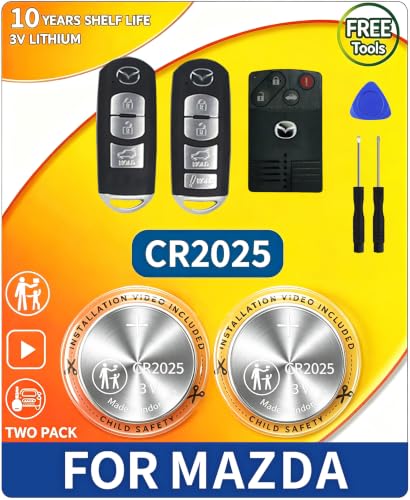
CR2025 batteries for Mazda key fobs with tools and a video guide.
Knmipm’s CR2025 pack covers Mazda owners with models from 1999-2020, though you’ll want to skip it if you have a flip key or a 2021+ vehicle. You get two batteries, a pry tool, and a link to a step-by-step installation video.
The batteries are OEM-equivalent and match the original specs for the Mazda3, Mazda6, CX-5, and other listed models.
For Mazda drivers dealing with a weak or unresponsive key fob, this is a straightforward fix. The video guide walks you through the DIY replacement, and the included tools help prevent cracking the fob case open. However, it’s strictly incompatible with Mazda’s flip-key designs and newer models.
I’d definitely check the product images to confirm your specific fob matches before hitting buy.
|
4
|
Knmipm Key Fob Battery Replacement for Tesla Model X & X Plaid (Pack of 2) | OEM CR2354 Re |

CR2354 batteries specifically for Tesla Model X and X Plaid key fobs.
This Knmipm pack supplies two CR2354 batteries tailored specifically for Tesla Model X and X Plaid key fobs. It includes a pry tool and an installation video to keep the replacement hassle-free. The batteries are OEM-grade, matching Tesla’s original specifications for these particular models.
Since this pack is designed exclusively for Tesla Model X and X Plaid owners, it addresses the unique battery size these high-end remotes require. Installation is straightforward with no reprogramming needed. But if you drive a Model S, 3, or Y, you’ll need to look elsewhere.
The included video link makes the process much less intimidating if you haven’t opened a fob before.
|
5
|
Knmipm CR2025 Key Fob Battery Replacement for Ford Lincoln Key Remote |

CR2025 batteries for Ford and Lincoln smart key remotes with tools included.
Knmipm’s CR2025 pack targets Ford and Lincoln smart key remotes from 2013-2018, including F-150, Explorer, Mustang, and Lincoln MKX models. The kit includes a pry tool and installation video, and the batteries are OEM-equivalent for remotes carrying FCC IDs M3N-A2C31243300 or A2C31243800.
If your Ford or Lincoln dashboard is warning you about a low key fob battery, this is a practical way to handle it yourself. The DIY installation is quick, and having the right pry tool prevents you from gouging the remote plastic.
It is limited to specific models and years, though, so I’d verify compatibility first. It won’t work for flip keys or standard remotes outside that listed range.
|
6
|
Pinochi CR1620 Key fob Battery Replacement for Subaru (2010-2020) Crosstrek Forester Ascen |
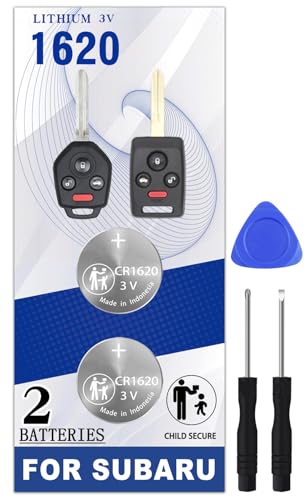
CR1620 batteries for Subaru key fobs with OEM specs and installation tools.
Pinochi’s CR1620 pack includes two batteries for Subaru head key fobs from 2010-2020, covering models like the Crosstrek, Forester, and Outback. The kit comes with three pry tools and an installation video, matching OEM specs for FCC IDs CWTB1G077, CWTWBU766, and CWTWB1U811.
I’d point Subaru owners here if their 3- or 4-button remotes are losing range or acting intermittently. The self-installation process is simple, and you don’t have to worry about reprogramming. The main drawback is that it won’t work with Subaru’s standard keys or flip-key designs.
Always cross-check your fob’s FCC ID with the product images to be safe.
|
7
|
Pinochi Key Fob Battery Replacement for Chevrolet (2016-2022+) Smart Remote | Fits Chevy B |

CR2032 batteries for Chevrolet smart remotes with broad model compatibility.
This Pinochi pack provides CR2032 batteries for Chevrolet smart key remotes from 2016-2022, covering models like the Blazer, Camaro, Equinox, and Malibu. It includes a pry tool and a step-by-step installation video, with OEM-equivalent batteries sized for 3-6 button remotes.
For Chevy drivers running modern smart keys, this handles the job cleanly. The DIY replacement is fast, and the included tools ensure you don’t damage the housing while prying it apart. It is limited to the listed models and years, so confirm your vehicle fits the bill.
It won’t work for older Chevy remotes or those with different button configurations.
|
8
|
Knmipm CR2450 Key Fob Replacement Batteries for Ford/Lincoln, 1-Pack |

CR2450 battery for newer Ford/Lincoln smart remotes with broad coverage.
Knmipm’s CR2450 pack includes one battery for Ford and Lincoln intelligent access smart remotes from 2017-2025. It covers a wide range of models, including the F-150, Bronco, Mustang, and Lincoln Aviator. The kit includes a pry tool and installation video, with OEM-grade batteries for compatible remotes.
If you have a newer Ford or Lincoln and the key fob is acting up, this is the replacement I’d look at. The installation is straightforward, and the battery meets OEM specs.
Keep in mind it’s incompatible with flip keys or standard remotes, and since it’s a single-battery pack, you might need to order another one if you have multiple fobs.
|
9
|
Crown cr-gc150 12v 12 Volt Golf Cart Battery marine solar club car yamaha rv new X4 |

12V deep-cycle golf cart battery for RVs, marine, and solar applications.
The Crown CR-GC150 is a 12V, 150Ah deep-cycle battery designed for golf carts, RVs, marine use, and solar applications. It replaces Trojan T-1275 and other 12V deep-cycle batteries, featuring a durable polypropylene case and SAE automotive terminals.
The battery’s thick plates and tetra basic lead sulfate content are built for long life and consistent performance.
My read is that this belongs in your cart if you need reliable power for off-grid setups or recreational vehicles. Its deep-cycle design handles repeated discharging and recharging, making it well-suited for solar arrays or extended RV trips.
Be aware that it’s heavy at 81 lbs, so plan your installation accordingly. It’s also not meant for standard car starting, it’s optimized for sustained power delivery rather than high cranking amps.
|
10
|
Key Fob Replacement Batteries for Subaru Smart Remote (Check Fitment Guide) |

CR2032 batteries for Subaru smart remotes with installation tools included.
This pack includes two CR2032 batteries for Subaru smart key fobs from 2015-2025. It comes with pry tools and an installation video, matching OEM specs for compatible remotes. The batteries are designed for Subaru’s smart fob systems, excluding standard keys with exposed metal.
If your Subaru smart remote is throwing low battery warnings, this is a reliable way to fix it yourself. The DIY installation is simple, and no reprogramming is required. It is incompatible with older Subaru models or standard keys, though.
I’d suggest verifying your fob’s compatibility using the fitment guide before purchasing.
From OEM-grade key fob batteries to heavy-duty deep-cycle options, these picks address the most common power needs for vehicles and accessories. Whether you’re replacing a dying remote or upgrading an RV’s battery system, the right choice depends on compatibility and intended use.
How To Test Your Car Battery at Home
A multimeter and a few minutes can tell you if your battery is failing before it actually leaves you stranded. This approach works for both car and deep-cycle batteries, giving you a clear picture of whether a replacement is imminent.
Park the car on a flat surface, turn off the engine, and remove the key. Ensure all lights and accessories are off to avoid false readings.
Locate the battery and clean any corrosion from the terminals with a wire brush. Corrosion can interfere with accurate voltage measurements.
Set your multimeter to DC voltage (20V range) and connect the red probe to the positive terminal, the black probe to the negative terminal.
Read the voltage: 12.6V or higher means a fully charged battery. 12.2-12.4V indicates a partially discharged battery that may need a charge or replacement soon.
Start the engine and check the voltage again. A healthy alternator should show 13.7-14.7V. Readings outside this range suggest alternator or battery issues.
For a load test, use a battery tester or visit an auto parts store. A failing battery under load will drop below 9.6V during the test.
Testing regularly catches issues before they become emergencies. If your battery consistently reads below 12. 4V when the car is off, or fails to hold a charge after a drive, I’d start shopping for a replacement. In colder climates, I’d test more frequently since cold weather saps cranking power fast.
For deep-cycle batteries like the Crown CR-GC150, use a hydrometer to check the specific gravity of the electrolyte in each cell. A reading below 1. 225 in any cell means it needs a charge or a swap.
Always wear gloves and eye protection when handling batteries, sulfuric acid and lead aren’t things you want on your skin.
When To Replace vs. When To Recharge
Not every weak battery needs to be thrown away. Some just need a jump or a proper charge cycle. Knowing the difference saves money and keeps you from buying parts you don’t actually need.
| Scenario | Action | Why |
|---|---|---|
| Battery voltage below 12V, no cranking | Recharge or jump-start | Battery may be discharged but not dead |
| Battery voltage 12.4V+, slow cranking | Load test | May indicate internal resistance or weak cells |
| Battery voltage drops below 10V under load | Replace | Failing cells cannot hold charge |
| Swollen or leaking battery case | Replace immediately | Internal damage is irreversible |
| Battery older than 5 years (3 in hot climates) | Replace proactively | Age degrades performance regardless of voltage |
| Frequent jump-starts needed | Replace | Battery cannot sustain a charge |
A jump-start can revive a discharged battery, but if it dies again quickly, the battery is likely done. Use a battery charger to fully top off a weak battery, then retest it after 24 hours. If the voltage drops significantly while sitting, the battery is failing internally.
For deep-cycle batteries, letting them drain completely (below 10. 5V) can damage the cells, so try to avoid deep discharges. The Crown CR-GC150, for example, benefits from a smart charger that prevents overcharging.
Stick to the manufacturer’s guidelines for charging and maintenance to get the most life out of whatever you’re running.
Maintenance Tips To Extend Battery Life
Small habits can add years to your battery’s lifespan. These steps apply to car, key fob, and deep-cycle batteries alike, reducing how often you have to buy replacements.
- Drive your car regularly, especially for trips longer than 20 minutes, to allow the alternator to fully recharge the battery.
- Keep terminals clean and free of corrosion by applying a thin layer of petroleum jelly or terminal grease.
- Avoid leaving accessories (lights, radio) on when the engine is off to prevent parasitic drains.
- Store vehicles in a garage or shaded area to reduce exposure to extreme temperatures.
- For deep-cycle batteries, use a smart charger to maintain optimal charge levels during storage.
- Test your battery’s voltage every 3-6 months, especially in extreme climates.
- Replace your key fob battery at the first sign of reduced range or intermittent function to avoid lockouts.
Extreme temperatures are a battery’s worst enemy. In hot climates, park in the shade or use a battery insulation blanket to cut down on heat exposure. In cold climates, consider a battery warmer or trickle charger to maintain performance.
For key fobs, store them away from direct sunlight and extreme cold, as lithium batteries degrade faster under those conditions. The installation videos included with packs like Pinochi’s or Knmipm’s simplify DIY replacements, but always handle batteries carefully to avoid short circuits or physical damage.
As a general rule, I’d plan to replace your car battery every 3-5 years, or sooner if you live in an extreme climate or notice slow cranking and weird electrical glitches. For key fobs, swap the battery the moment you see reduced range or dashboard warnings.
Today, grab a multimeter or swing by an auto parts store for a free battery test so you know exactly where you stand before you’re stuck on the side of the road.

- Marine Chargers and Backup Batteries: 9 Options Compared (2026) - October 27, 2026
- LTO Cells vs. SLA Generator Batteries: 5 Options Compared (2026) - October 27, 2026
- 12V/24V Backup Batteries and the EcoFlow DELTA Pro 3 (2026) - October 27, 2026