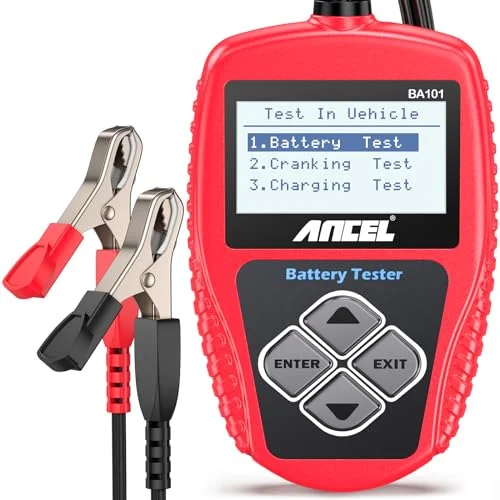
Is A Battery Ac Or Dc?
Ever stared at a battery, then at a multimeter, wondering if that little cylinder pushes alternating or direct current? It’s a fair question, especially when chargers, adapters, and wall outlets all get lumped together in everyday talk.
The short answer is that batteries are DC, but the practical answer is that you’ll want to prove it yourself. This guide explains the difference, shows what to measure, and points to testers that make the check simple.
Why Batteries Are Always DC
Recommended Products


Before you reach for a tester, it helps to understand why a battery behaves the way it does. The chemistry inside sets the direction of flow, and that direction never flips on its own.
A battery produces direct current because its internal chemistry pushes electrons in one steady direction. One terminal stays positive, the other stays negative, and the current leaves the negative end and returns to the positive end through your circuit. That one-way flow is the defining trait of DC.
Alternating current, by contrast, reverses direction many times per second, which is why wall outlets can send power long distances through transformers. A battery has no mechanism to reverse its own polarity. It will happily push current one way until it is drained, and then it stops.
This is why every disposable cell, phone battery, car battery, and button cell is classified as a DC source.
DC vs AC At A Glance
| Property | Battery (DC) | Wall Outlet (AC) |
|---|---|---|
| Direction of flow | One way only | Reverses 50-60 times per second |
| Typical source | Cells, car batteries, USB packs | Mains power, generators |
| Voltage example | 1.5V, 9V, 12V | 120V or 230V |
| Polarity | Fixed positive and negative | Alternates positive and negative |
| Measured with | DC voltage setting | AC voltage setting |
How To Confirm It With A Tester
Recommended Products


You do not have to take the chemistry on faith. A basic voltage tester will show you exactly what a battery is doing, and the process takes less than a minute.
Set your multimeter’s dial to the DC voltage range, usually marked with a straight line and a dashed line.
Plug the black lead into the COM jack and the red lead into the V jack.
Touch the black probe to the negative terminal and the red probe to the positive terminal.
Read the display; a steady positive number confirms direct current with correct polarity.
Switch to the AC voltage setting and repeat; a near-zero reading confirms there is no alternating current.
- Always start on the highest voltage range if you are unsure, then step down for a clearer reading.
- Never touch the probe tips together while they are inserted into a live circuit.
- A reading that bounces or reads zero on DC usually means a dead battery or a poor connection.
- If the display shows a negative number, your probes are reversed, not the battery.
- Replace the multimeter’s own battery when the low-battery icon appears to keep readings accurate.
Testers That Prove A Battery Is DC
Recommended Products


These tools all measure DC voltage, and most also handle AC so you can compare the two side by side. Any of them will answer the battery question in seconds, whether you are checking a AA cell, a car battery, or a wall adapter.
Pick the one that matches your comfort level and the jobs you actually do.
|
1
|
Digital Multimeter Voltmeter Battery Voltage Multi Tester Continuity Ohm Volt Amp DC AC Cu |

It measures both AC and DC voltage, so you can see the battery’s one-way flow directly.
This digital multimeter covers AC and DC voltage, DC current, resistance, continuity, diodes, and battery testing. The 2. 7-inch backlit LCD and data-hold button make readings easy to capture, even in a dim garage.
It ships with a 9V battery, test leads, and a user manual, so you can start checking a battery the moment it arrives. The orange rubber shell and fold-out stand keep it stable on a workbench.
For a beginner or a car owner, this is a forgiving first meter because the ranges are clearly marked and overload protection guards against mistakes. It handles household outlets and automotive circuits well.
The main limitation is that it is manual-ranging, so you must turn the dial to the correct DC voltage range before testing. If you want the meter to pick the range for you, look at an auto-ranging model instead.
|
2
|
Klein Tools MM325 Digital Manual-Ranging Multimeter | 600V AC/DC Voltage Tester, Tests Bat |
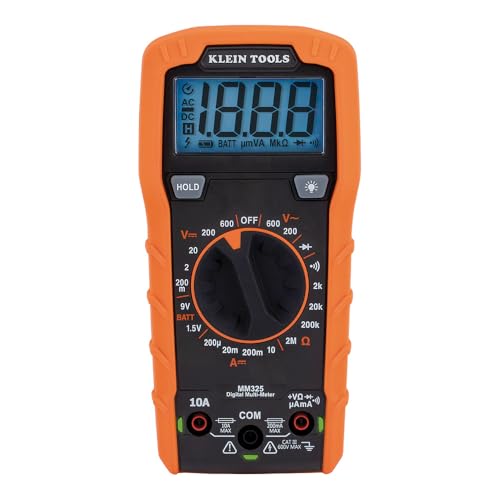
Klein’s lead-alert LEDs show correct probe placement before you even read the DC voltage.
The Klein Tools MM325 is a manual-ranging multimeter that measures AC and DC voltage up to 600V, 10A DC current, resistance, continuity, diodes, and batteries.
Its standout feature is lead-alert protection: LEDs light up to confirm your test leads are in the right jacks, which reduces the chance of a wrong reading. A backlit LCD keeps numbers visible in low light, and the kickstand plus optional magnetic hanger let you work hands-free.
This is a solid choice for someone who wants a trusted brand name without paying for a full auto-ranging bench meter. It handles automotive and household checks, including confirming that a battery is DC. The trade-off is that it is manual-ranging, so you still select the voltage range yourself.
It also does not measure AC current, which matters only if you plan to clamp around live AC wires later.
|
3
|
AstroAI Digital Multimeter Tester 2000 Counts with DC AC Voltmeter and Ohm Volt Amp Meter; |
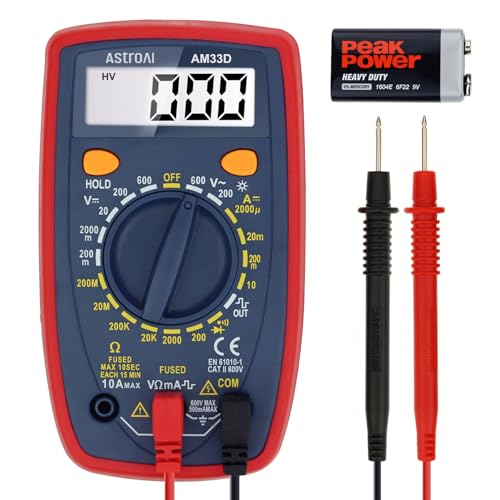
Its 2000-count display shows DC voltage clearly, confirming a battery’s one-way current.
This AstroAI multimeter measures AC and DC voltage, DC current, resistance, continuity, and diodes. The 2000-count display samples twice per second, and the backlit screen with data hold makes it easy to grab a stable number. Double fuses protect against overload, and the silicone cover adds drop resistance.
It includes test leads, a manual, and batteries, so it is ready out of the box for checking whether a battery is AC or DC.
The blue model is aimed at household troubleshooting, automotive circuits, and basic electronics. It is a good fit if you want a low-cost meter that still feels protected against accidental overloads.
One honest limitation is that it cannot test AC current at all, and it will not read AC voltages below 100mV. For battery checks and outlet tests, though, those limits rarely come into play.
|
4
|
ANENG Digital Multimeter with Case,DC AC Voltmeter,Ohm Volt Amp Meter | Voltage Tester Mea |

It measures AC/DC voltage plus capacitance, so it goes beyond a simple battery polarity check.
The ANENG digital multimeter measures AC/DC voltage, current, resistance, continuity, diodes, and live wire, and it adds capacitance testing that many budget meters skip. It comes with a silicone protective case, two high-quality leads, and two pre-installed AA batteries.
The display is clear and the probes allow precise readings, which helps when you want to confirm that a battery is producing steady DC rather than AC.
This is a versatile pick for hobbyists, students, and anyone who wants capacitance on the menu without spending much. The compact body and case make it easy to toss in a bag.
The limitation is that the manual is thin and the rotary switch requires careful placement; if you leave it on the wrong setting, you will get a confusing reading. Double-check the dial before you trust the number.
|
5
|
KAIWEETS Digital Multimeter Voltmeter with Case for Car Batterry Test DIY | AC/DC Voltage, |

It includes a dedicated car battery test focus, making DC confirmation its main job.
The KAIWEETS digital multimeter measures AC/DC voltage, DC current, resistance, continuity, and diodes. It is rated CAT III 600V with double fuses and overload protection on every range. The package includes a carrying case, two cable leads, and two pre-installed AAA batteries.
Data hold and a backlit LCD help you capture readings in dim spots. For the question of whether a battery is AC or DC, its DC voltage mode gives a direct answer.
This meter suits electricians, homeowners, and automotive tinkerers who want a compact tool with a case. The lifetime after-sale support is a nice bonus at this price point. The key limitation is that it cannot measure AC current, so it is not the right tool for clamp-style AC load testing.
It also requires you to set the rotary switch correctly, or the display will mislead you.
|
6
|
AstroAI Digital Multimeter Tester 2000 Counts with DC AC Voltmeter and Ohm Volt Amp Meter; |
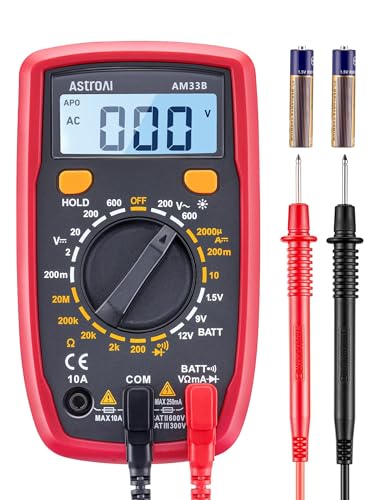
Its 1.5V, 9V, and 12V battery modes automatically show whether a cell is good DC.
This black AstroAI multimeter measures AC/DC voltage, DC current, resistance, continuity, and diodes, and it adds dedicated 1. 5V, 9V, and 12V battery test modes. Those modes automatically detect and display battery status, which makes the DC question almost self-answering: the meter expects DC and reports accordingly.
Double fuses, a silicone cover, data hold, auto shutoff, and a backlit LCD round out the feature set.
It is a practical pick for DIYers and hobbyists who check a lot of household batteries and want a quick good-or-bad read. The auto shutoff saves the included battery when you forget to turn it off.
The limitation is that it cannot test AC current, so it will not help with clamp-style AC measurements. It also needs the rotary switch set correctly before any reading is meaningful.
|
7
|
Klein Tools ET60 Voltage Tester, Tests AC/DC and Low Voltage | No Batteries Needed |
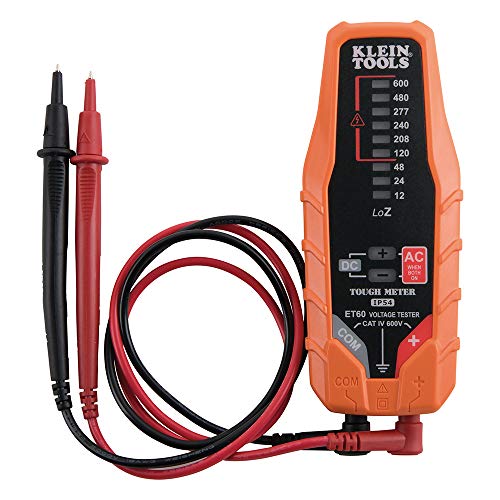
It shows AC or DC voltage across nine levels with no batteries required to operate.
The Klein Tools ET60 is a voltage tester rather than a full multimeter. It tests AC and DC voltage from 12 to 600V across nine levels, using standard replaceable test leads. A bright LED display reports the voltage present, and built-in test lead holders are spaced for tamper-resistant US outlets.
It is CAT IV 600V rated and needs no batteries, because the circuit under test powers it.
This is ideal when you want a fast yes-or-no voltage check without dials or ranges. It is especially handy for confirming that a car battery or power tool pack is delivering DC. The limitation is that it does not give a precise numeric reading or measure current, resistance, or continuity.
If you need exact volts rather than a level indication, choose a full multimeter instead.
|
8
|
AstroAI DM130B Multimeter, 4000 Counts, Auto-Ranging, Capacitance Testing | Measures AC/DC |

Its auto-ranging 4000-count display and battery modes read DC voltage without dial guesswork.
The AstroAI DM130B is an auto-ranging 4000-count multimeter that measures AC/DC voltage, AC/DC current, resistance, continuity, capacitance, and diodes. It includes 1. 5V, 9V, and 12V battery modes, plus non-contact voltage detection for safety.
Data hold, a large backlit LCD, a kickstand, and a low-battery indicator make it comfortable to use. Two ceramic fuses and a thermistor protection circuit guard against overloads.
This is the pick for someone who wants the meter to choose the range automatically, which removes a common source of beginner error. It handles garage tinkering and field work alike.
The honest limitation is that auto-ranging can feel slower than a manual meter when you already know the expected voltage. The NCV feature also only detects AC, so it will not help you find a DC source.
|
9
|
Klein Tools ET45 Digital AC/DC Voltage Tester, 12-240V AC, 32-330V DC | LED Illumination, |

It indicates DC polarity and voltage level with LEDs, directly answering the battery question.
The Klein Tools ET45 is a compact voltage tester for AC and DC. It checks AC from 24 to 240V and DC from 32 to 330V across four levels, with bright LEDs that indicate voltage type and level.
It also shows DC polarity, which is exactly what you need to confirm a battery’s direction of flow. Built-in test lead holders fit US-style outlets, and it is IP44 dust and water resistant with 9. 8-foot drop protection.
This tester is built for job sites and quick diagnostics where a full multimeter is overkill. It is battery-free, powered by the applied voltage, so it is always ready. The limitation is that it only works within its stated voltage windows, so a single 1.
5V AA cell is below its DC range. For automotive and larger battery packs, it is a fast and rugged answer.
|
10
|
AstroAI Digital Clamp Meter Multimeter 4000 Counts Auto-ranging Amp Tester Measuring AC/DC |
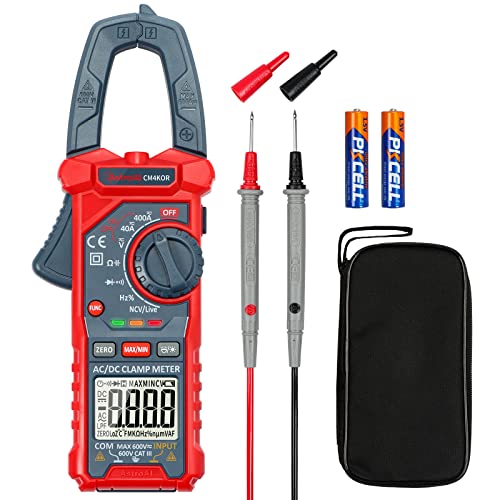
It measures AC/DC voltage and current, so you can verify a battery’s DC output and more.
The AstroAI digital clamp meter measures AC/DC current, AC/DC voltage, capacitance, frequency, duty cycle, resistance, diodes, continuity, and live wire. Its large jaw opening lets you measure current without breaking the circuit, and non-contact voltage testing gives sound and light alarms.
Data hold, max/min, auto power off, a backlit screen, and a flashlight make it useful in dark spaces. A zero function reduces magnetic interference for more accurate readings.
This is the right tool if you also work on larger DC systems, such as solar, marine, or automotive wiring, where clamping around a cable is easier than probing. It is CAT III 600V rated and compact enough for narrow spaces.
The limitation is that the clamp jaw only measures current, not voltage, so you must still use the test leads for voltage checks. It also cannot measure AC current below its lowest range.
Every tester above can confirm that a battery is DC, and several can compare that reading against an AC source for context. The differences come down to whether you want a precise numeric display, a simple LED indication, or clamp-style current measurement.
Match the tool to the batteries and circuits you actually plan to check, and the answer will be obvious the first time you touch the probes.
Reading The Result Without Second-Guessing
Recommended Products


Once you have a tester in hand, the next challenge is trusting what the screen tells you. A few habits separate a confident reading from a confusing one.
Healthy DC Voltage
A fresh AA alkaline cell should read close to 1. 6V on the DC setting. A 9V battery should read around 9. 5V when new. A 12V car battery at rest should sit near 12. 6V.
If your meter shows a steady positive number in that neighborhood, the battery is DC and working as expected. A reading that slowly drops while you watch usually means the cell is weak under load, not that the current type changed.
When The Number Looks Wrong
A zero reading on DC usually points to a dead battery, a broken test lead, or probes touching the wrong terminals. A negative number simply means your red and black probes are reversed.
If you switch to the AC setting and still see a meaningful voltage on a battery, something is off: either the meter is set incorrectly or you are not actually measuring the battery. Recheck the dial position and the lead jacks before assuming the battery is unusual.
- Test a known-good battery first to confirm your meter and leads are working.
- Keep your fingers behind the probe guards to avoid adding your body to the circuit.
- Wait a few seconds for the display to settle before writing down a number.
- Replace the meter’s own battery as soon as the low-battery icon appears.
- Store leads coiled loosely so the wire does not break inside the insulation.
Where People Get AC And DC Confused
The battery itself is never the source of confusion. The mix-ups happen at the edges, where adapters, chargers, and labels blur the line between the two current types.
The most common mix-up is the power adapter. A laptop charger or phone brick plugs into an AC wall outlet, but the cable that reaches your device carries DC. The brick converts one to the other.
Another confusion comes from labels: some devices say AC/DC because they can accept either input, not because the battery inside produces both. A third source of doubt is the inverter, which takes DC from a battery and creates AC for household appliances.
In each case, the battery remains a DC source, and the conversion happens in a separate box. Knowing where the conversion occurs clears up most of the doubt.
Common Devices And Their Current Type
| Device | What It Stores Or Uses | What Comes Out |
|---|---|---|
| AA alkaline cell | DC chemical energy | DC |
| Car battery | DC chemical energy | DC |
| Phone power bank | DC stored in lithium cells | DC via USB |
| Laptop power brick | Converts AC input | DC to the laptop |
| Wall outlet | AC from the grid | AC |
| Solar panel plus inverter | DC from panels | AC for home circuits |
A battery is always a DC source, and a quick DC voltage reading on any basic tester proves it in seconds.
Today, grab the multimeter you already own, set it to DC volts, and touch the probes to a known-good battery so you can see the steady positive number for yourself. Once you have watched that reading hold steady, the AC-versus-DC question stops being abstract.
Keep the meter handy for the next time a charger, adapter, or dead cell makes you pause.

- 10 Best Battery For Generator Ev Battery Bank Marine 2026 - October 27, 2026
- 10 Best Battery For Generator Ev Battery Bank Lto 2026 - October 27, 2026
- 10 Best Battery For Generator Ev Battery Bank Low Voltage 2026 - October 27, 2026