How To Read A Battery Charger?
A battery charger looks straightforward until the needle twitches, an LED shifts color, or the timer keeps ticking. The real challenge isn’t just clamping it on; it’s distinguishing between charging, boosting, maintaining, and fault conditions before damage occurs.
This guide breaks down those readings first, then uses nine manual-timer chargers as concrete examples of how to interpret labels, timers, meters, and safety cues.
What A Battery Charger Display Is Telling You
Recommended Products


Confusion usually stems from mixing up voltage, current, and time. A manual charger displays current flow, selected mode, and elapsed charge separately. Read them as distinct signals. Together, they tell you whether energy is moving gently, aggressively, or unsafely.
Start with the basic promise: a charger pushes current into a battery until voltage rises toward a safe ceiling. A manual amp meter often shows rate, not exact capacity. Higher numbers mean faster energy transfer; lower numbers suggest slower topping or maintenance. Voltage indicates the electrical pressure being applied.
Ensure six- or twelve-volt settings match the battery. A timer limits exposure when chemistry needs restraint. Indicator lamps reduce guesswork, typically marking power, reverse connection, charging, and completion. My recommended sequence: confirm battery voltage first, choose a mode second, watch the meter third, and interpret lamps last.
If those signals disagree, stop and recheck clamps, settings, and battery type before adding time.
Panel Signals Decoded
| Signal | Likely Meaning | Your Next Move |
|---|---|---|
| Amp needle high | Fast charge or boost | Watch heat and time |
| Amp needle low | Slow charge or maintain | Leave only if designed |
| Green lamp | Charge complete | Disconnect soon |
| Red reverse lamp | Clamps reversed | Swap clamps now |
| Timer running | Manual session active | Note start time |
Reading Modes Before The Timer Starts
Recommended Products


The label matters because current is a tool, not a reward. Engine start, boost, charge, and maintain solve different problems. Choose based on battery size, discharge depth, and patience. A reading only makes sense after selecting the right mode.
- Match 6V or 12V to the battery before any amp setting matters.
- Use engine start only when cranking support is the actual goal.
- Choose boost for deeply discharged batteries, not routine topping.
- Prefer low amp charge when time allows cooler battery recovery.
- Use maintain mode only after the charger reaches near full voltage.
Park safely, open the hood, and inspect terminals for corrosion first.
Confirm battery voltage, then set the charger to that same voltage.
Connect red to positive, black to negative or chassis ground.
Select the lowest useful amp mode, then start the timer or charge.
Recheck the meter after five minutes for heat, smell, or errors.
Manual-Timer Picks For Reading Your Charger
Recommended Products

These nine units serve as useful evidence because their manuals and panels expose the exact controls people struggle to read. You’ll see timers, amp ratings, boost modes, LED language, and clamp rules. Compare them as examples of legible charging behavior.
The goal isn’t brand loyalty; it’s recognizing what each control is trying to tell you.
|
1
|
Schumacher Electric Wheeled 6/12V 250A Car Battery Starter/Charger – SC1445 | Manual Timer |

Its 135-minute manual timer and 250A start make meter behavior easy to observe clearly.
The SC1445 is a wheeled manual-timer charger built around serious starting force. Its 250-amp engine start, 50A and 25A boost, and 135-minute timer provide clear examples of high-rate versus controlled charging. For reading practice, the timer is the key feature.
It forces you to connect mode, elapsed time, and expected battery response.
It fits shops handling cars, trucks, marine batteries, and power sports that need fast revival. The wide 6V and 12V support also teaches voltage matching before amperage. The limitation is control responsibility.
A manual timer will keep delivering the selected rate if you walk away, so the panel only helps when you watch it.
|
2
|
Schumacher Electric 10A Car Battery Charger & 200A Engine Start – SC1446 | Wheels – Manual |

A 200A start with 40A boost shows how boost differs from a short cranking burst.
The SC1446 uses a 135-minute manual timer, 200-amp engine start, and 40-amp boost across 6V and 12V batteries. Those numbers are useful when learning labels because cranking amps and charging amps solve different jobs. The timer makes each session finite, which helps connect readings to time instead of guessing.
This suits DIY mechanics who want stronger starting support than a small maintainer. Standard, AGM, gel, and deep-cycle support make the voltage and chemistry checks feel concrete. The tradeoff is bulk. Wheeled manual units reward attention, and careless mode selection can overheat a small battery quickly.
|
3
|
Associated Equipment US20 6/12 Volt Value Battery Charger Blue 24 Inch |

Its 90-minute timer with hold teaches reading a session that pauses rather than ends.
The Associated Equipment US20 is a simpler 6/12 volt value charger with a 90-minute timer and hold. The hold function is a great reading lesson. It shows why a timer position may not equal active charging unless you confirm state separately.
Fewer modes can make cause and effect easier to trace.
It fits users who want a basic shop charger without complex automatic logic. The handle, steel foot, and CSA listing add practical confidence. Weather-safe wording helps, but the reading lesson stays the same. Limitation: fewer indicators mean less guidance, so your meter and timer habits carry more weight.
|
4
|
Schumacher Electric Wheeled 10A Car Battery Charger & Maintainer – DSR139 | DSR Pro-Grade |

An easy-to-read amp meter plus DSR Pro labeling clarifies professional manual monitoring.
The DSR139 is a pro-grade wheeled charger and maintainer with a 135-minute timer, 225A engine start, and 25A or 50A boost. Its listed easy-to-read amp meter directly supports the user question. You can watch current behavior while matching solid-state circuitry, flexible 6-gauge cables, and long reach to real workflow.
It fits enthusiasts and shops that move between SUVs, trucks, boats, and power sports. Retractable handle, wheels, and front clamps make positioning part of safe reading. The limitation is professional scale. A powerful manual unit can be unforgiving on small batteries when the wrong rate is chosen.
|
5
|
Schumacher Electric 6A Car Battery Charger & Maintainer, 12V – SC1361 | 50A Engine Start – |

Reverse hook-up protection turns a wrong connection into a clear no-start safety signal.
The SC1361 is a 12V 6A charger and maintainer with a 50A engine start, 10A boost, and auto restart. It answers reading questions by separating smart trickle behavior from emergency starting. The microprocessor charge from 2A to 6A shows how current can taper while voltage stays maintained.
It fits motorcycle, ATV, car, SUV, and boat owners who store vehicles between uses. Low-profile clamps and reverse hook-up protection are practical teaching features. The limitation is 12V-only focus. If your fleet includes 6V batteries, the label cannot be read as universal support.
|
6
|
Schumacher Electric Wheeled 10A Car Battery Charger & Maintainer – SC1633 |
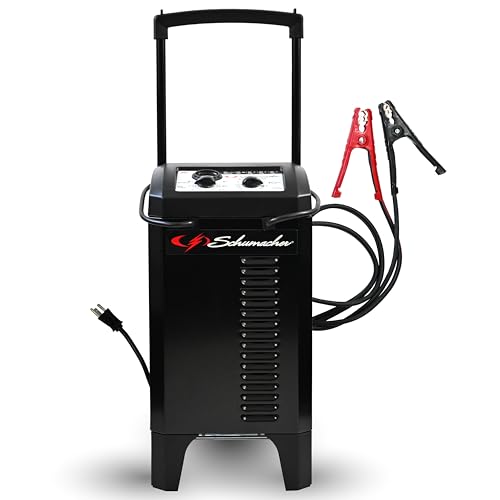
Its 12V and 24V boost modes force a careful voltage check before interpreting amps.
The SC1633 is a wheeled 2-in-1 charger and engine starter with 10A charging, 200A start, and 50A or 25A boost. The notable reading lesson is voltage range. It supports 12V and 24V standard, AGM, gel, and deep-cycle batteries, so the panel must be matched before any amp number means anything.
It fits garages serving cars, trucks, SUVs, marine batteries, and some equipment. The boost modes show how deeply discharged batteries accept aggressive current first. The limitation is broader complexity. More modes can confuse beginners unless voltage is confirmed every single time.
|
7
|
Century K3153-1 Automatic/Manual Deep Cycle Battery Charger Starter, 100/15/2 amps, 6/12V |

LED reverse and abnormal lights give direct fault language instead of vague needle movement.
The Century K3153-1 blends automatic and manual deep-cycle charging at 100, 15, and 2 amps across 6V and 12V. Its LEDs are the clearest answer to reading confusion. Reverse connection and abnormal battery show red, while charging and complete show green, giving simple state labels.
It fits users who want strong starting help plus low-rate finishing control. The 10A 6V manual setting and 12V automatic or manual options make mode selection visible. The limitation is dated simplicity. Saw-tooth clamps help connection, but fewer smart protections demand careful setup discipline.
|
8
|
CRAFTSMAN Wheeled 6A Car Battery Charger & Maintainer, 12V – CMXCESM274 |

Craftsman pairs a 135-minute timer with 175A start to show controlled versus emergency use.
The CMXCESM274 is a wheeled 12V charger and maintainer with 6A charging, 175A engine start, and 25A boost. Its 135-minute timer echoes the manual-control theme while the ratings show a gentler charge path than pro jump units. Gas, diesel, AGM, gel, and deep-cycle support widen the lesson.
It fits home garages that want one recognizable brand for occasional starts and maintenance. Precision manual control is helpful when learning to log time and response. The limitation is modest charge current. Big batteries may need patience even when the boost mode feels impressive.
|
9
|
Schumacher Electric Wheeled 6A Car Battery Charger & Maintainer – SC1364 | Automatic Opera |

Automatic operation plus 150A start shows how maintain and recondition modes change the reading.
The SC1364 is a wheeled automatic 12V charger and maintainer with 150A engine start and 20A boost. It starts, charges, maintains, and reconditions standard or AGM batteries. The automatic layer changes interpretation. Instead of only watching a timer, you watch voltage recovery and completion behavior.
It fits drivers who store cars, trucks, SUVs, ATVs, or boats and want less babysitting. Microprocessor 2A to 6A charging plus trickle maintenance reduces overcharge worry. The limitation is automation trust. Even smart units need clean clamps and correct voltage before their logic can help.
Across these examples, the readable pattern stays consistent. High amps are for starting or rescue, lower amps are for recovery, and maintenance is a different job. Timers impose discipline, while LEDs simplify status. The best reader checks voltage, respects chemistry, and never lets a loud rating replace observation.
Set The Timer Without Guessing The Finish
Manual timers are helpful only when tied to battery condition. A deeply discharged battery needs staged recovery, not maximum courage. Use boost to wake it, then drop to charge. Use maintain only near completion. These steps make the display a plan instead of a mystery.
Start with voltage match and clean clamps before touching the dial.
Give a dead battery a short boost window, then reassess warmth.
Move to a lower charge rate once the battery accepts current calmly.
Log start time, selected amps, and any lamp changes every ten minutes.
Stop early if you smell heat, see swelling, or spot a red fault light.
- Do not treat 135 minutes as automatic permission to ignore the battery.
- Use hold positions only after confirming current is actually flowing.
- Reset the session after moving between boost and lower charge.
- Choose lower amps when the battery is small, warm, or nearly full.
- Record what worked, because batteries repeat their behavior.
Keep Clamps, Cables, And Meters Trustworthy Over Time
A reading is only as honest as the path carrying current. Corrosion, loose clamps, and tired cables can mimic a bad battery. Clean hardware makes the meter calmer. Storage habits protect gauges and cords from damage that later gets misread as charging trouble.
Inspect before every session. Look for cracked insulation, green terminal crust, bent clamps, and stiff cable jackets. A poor connection can create sparks, voltage drop, and confusing meter swings. Wipe clamps after use and keep them from dragging across concrete. Coil cords loosely so internal strands do not fatigue.
Check wheels, handles, and feet on mobile units, because unstable placement leads to accidental clamp tension. If a needle flickers after connection, do not immediately blame the battery. Wiggle each clamp gently while watching the display. A stable change points to contact.
No change can point to setting, protection, or a deeper fault. Store the manual with the unit. Future you will want the exact timer and lamp definitions.
Trouble Signs During A Session
| Sign | Common Cause | Immediate Check |
|---|---|---|
| Needle jumps | Loose clamp contact | Re-seat both clamps |
| Hot cable | Excess current | Lower the amp mode |
| No response | Wrong voltage mode | Confirm 6V or 12V |
| Red lamp | Reverse or fault | Disconnect and inspect |
| Slow rise | Sulfated battery | Extend low amp time |
Know When A Reading Means Stop, Not Wait Longer
The hardest skill is restraint. Some readings demand patience, while others demand shutdown. Heat, smell, swelling, and fault lamps override optimism. Completion signs should trigger prompt disconnect on basic manual units. Smart maintainers still need correct chemistry and clean terminals.
Completion Without Maintenance Logic
A green lamp on a simple charger usually means the battery has reached a usable full point. Disconnect soon, especially in hot weather. Trickle maintenance is different. It is designed for batteries already recovered and stable.
If the unit lacks true maintain logic, leaving it attached can slowly cook electrolyte and shorten life.
Fault Lamps Outrank Hope
Reverse connection or abnormal battery lights should end the session immediately. Do not restart to see whether the lamp disappears. Correct the cause first. A reversed clamp can damage electronics, and an abnormal reading can signal a shorted cell. The panel is giving you a direct sentence.
Believe it before the battery argues back.
- Stop for swelling, hissing, steam, or strong sulfur odor.
- Stop when clamps or cables become too hot to hold briefly.
- Stop if voltage setting and battery label disagree.
- Stop when a red fault lamp appears after correct connection.
- Stop routine charging once full and no maintain mode exists.
Read a battery charger by confirming voltage, selecting the right mode, connecting correctly, then watching amps, lamps, and time together. Do that before the next garage session. Pick one stored battery, check its label, set the matching voltage, and run a short logged charge while you stay nearby.
That small controlled practice will make every future needle and LED feel less like guesswork and more like information.

- 10 Best Battery For Generator Ev Battery Bank Marine 2026 - October 27, 2026
- 10 Best Battery For Generator Ev Battery Bank Lto 2026 - October 27, 2026
- 10 Best Battery For Generator Ev Battery Bank Low Voltage 2026 - October 27, 2026