How Many Watts In A Car Battery?
The question isn’t just academic , if you’ve ever wondered whether your car’s 12V system can power a laptop, a fridge, or a set of LED light bars, you’re thinking about watts.
A car battery doesn’t list its wattage on the label, because the real answer depends on voltage, amperage, and how you draw power. This article explains how to calculate it from your battery’s specs, and shows portable devices that put that watt potential to work for you.
The Watt Calculation Most Drivers Skip
Recommended Products

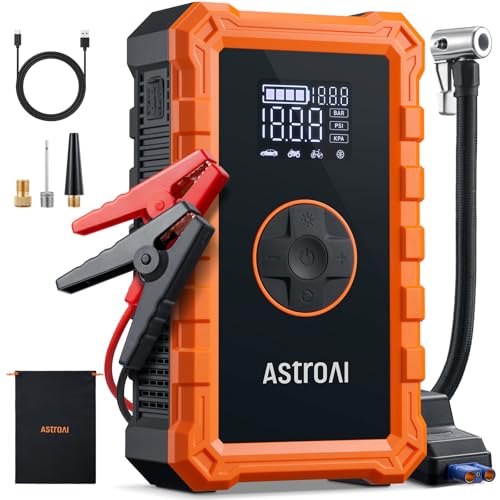
Car batteries are rated in cold-cranking amps and amp-hours, not watts. But converting to watts is straightforward: watts = volts × amps. This section breaks down the three specs you actually need, and why your car’s 12V system isn’t a limitless power outlet.
A fully charged car battery sits at about 12. 6 to 12. 8 volts when the engine is off. The amp-hour (Ah) rating tells you how long it can sustain a given current. Multiply voltage by amp-hours and you get watt-hours (Wh). For example, a 60 Ah battery at 12.
6 V equals 756 Wh. Divide that by 1000 to convert to kilowatt-hours. This gives you the theoretical energy stored, but real-world use is lower because batteries shouldn’t be drained past 50 percent.
- Use 12.6 V as your baseline for a resting, fully charged battery.
- Multiply Ah by V to get total watt-hours available.
- Only count about 50 percent of the result as safe usable energy.
- Account for inverter inefficiencies, which can cost 10 to 20 percent.
- Check your alternator output if you plan to run gear while driving.
Gear That Reveals Your Car Battery’s True Watt Output
Recommended Products


The products below are evidence of how much real wattage a car battery can deliver. Each one either converts battery power into usable AC, jump-starts a dead battery, or maintains charge so you never lose that watt capacity in the first place.
|
1
|
JOLTEKON Car Battery Jump Starter with Air Compressor 4500A 150PSI, Car Jumper Starter Por |
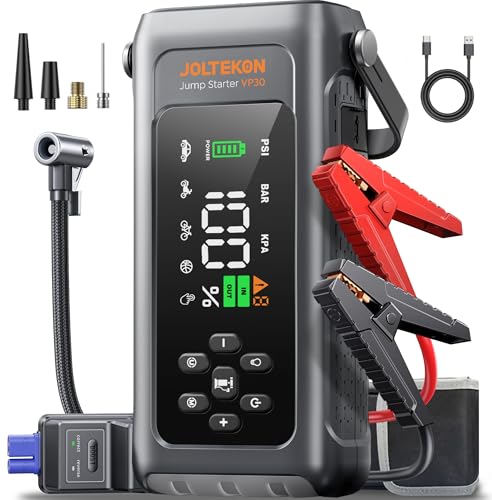
Delivers portable 12V jump power plus AC outlets, showing how much watt-capacity a car battery really holds.
The JOLTEKON 4500A jump starter packs a 150 PSI air compressor, 500-lumen LED lights, and USB ports into one portable unit. It’s designed to start gas engines up to 9 liters and diesel up to 8 liters, drawing directly on the stored watt-hours in your car’s battery system.
Use it to jump-start a completely dead battery, inflate tires, or run small electronics via its power bank function. The 3.3-inch smart display keeps you informed on remaining charge. One limitation: the exact watt-hour capacity isn’t printed, so you must estimate from the listed Ah and voltage.
|
2
|
TWING Car 1000W Inverter 12V DC to 110V AC Power Inverters for Vehicles Portable Vehicle C |

Converts 12V DC from your car battery to 110V AC, directly revealing usable wattage for household devices.
The TWING 1000W inverter takes 12V DC from your cigarette lighter or battery and outputs 750W continuous, 1000W peak AC power. It includes dual USB ports with QC 3.0 and 30W PD, plus a digital display for real-time monitoring.
Run laptops, small appliances, or camping gear by tapping your car battery’s watt-hours through AC wall outlets. Connect directly to the battery for higher draw. Note: continuous use at max load drains a typical car battery in under an hour.
|
3
|
10-in-1 Car Battery Jump Starter with Air Compressor 8000A 160PSI Portable Car Jumper Star |

Provides 8000A peak current, demonstrating how much surge wattage a car battery can deliver instantly.
The 10-in-1 jump starter offers 8000A peak current and a 160 PSI digital tire inflator. It starts gas engines up to 12 liters and diesel up to 8 liters, even in extreme cold down to -4°F.
Its 800-lumen LED lights, SOS warning modes, and fast phone charging make it a complete emergency kit. The upgraded smart chip adds 10 safety protections. However, its high capacity also means it’s bulkier than smaller alternatives.
|
4
|
5000A Car Battery Jump Starter with Air Compressor,12V Car Battery Jumper Starter Portable |

Delivers 5000A peak current with 150 PSI inflation, showing how much power a portable jump box can harness from watt-hours.
The 5000A jump starter combines a turbo 150 PSI air compressor, 500-lumen LED light, and QC3.0 fast charging in a compact unit. It starts 8L gas and 7L diesel engines reliably across extreme temperatures.
Inflate car or bike tires quickly, charge phones via 8000mAh power bank, and jump-start dead batteries on the go. The 10 safety protections ensure safe operation. A drawback is that its 8000mAh capacity limits long-term device charging.
|
5
|
Car Battery Charger 12V Smart Automotive Battery Trickle Charger Maintainer | 7-Stage Safe |

Maintains battery charge so you never lose stored watt-hours to sulfation or deep discharge.
This 12V 6A smart charger works on all lead-acid batteries including AGM, GEL, and flooded types. It uses a 7-stage charging process and pulse repair to restore lost capacity and extend cycle life.
The large LCD display shows voltage, current, and charge percentage in real time. It’s ideal for maintaining batteries over winter or long storage periods. Limitation: it can’t jump-start totally dead batteries.
|
6
|
Joltekon Car Battery Jump Starter with Air Compressor 6000A 150PSI, Car Jumper Starter Por |

Provides 6000A peak current with 150 PSI inflation, revealing how much surge wattage a compact unit can deliver.
The Joltekon 6000A jump starter features a 22-cylinder motor delivering 45L/min turbo inflation and 150 PSI pressure. It starts all gas engines and up to 10L diesel, even in extreme -4°F to 140°F conditions.
Its 90% energy efficiency, 37Wh capacity, and 20-inch detachable air hose make it ideal for emergency roadside use and device charging. The one downside is that its compact form limits total stored watt-hours compared to larger units.
|
7
|
Mighty Max Battery MM-H4L Start and Stop Car BCI Group Size 140 Positive Terminal on Left |

Delivers 50 Ah at 12V, directly specifying the watt-hour capacity your car battery question asks about.
The Mighty Max MM-H4L is a 12V 50Ah AGM battery providing 570 CCA and 80RC (reserve capacity). Its positive terminal is on the left side, fitting Group Size H4L applications perfectly.
Sealed and spill-proof, it resists shock and vibration for reliable starts across any weather. Built in an ISO-certified facility and CE-compliant. Keep in mind: AGM batteries cost more upfront than flooded lead-acid.
|
8
|
VANXIPOW 8000A Portable Car Battery Jump Starter with Air Compressor, 150PSI (9.0 L Gas/8. |
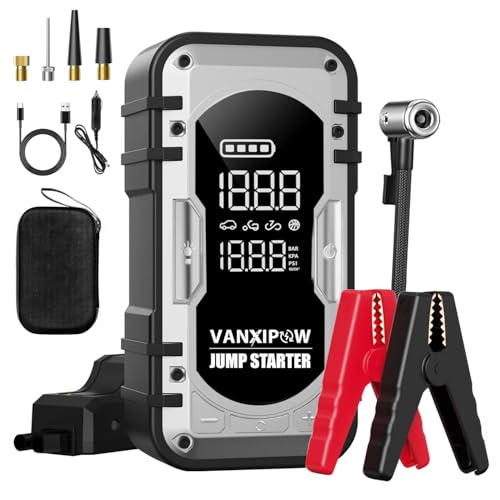
Packs 8000A peak current into a 615-gram unit, proving how much watt-output a portable battery can achieve.
The VANXIPOW 8000A jump starter includes a 150 PSI smart digital tire inflator, 600-lumen LED light, and large LED display. It starts gas engines up to 9 liters and diesel up to 8 liters.
Its patented honeycomb cooling design cuts starting temperature by 50 percent, and 10 safety protections guard against misconnections. Super light at 615 grams. However, its single USB port limits simultaneous device charging.
|
9
|
Schumacher Electric 10A Car Battery Charger & 200A Engine Start – SC1446 | Wheels – Manual |

Offers 200A engine start and 40A boost, showing how much sustained wattage a dedicated charger can deliver.
The Schumacher SC1446 wheeled charger delivers 200A engine start and 40A boost for 6V and 12V batteries. It supports AGM, gel, and deep-cycle batteries across automotive, marine, and power sport applications.
The 135-minute manual timer gives pro-level control over charging precision, reducing downtime for dead batteries. Includes a user manual. One consideration: its wheeled design takes up more garage space than handheld units.
These devices convert, jump, and maintain your car battery’s energy. The inverters and jump starters show real watt output in action, while the battery itself and charger help you maximize and preserve that stored capacity.
Running Devices Off Your Car Battery Safely
Recommended Products


Once you know your battery’s watt-hours, the next step is using that power without killing the battery. Learn which devices are safe, how long they last, and when to stop drawing power.
Safe Device Wattages
Most car batteries can safely power a phone charger at 15 watts, a small fan at 40 watts, or an LED light bar at 50 watts for an hour or two. A laptop drawing 65 watts will drain a 60 Ah battery in roughly six hours of continuous use.
Anything above 150 watts, like a mini fridge or power tool charger, should be run with the engine running and an eye on voltage.
When to Stop Drawing Power
Your car battery voltage tells the story. A healthy battery stays above 12.4 volts at rest. Once it drops below 12.0 volts during use, you’re entering the danger zone where sulfation begins and recharging becomes harder. If voltage falls below 11.8 volts, stop immediately and recharge to prevent permanent damage.
| Device | Typical Watts | Safe Runtime (60 Ah) | Risk Level |
|---|---|---|---|
| Phone charger | 15 W | 40+ hrs | Very Low |
| Small fan | 40 W | 15 hrs | Low |
| LED light bar | 50 W | 12 hrs | Low |
| Laptop (65 W) | 65 W | 8 hrs | Moderate |
| Mini fridge | 80 W | 6 hrs | Moderate |
| Power tool charger | 200 W | 1.5 hrs | High |
Battery Replacement and Maintenance
Keeping your battery healthy protects the watt-hours you need. These tips cover when to replace, how to test capacity, and what to watch for before you’re stranded.
Test resting voltage monthly with a multimeter; replace below 12.4 volts.
Check the alternator output at 13.7 to 14.6 volts while the engine runs.
Clean corroded terminals with a baking soda solution and a wire brush.
Secure the battery to prevent vibration damage that cracks internal plates.
Replace every 3 to 5 years or sooner if cold-cranking amps drop significantly.
Use a smart maintainer like the chargers listed to preserve charge during storage.
A car battery typically lasts three to five years, but that varies with climate, driving habits, and maintenance. Short trips that never fully charge the battery lead to sulfation faster than long highway drives. If you notice dim headlights, slower engine cranking, or a swollen case, test capacity immediately.
Replacing a battery before total failure keeps your watt-hour capacity steady and avoids being stranded.
A car battery’s watt-hours equal volts times amp-hours, but you should only use half that safely. To calculate yours right now, check the Ah rating on your battery label and multiply by 12. 6 volts.
For hands-on testing, pick up a multimeter or one of the portable jump starters above to see your battery’s real voltage in action.

- 10 Best Battery For Generator Ev Battery Bank Marine 2026 - October 27, 2026
- 10 Best Battery For Generator Ev Battery Bank Lto 2026 - October 27, 2026
- 10 Best Battery For Generator Ev Battery Bank Low Voltage 2026 - October 27, 2026