Carbon Monoxide Detector Battery Replacement: Model and Cell Fit
A low-battery chirp in the middle of the night is usually all the reminder you need. Replacing a carbon monoxide detector battery is generally straightforward, but the correct replacement depends on the detector: many use a 9V alkaline cell, while some use a CR123A lithium battery.
This guide explains how to identify the right battery, change it safely, and choose dependable replacements.
Why Battery Replacement Matters For CO Detectors
A working battery gives a carbon monoxide detector the power it needs to monitor the air continuously. As the battery weakens, the unit may chirp, shut down, or stop providing dependable protection.
Most models take either a standard 9V alkaline battery or a CR123A lithium cell, so checking the detector label or manual before opening the battery compartment is worth the extra minute.
Carbon monoxide detectors need a steady power source to remain on guard around the clock. A weak or dead battery can trigger low-battery chirps and, depending on the model, may leave the detector unable to respond properly to rising CO levels.
Confirm whether your unit takes a 9V or CR123A battery before buying replacements; the two types are not interchangeable.
| Battery Type | Typical Use | Lifespan | Average Cost |
|---|---|---|---|
| 9V Alkaline | Standard detectors | 6-12 months | $5-$10 |
| CR123A Lithium | Long-life models | 5-10 years | $10-$15 |
| AA Alkaline | Backup units | 6-12 months | $5-$8 |
Picks To Replace Batteries On Your CO Detector
Battery choice comes down to the detector’s required size and how often you want to replace it. The options below include familiar 9V alkaline batteries for standard detectors and CR123A lithium cells for compatible long-life or smart alarm systems.
|
1
|
Duracell Coppertop 9V Battery, 2 Count, Smoke Detector, Long-lasting |
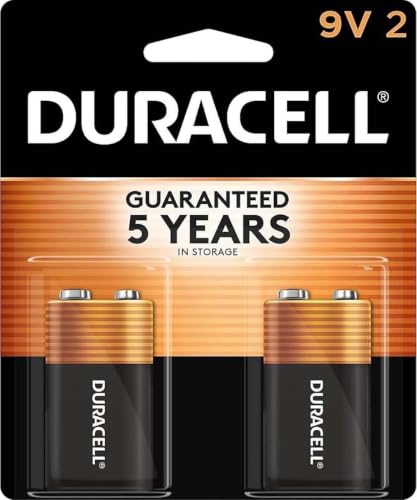
Duracell Coppertop 9V is a straightforward pick for annual replacements in compatible CO detectors.
The Duracell Coppertop 9V comes as a two-count pack intended for smoke detectors, carbon monoxide detectors, security sensors, and other emergency devices.
Its five-year storage guarantee is useful if you like to keep a spare ready for the next annual check rather than shop for one after the detector starts chirping.
I would shortlist this for a household with standard 9V detector compartments and a preference for a familiar brand. It is an alkaline cell, so plan on checking the detector regularly and replacing the battery on the schedule recommended by the manufacturer, commonly about once a year.
|
2
|
DURNERGY 9V Batteries, 9 Volt Batteries 8 Pack,10-Year Shelf Life, 9V Batteries for Smoke |

DURNERGY’s eight-pack gives compatible 9V detectors a large supply of alkaline replacements, with a stated 10-year shelf life.
DURNERGY’s 9V alkaline batteries come in an eight-pack and are marketed for smoke detectors, carbon monoxide detectors, and other household devices. The listing identifies them as 6LR61 cells and highlights longer service life than ordinary carbon-zinc 6F22 batteries, along with a corrosion-resistant steel casing.
The larger pack makes sense when several detectors use 9V batteries or when you want replacements stored at home. The CE certification and leak-resistant design are useful details, though this is a less familiar name than Duracell or Energizer.
Check the date and storage instructions before putting a spare into service.
|
3
|
Amazon Basics 8-Pack 9V Long-Lasting Alkaline Batteries for Smoke Detector, Electronics & |

Amazon Basics’ eight-pack is a practical way to keep several compatible 9V detectors supplied.
This Amazon Basics eight-pack contains 9V alkaline batteries for smoke detectors, garage door openers, radios, toys, and similar devices. The listed five-year leak-free shelf life makes it convenient to keep extras on hand instead of buying a single replacement whenever one detector begins to chirp.
I would look at this pack for a home with multiple standard 9V alarms. It is intended for immediate use or emergency storage, but it is still important to confirm that your detector accepts a replaceable alkaline battery and to follow the unit’s own replacement interval.
|
4
|
Amazon Basics 4-Pack 9V Long-Lasting Alkaline Batteries for Smoke Detector, Electronics & |

The Amazon Basics four-pack fits smaller households that need a few standard 9V spares.
The four-pack offers the same basic format as the larger Amazon Basics option, with 9V alkaline cells for smoke detectors, garage door openers, and everyday electronics. It is a sensible quantity when one household has only a few compatible detectors and does not need a large stockpile.
A five-year leak-free shelf life gives these batteries useful staying power in storage. I would choose this size when you want one or two replacements available without leaving a larger pack unused. As with any replaceable alkaline battery, check the detector periodically and replace it according to the manufacturer’s guidance.
|
5
|
Energizer MAX 9V Batteries (2 Pack), 9 Volt Alkaline Batteries – Packaging May Vary |

Energizer MAX 9V is a familiar alkaline option for compatible alarms and safety devices.
Energizer MAX 9V batteries come in a two-pack and are listed for smoke detectors, carbon monoxide alarms, hand-held meters, toys, and other everyday electronics. The listing also notes long-lasting power and up to five years of storage life, which helps if one battery is intended as a spare.
This is an easy option to consider when your detector uses a standard 9V slot and you prefer an established battery brand. The batteries include up to four percent recycled materials. They remain alkaline cells, so continuous-use detectors still need regular checks and scheduled replacement.
|
6
|
Enegitech CR123A 3V Lithium Battery, 123 Lithium Batteries 3 Volt 1600mAh for Smart Smoke |

Enegitech CR123A lithium batteries suit compatible smart alarms and security devices that need a 3V cell.
Enegitech’s CR123A lithium batteries are non-rechargeable 3V cells with a listed 1600mAh capacity. The listing names smoke alarms, smoke detectors, flood and freeze sensors, smart locks, water-leak detectors, and other home alarm equipment as compatible applications.
My read is that these make sense only when the detector specifically calls for a CR123A battery; they are not substitutes for a 9V alkaline cell. Their lithium format is aimed at long-term, low-drain devices, while the higher cost and non-rechargeable design make correct compatibility especially important.
Do not attempt to charge them.
|
7
|
PKCELL 9V Batteries 10 Pack 9 Volt Battery for Smoke Alarms | 6F22 Square Battery Carbon Z |

PKCELL 9V carbon-zinc batteries are intended for compatible detectors that use the 6F22 format.
PKCELL’s ten-pack contains 6F22 carbon-zinc 9V batteries for smoke detectors and alarms. The batteries are presented as suitable for continuous-use devices and are designed to provide steady output during ongoing operation.
I would consider these when a detector explicitly accepts this battery chemistry and you want several replacements in reserve. The 9V format fits many familiar detector compartments, but carbon-zinc cells generally do not offer the same service life as alkaline batteries. Confirm the detector’s requirements before choosing them.
|
8
|
Enegitech CR123A 3V Lithium Battery, 123 3 Volt Lithium Battery, for Home Security Alarm S |

The Enegitech CR123A two-pack provides compatible 3V lithium replacements for selected smart alarms and security equipment.
This Enegitech two-pack contains non-rechargeable CR123A lithium batteries rated at 3V and 1600mAh. The listing positions them for home security alarm systems, smart locks, and carbon monoxide detectors that specifically use CR123A cells, with PTC protection included.
The compact pack is a reasonable fit for a single detector or a small security setup, and the cells are listed as replacements for part numbers including DL123A and SF123A. Before ordering, match the part number and voltage printed on the detector or its existing battery.
Lithium cells should not be recharged, and disposal should follow local guidance.
|
9
|
PKNOVA 9V Batteries Carbon 9 Volt Battery for Smoke Detector 9V 6F22 Square Battery, Long- |

PKNOVA’s four-pack offers 6F22 carbon-zinc replacements with a wide stated operating-temperature range.
PKNOVA 9V batteries come in a four-pack of 6F22 carbon-zinc cells for smoke detectors and other home safety devices. The listing says they are designed to operate from -4°F to 140°F, a detail that may matter in garages, outbuildings, or other spaces with wider temperature swings.
The double-sealed construction is intended to limit leakage, and the listing says the batteries avoid chromium, lead, and mercury. They can also be used in devices such as multimeters and wireless doorbells. The main trade-off is the carbon-zinc chemistry, which typically offers less runtime than alkaline batteries in continuous-use applications.
|
10
|
HW CR123A 3V Lithium Battery 6-Pack, 1700mAh High Capacity 123 Batteries | 10-year shelf l |

HW CR123A lithium batteries offer a higher listed capacity and long storage life for compatible detectors.
HW’s CR123A batteries are listed as 3V, 1700mAh non-rechargeable lithium cells and come in a six-pack. They are intended for fire alarms, smoke detectors, and carbon monoxide alarms that require the CR123A format, rather than standard 9V compartments.
The listing cites UL and RoHS certification, a leak-proof design, PTC protection, and operation from -40°F to 158°F. A ten-year storage life can be helpful when keeping emergency replacements available.
I would reserve this larger pack for homes or properties with several compatible devices, since a single-detector household may not use six cells quickly.
For standard 9V detectors, the Duracell, Energizer, and Amazon Basics options are familiar alkaline choices, while the larger DURNERGY pack suits homes with several alarms. CR123A cells from Enegitech or HW are for detectors that specifically require that lithium format.
Match the battery to the model first, then weigh pack size, storage life, and replacement frequency.
Steps To Replace A CO Detector Battery Safely
When the detector starts chirping, replacing the battery is usually a short household task. Locate the battery compartment, remove the old cell, fit the exact replacement shown on the detector or in its manual, and close the housing securely.
Press the test button afterward; if the alarm does not respond as expected, reinstall the battery or consult the manufacturer’s instructions before relying on the unit.
Open the detector housing by twisting or sliding the cover off carefully.
Remove the old battery, noting its position and polarity orientation.
Insert the new battery, aligning positive and negative terminals correctly.
Secure the cover back in place until you hear a click or lock.
Test the alarm using the test button to confirm proper operation.
- Always turn off surrounding power if hardwired, even if replacing backup battery.
- Use only manufacturer-recommended battery types to avoid voltage issues.
- Never force a battery into place, mismatched sizes risk internal damage.
- Dispose of alkaline and lithium batteries at designated recycling centers.
- Keep a spare battery near each detector for quick replacements.
Timing And Maintenance For Continuous Protection
A new battery is useful only if it remains ready when needed. Keep an eye on the detector’s warning chirps, follow the manufacturer’s replacement schedule, and test the alarm regularly so a depleted cell or another fault does not go unnoticed.
| Battery Type | Recommended Replacement | Signs Of Failure |
|---|---|---|
| 9V Alkaline | Every 12 months | Chirping, dim display |
| CR123A Lithium | Every 5-10 years | LED warning flash |
| AA Backup | Every 6 months | Intermittent silence |
Many manufacturers recommend changing alkaline batteries in carbon monoxide detectors about every 12 months, even if the detector has not started chirping. CR123A lithium cells can last longer, often five to ten years depending on the device, but they should still be checked annually.
A calendar reminder tied to a routine home-maintenance date can prevent missed replacements. Keep the correct spare battery nearby, and test the detector after installation and at the interval specified by the manufacturer.
Yes, replacing a carbon monoxide detector battery is usually manageable at home: open the compartment, install the exact battery type listed for the detector, and run the test function.
For a standard 9V model, a fresh Duracell, Energizer, or Amazon Basics cell is a reasonable starting point; CR123A detectors need a compatible lithium replacement instead. Set a recurring reminder so the next change is planned rather than prompted by a late-night chirp.

- Marine Chargers and Backup Batteries: 9 Options Compared (2026) - October 27, 2026
- LTO Cells vs. SLA Generator Batteries: 5 Options Compared (2026) - October 27, 2026
- 12V/24V Backup Batteries and the EcoFlow DELTA Pro 3 (2026) - October 27, 2026