Lithium-Ion Cell Testing: Open-Circuit Voltage and Capacity Retention
What kind of test a lithium ion battery needs depends entirely on the question you’re asking. If you want to know whether a cell still holds a usable charge, voltage is the starting point.
If you want to know whether it’s safe to keep using, you’re looking at swelling, heat, and internal resistance instead. The wrong tool hands you a confident-looking number that answers none of these, while a structured approach tells you whether the cell is worth keeping, rebalancing, or recycling.
Here’s how I’d break down the methods and the tools that actually fit lithium chemistry.
What Lithium Ion Testing Actually Measures
Before plugging anything in, it helps to know which numbers actually mean something for a lithium ion battery. Voltage on its own tells you about charge state; internal resistance and capacity are what tell you about health.
Open Circuit Voltage
Voltage is the quickest read, but it’s also the easiest to misread. A lithium ion cell needs a few hours of rest before its open circuit voltage settles, and that settled number drifts downward as the cell ages.
Internal Resistance
Internal resistance is the quiet tell. It climbs gradually as cells age, and the first symptom is voltage sag under load , the battery looks fine at rest but stumbles the moment you ask it for current.
By the time failure seems sudden, resistance has usually been creeping upward for months.
Capacity Retention
Capacity is the number most people actually care about: how much energy the cell holds now versus when it was new. The rough industry line for worn out sits at eighty percent of original capacity.
Key Metrics For Lithium Ion Health
| Metric | Normal Range | Degraded Range | Failure Indication |
|---|---|---|---|
| Voltage | 3.6V to 4.2V | Below 3.0V | Below 2.5V |
| Internal Resistance | Under 100mOhm | 100 to 200mOhm | Above 200mOhm |
| Capacity | Above 80% | Fifty To Eighty Percent | Below Fifty Percent |
Tools To Test Lithium Ion Batteries
No single tester covers every lithium job. Checking a loose 18650 cell, a laptop pack, and a vehicle battery are three different problems, so I’ve matched each pick below to the situation it handles best rather than pretending one tool does it all.
|
1
|
ANCEL BT410 12V 24V Car Battery Tester for Lead-Acid & Lithium Batteries, 100-2000 CCA Aut |

The ANCEL BT410 covers lithium ion automotive batteries in 12V and 24V systems, with cranking and charging diagnostics built in.
The ANCEL BT410 is a handheld analyzer that speaks both chemistries , lithium ion and lead-acid , across 12V and 24V systems. It reads state of health, voltage, and internal resistance within seconds, and it goes a step further with cranking and charging system tests.
Cars, trucks, motorcycles, and marine lithium setups are where this one makes sense, and the color screen stays legible whether you’re in a dim garage or direct sun.
My read on the limitation: it’s a vehicle-context tester, not a bench instrument, so it can’t properly evaluate a bare lithium ion cell outside its system.
|
2
|
ANCEL BT310 Battery Tester 12V 24V, 100-2000 CCA Load Tester with Test Data | Car Battery |

The BT310 boils its readings down to GOOD or REPLACE verdicts for lithium batteries and keeps a test history so you can track wear over time.
The ANCEL BT310 is a compact tester for lithium ion and lead-acid batteries between 100 and 2000 CCA. It measures SOH, SOC, voltage, current, and internal resistance, then translates everything into five plain-language verdicts , no interpretation required.
The stored test history is the reason I’d shortlist this one: test the same battery across a few months and you can watch degradation happen instead of guessing at it. It won’t do cell-level forensic work, but for routine checks across several vehicles it fits well.
|
3
|
Acclope BT90 PRO 30-3800 CCA QR Report 2-360Ah Battery Tester 6V/12V/24V | No APP WIFI wit |

The BT90 PRO folds ambient temperature into its SOH and resistance math, which corrects the cold-weather under-reads and hot-weather over-reads that skew lithium testing.
The Acclope BT90 PRO handles 6V systems up to 3800 CCA, working with both lithium ion and lead-acid chemistries. It reports SOH, SOC, voltage, and resistance, adds cranking and charging checks, and includes ripple insight.
The temperature compensation is the standout: a lithium battery tested on a freezing morning reads differently than the same battery at noon, and this unit adjusts for that instead of handing you a misleading number. QR cloud reports make sharing results painless.
It’s bulkier than typical handheld testers, so it suits a bench better than a tool bag.
|
4
|
Magnetic Battery Tester for AA AAA C D 9V, Buttons, Ni-MH, Alk, Li-ion |

This tester measures lithium ion and button cell voltage directly across common household sizes using a simple magnetic slot.
The Magnetic Battery Tester is a small portable unit for lithium ion, alkaline, NiMH, and button cells from 1.2V up to 3.7V. A magnetic slider holds each battery in place while the LCD shows voltage and a good, weak, or poor health reading.
It handles AA, AAA, C, D, 9V, and lithium button cells like the CR123A and CR2032, which covers most of what’s rattling around in a household drawer.
The honest limitation: it reads voltage only , no capacity, no internal resistance , so it tells you whether a cell is dead, not how much life it has left.
|
5
|
Acclope BT60 PRO 2-120AH Battery Tester 6V/12V/24V 100-3000 CCA QR Report | Support Regula |

The BT60 PRO runs lithium voltage and health checks and generates QR cloud reports, which makes record-keeping nearly effortless.
The Acclope BT60 PRO covers 6V to 24V batteries up to 3000 CCA and works with regular flooded, AGM, GEL, EFB, and lithium types. Beyond cranking, charging, and waveform diagnostics, it produces shareable QR reports for every test it runs.
On lithium ion it handles voltage and state of health checks dependably, and the cloud reporting is genuinely useful if you test often enough to want a paper trail. The 2 to 120Ah range is the constraint , larger lithium packs outside vehicle territory fall outside its scope.
|
6
|
Acclope BT60 PRO 2-120Ah Battery Tester 6V/12V/24V 100-3000 CCA QR Report | Tests Regular/ |
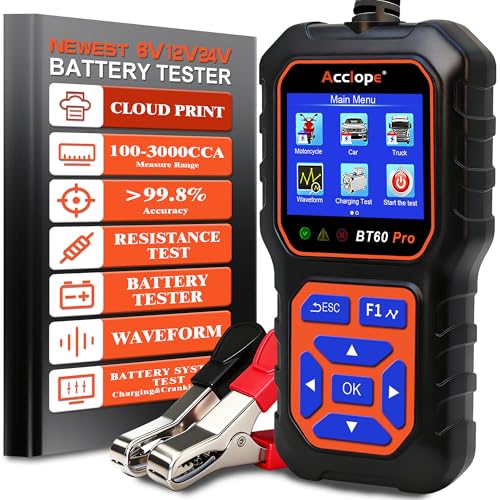
This BT60 PRO variant adds a dedicated 6V motorcycle mode and clear lithium health checks with QR sharing.
This version of the Acclope BT60 PRO spans 6V to 24V and 100 to 3000 CCA, supporting lithium alongside AGM, GEL, EFB, and flooded batteries. It runs cranking and charging diagnostics, plus a dedicated 6V mode aimed squarely at motorcycle lithium batteries.
The lithium voltage and health functions suit smaller packs well, and QR cloud reports make it easy to hand results to a customer or a mechanic. One thing it won’t do is read diagnostic trouble codes from vehicle systems , it’s a battery tester, nothing more.
|
7
|
La Crosse 911-65557-INT Portable Digital Battery Tester,Black |

The La Crosse tester confirms lithium button cell voltage and alkaline charge status in three quick steps.
The La Crosse 911-65557 is a portable tester for alkaline, rechargeable, lithium, and lithium ion button cells. It covers AAA, AA, C, D, N, and 9V sizes, and it picks the correct voltage range for each chemistry automatically.
A three-step process and an LED bar that reads good, weak, or poor , that’s the whole pitch, and for household checks it’s enough. It won’t measure capacity or how a lithium ion battery behaves under discharge load, so treat it as a quick-sort tool rather than an analyzer.
|
8
|
Lancol Micro 500 Car Battery Tester, 12V Lithium Battery Test 40-3000 CCA Cranking System |

The Lancol MICRO500 tests 12V lithium batteries with up to 99.8 percent accuracy and reports cranking and charging performance in the same pass.
The Lancol MICRO500 is a 12V battery analyzer covering lithium and lead-acid batteries from 40 to 3000 CCA. It reads voltage, SOC, SOH, CCA, and internal resistance with high precision.
The double conductor Kelvin clamps are what push its lithium readings toward that accuracy figure, and cranking plus charging system tests happen in a single pass. Two trade-offs to note: the LED display can wash out in bright sunlight, and there’s no cloud reporting like you’d find on pricier units.
|
9
|
DWEII 1pcs 18650 Lithium Battery Capacity Tester Module MAh MWh Digital Battery Power Dete |

The DWEII tester measures 18650 lithium capacity in mAh and MWh across four channels at once, with internal resistance data for each.
The DWEII 18650 tester is a four-channel digital module that puts lithium ion cells through full charge and discharge cycles. Each channel reports capacity in mAh and MWh, plus voltage, current, power, and internal resistance.
The 1.77-inch LCD shows all four channels simultaneously, which makes sorting through a pile of 18650 cells far faster than testing one at a time. With measurement error hovering around ten percent, this isn’t certified capacity verification , it’s the tool for separating good cells from tired ones.
Every tester above solves a different slice of the lithium testing problem , vehicle packs, household cells, or loose 18650s. Picking the one that matches your actual battery type beats buying a do-everything unit that does nothing well.
Safe Testing Practices For Lithium Batteries
Safety is the part of lithium testing that deserves more respect than it usually gets. Watch voltage, keep an eye on temperature, and stop the moment readings head somewhere dangerous. A disciplined process protects the battery, the tester, and everything around both.
First, visually inspect the battery for swelling, cuts, or corrosion before connecting any tester.
Next, confirm the cell voltage sits between 2.5V and 4.2V before running deeper tests.
Then connect the tester leads with correct polarity and keep hands clear of vent areas.
Monitor temperature continuously and stop if the cell feels warm or exceeds safe limits.
Finally, record capacity and resistance values to track degradation over future cycles.
- Do test in a fire safe area away from flammable materials.
- Do verify voltage before connecting a load or analyzer.
- Do record results so you can compare capacity trends over time.
- Do stop testing immediately if the cell swells or heats up.
- Do use protective gear when testing damaged or unknown lithium cells.
- Don’t exceed the testers rated voltage range for lithium chemistry.
- Don’t rely on voltage alone for assessing lithium battery health.
When To Retire A Worn Lithium Battery
Accurate readings only get you so far , lithium ion batteries age no matter what the numbers say, and replacing one before it fails is what keeps devices safe and running well.
Physical Damage And Swelling
Swelling, punctures, and leaks disqualify a lithium ion cell no matter what its voltage reads. Physical damage can mean the internal separator is compromised, and that’s where fire and short circuit risk lives.
Capacity And Resistance Drift
Below eighty percent of original capacity , or once internal resistance has roughly doubled , a lithium battery costs you runtime and generates more heat. Hanging onto it saves nothing and adds risk.
Voltage Sag Under Load
A sharp voltage drop under normal load is the cell admitting it can no longer support its device. Replacing it restores performance and ends the surprise shutdowns.
The numbers are only half the decision. Combining voltage, capacity, resistance, and a visual once-over into a single judgment is where testing pays off , and a lithium ion battery that fails two or more of those thresholds belongs in a certified e-waste recycling program, not a drawer.
Matching Test Tools To Your Lithium Goals
Matching the tester to the job is what saves time and cuts down on bad readings when you’re evaluating lithium ion batteries. A vehicle analyzer won’t sort 18650s, and a cell sorter won’t diagnose a car.
Choosing A Lithium Battery Tester
| Goal | Recommended Tester | Reason |
|---|---|---|
| Vehicle packs | ANCEL BT410 | Handles 12V 24V lithium |
| Household cells | Magnetic Tester | Covers button and alkaline |
| Workshop reports | Acclope BT60 PRO | QR cloud reports |
| 18650 packs | DWEII Module | Four channel capacity |
| Quick checks | La Crosse Tester | Simple three step use |
No single lithium tester does everything, so I’d match the tool to the size and chemistry you deal with most often.
A handheld automotive analyzer covers lithium vehicle packs, a bench module covers loose 18650 cells, and if you treat every test as one recorded data point, your judgment gets sharper with each comparison.
Testing a lithium ion battery comes down to one question: is it still safe and useful, or is it time to let it go? Pick the tester that matches your battery’s size and chemistry, run a full charge-discharge cycle, and write down voltage, capacity, and resistance each time.
Comparing this month’s numbers to last month’s beats guessing, every single time.

- Marine Chargers and Backup Batteries: 9 Options Compared (2026) - October 27, 2026
- LTO Cells vs. SLA Generator Batteries: 5 Options Compared (2026) - October 27, 2026
- 12V/24V Backup Batteries and the EcoFlow DELTA Pro 3 (2026) - October 27, 2026