Moving a Golf Cart Without Battery Power: Tow Modes and Checks
A cart that will not move is a miserable way to spend a round. You are watching the group ahead disappear while you sort out whether the pack is flat or the controller has already shut the motor down.
I would start with what still works with no main battery, tow, neutral, or a small 12V feed for lights, then match any replacement to the cart’s voltage instead of grabbing the first box that says golf cart.
Why your cart may still roll without a battery
A dead pack does not always leave you stuck on the fairway. Some carts still roll once they are in tow or neutral. I would check that before anyone starts pushing.
Most newer electric carts need the main pack because the controller, lights, and safety interlocks all draw from it. Once voltage falls past the cutoff, the controller usually kills drive on purpose. Older carts with simple controllers are looser: they often push, or roll downhill, without the motor dragging.
A few owners hang a small 12-volt accessory battery on the lights and horn so they can finish a hole without pulling the traction pack down further. If yours has a tow or neutral switch, the manual should say whether it is meant to roll with the key off.
Check for a tow/neutral switch
Find the switch or lever marked TOW or NEUTRAL, usually on the dash or the controller box. That frees the motor so you are not fighting electrical drag. Some carts want the key off before the lever does anything.
If the cart then rolls easily, you can push it to the clubhouse or a charger without grinding the motor.
Test a jump-start from another cart
On a normal battery layout, a jump from another cart with a healthy pack is a fair next try: positive to positive, negative to negative, then see if it will move. That only helps when the controller and wiring are intact. A failed controller will not wake up from cables.
If the cart does move, go straight to a charger or finish the hole while it is taking a charge, do not treat a jump as a repaired pack.
Cart behaviors by power state
| Cart State | Power Required | What Works | What Doesn’t |
|---|---|---|---|
| Key off, battery dead | None | Manual push or tow, lights off | Motor, controller, lights |
| Key on, battery dead | None | Tow/neutral switch may allow rolling | Motor, controller, horn, lights |
| Key on, accessory battery installed | 12V only | Lights and horn work, limited speed | Main motor and controller |
| Battery fully charged | 36V/48V pack | Full operation, hill climbing, lights, stereo | Everything |
When a battery isn’t optional
Plenty of carts will not creep along once the main battery is out of the picture. Newer controllers often refuse to boot without the right voltage, and the safety loop can lock the motor completely.
If it will not power up and will not roll in tow, you are waiting on a charged pack.
An error code, or a cart that stays dark even after a jump, often means the controller, not just a flat battery. Carts with regenerative braking or charging usually need the battery in the circuit to close that safety loop.
Then the practical options are pulling the pack and charging it off the cart, or setting in a temporary pack so you can finish. Older carts with basic controllers are more forgiving and can usually be rolled or towed.
- Controller displays an error code and won’t clear
- Cart won’t move even in tow/neutral with a jump
- Key switch is damaged or missing
- Wiring to the controller is frayed or burnt
- Battery terminals are corroded beyond cleaning
- Cart is less than five years old and has a digital dash
Battery-free cart solutions to get you rolling today
If the pack quit mid-round, the useful split is what you are trying to restore.
I would shortlist a lithium kit only when you want the traction pack replaced, a sealed lead-acid set when the tray still expects that layout, or a small 12V AGM when you only need lights and a horn while someone pushes.
One pick is not a cart battery at all: a pedal kart for motion with no electrical system.
|
1
|
LOSSIGY 36V Lithium Golf Cart Battery Conversion Kit Built-in 12V Step-Down Converter, 200 |

A 36V lithium kit that replaces the dead pack and still feeds 12V lights and the horn from the same battery.
The Lossigy 36V kit centers on a 102Ah LiFePO4 battery, a 36V charger, and a built-in 12V step-down, so lights and the horn do not need a separate reducer. An LCD on a stand plus the Lossigy app show voltage, capacity, temperature, and cell status over Bluetooth.
The 200A BMS is specified for overcharge, over-discharge, heat, and shorts, and the listing puts life past 4,000 cycles, about 8-10 times a typical lead-acid pack. Straps and the display stand are in the box, so this is meant as one swap rather than a parts hunt.
I would shortlist this if you want a 36V lithium drop-in that also runs 12V accessories without an extra voltage reducer. The useful part is the dual readout: app plus the dash LCD, so you are not guessing charge from how the cart feels on a hill.
You pay more than another lead-acid set, and the old batteries still have to be disposed of once they are out.
|
2
|
Crown Battery 6CRV220 6V AGM Sealed Deep Cycle Battery – BCI Group GC2 – 220Ah @ 20Hr – Ma |

Sealed 6V AGM cells for carts that will not roll until a real deep-cycle bank is back in the tray.
Crown’s 6CRV220 is a sealed 6V AGM deep-cycle battery, offered here as an eight-pack. Rated output is 220Ah at the 20-hour rate and 172Ah at five hours, which is traction-bank territory rather than a lights-only battery.
The AGM case is spill-proof and does not need watering, so you are not maintaining flooded cells between rounds.
My read: this is the direct replacement when the cart simply will not move without its bank, or a spare set if you already run several 6V batteries. There is no Bluetooth or onboard gauge, so a separate voltmeter is how you check charge.
It is also heavier than a lithium conversion, so hill response will not match a LiFePO4 pack.
|
3
|
LOSSIGY 48V Lithium Battery Golf Cart, Built-in DC-DC Converter, 200A BMS, 48v Golf cart L |

A 48V lithium kit for carts that need full pack voltage back, not a 12V workaround.
Lossigy’s 48V kit pairs a 102Ah LiFePO4 battery with a charger, an LCD on a stand, and straps. The built-in DC-DC converter feeds 12V accessories, lights, horn, stereo, so you are not adding a reducer. A 200A BMS covers overcharge, over-discharge, overheating, and short circuits.
The app tracks voltage, capacity, temperature, and cell status next to the display, and listed cycle life is again past 4,000.
I would shortlist this only for a cart that is already 48V. The converter and monitoring are the reasons to pick the kit over a bare battery, but they do not change pack voltage.
Confirm 48V before you order; a 36V cart is a different install, and this is not a temporary jump pack.
|
4
|
M MASSIMO MOTOR 6V Leoch 6V 225Ah Sealed Lead-Acid Deep Cycle Golf Cart Battery Replacemen |

A sealed 6V 225Ah lead-acid battery when one cell in a deep-cycle bank has to come out.
The Leoch from M Massimo is a 6V 225Ah sealed lead-acid deep-cycle battery for golf carts and electric utility vehicles. Model 3-EVF-225 is the 225 amp-hour unit, and the sealed case is meant to cut watering and spills. It is one battery.
In a multi-battery cart you are replacing a single cell in the string, not the whole bank.
I would use it where the tray already takes a 6V deep-cycle battery, or keep one as a spare. Lead-acid still fades faster in heat than LiFePO4, and the weight shows up on hills with an older motor.
If that cart needs periodic equalization, this chemistry does not get you out of it.
|
5
|
Mehrpow 36V105Ah lithium golf cart Battery with Charger | built-in Bluetooth 200A BMS and |
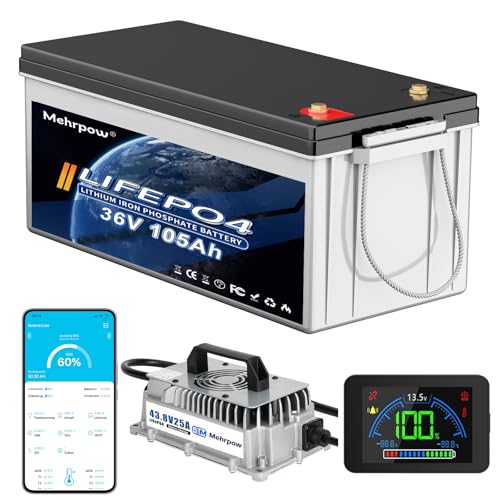
A 36V 105Ah lithium pack with Bluetooth and a listed 40-50 mile range when the original battery quits.
Mehrpow’s 36V 105Ah lithium battery is listed at 3. 84kWh, with a charger, Bluetooth, an LCD, and a 200A BMS that claims a 1000A peak for a 3-second pulse.
The same listing ties that to inclines up to 25° and about 40-50 miles, and says the pack is roughly 60% lighter than a comparable lead-acid setup. Charging stops below 0°C/32°F and discharging stops below -20°C.
App range is given as about 20 meters for voltage, current, and state of charge. Black or white ships at random; specs and accessories are the same either way.
I would look at this when you want a lighter 36V lithium pack and live readings, not a tiny accessory battery. Charge it with the included charger rather than assuming the old lead-acid routine still fits. Color is a coin flip.
It is still a main-pack swap, so it does not help a cart you only need to push to the clubhouse.
|
6
|
Daakmax 12V 35ah Deep Cycle AGM Battery Rechargeable SLA Maintenance-Free Batteries for Ca |
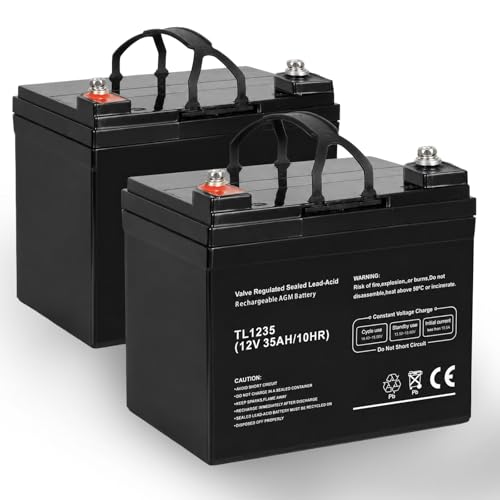
A sealed 12V 35Ah AGM for lights and accessories, not a stand-in for the traction pack.
Daakmax’s 12V 35Ah is a sealed AGM deep-cycle battery in a heavy-duty ABS case, aimed at RVs, UPS backup, marine, camping, and similar loads. AGM here means maintenance-free and leak-resistant, with some vibration resistance. Thirty-five amp-hours can run lights or a radio for a while.
It is not a golf-cart drive battery.
My read: use it only when you need 12V loads while the cart is pushed or towed. Leave a load on overnight and 35Ah disappears quickly. If the motor will not run, this battery will not change that.
|
7
|
Massimo Leoch 8V 180Ah Sealed Lead-Acid Deep Cycle Golf Cart Battery Replacement, Maintena |

An 8V sealed lead-acid battery for carts that still use that voltage in the bank.
This Massimo Leoch 8V 180Ah sealed lead-acid battery is the deep-cycle type used in many cart trays and neighborhood EVs. The case is spill-proof, so the maintenance pitch is no watering, and 180Ah is the figure to match against the battery you pull out.
Footprint is given as a common GC2/GC8 size, still measure the tray before you order.
I would treat it as a like-for-like 8V replacement, or as a spare if the cart runs several 8V batteries in series. One fresh battery in a tired bank only helps so much.
Heat still ages lead-acid faster than lithium, and the extra weight is what you feel on a climb.
|
8
|
Mighty Max Battery 12V 125AH SLA Battery for Zoeller 508 Aquanot Backup Sump |

A 12V 125Ah SLA that can feed accessories or help a careful jump, not a full cart conversion.
Mighty Max’s ML125-12 is a 12V 125Ah sealed lead-acid battery with spill-proof AGM construction and a UL listing. The stated temperature range is -20°C to 60°C, and the size given is 13. 11×6. 81×8. 74 inches. Mounting screws are included; a harness is not.
It is built for higher discharge than a tiny accessory cell.
I would keep this as a trunk backup for lights, a radio, or a cautious jump, not as the battery that replaces a 36V or 48V pack. The case is large and awkward to handle on the course.
High current is part of the design, but a car-style jump can still cook a golf cart’s 12V side if the connection is wrong.
|
9
|
Crazy Cart Shuffle | Kid-Powered Drifting Go Kart | Battery-Free, Easy and Fun Drifting Go |
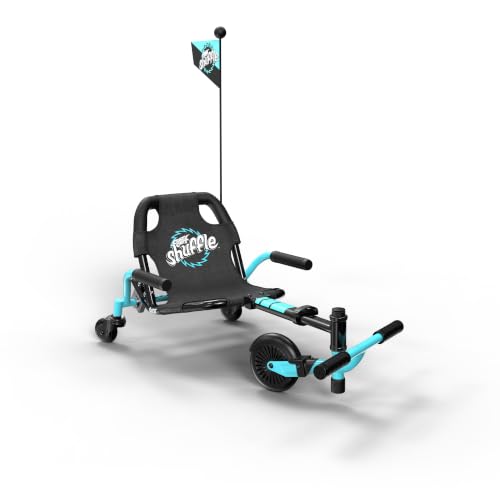
A pedal go-kart with no battery, charger, or motor to die mid-ride.
The Crazy Cart Shuffle is a rider-powered drift kart: an adjustable frame, polyurethane wheels, a drift bar, and rear caster wheels so it can spin without a drivetrain. There is no battery and no charger. Speed is whatever the rider can pedal.
I would shortlist this only if the real ask is something that moves with no electrical system, not a golf cart that died on the seventh hole. The frame adjusts as a child grows, and the drift bar is about balance more than pace. It wants flat, smooth ground.
It will not tow a cart back to the clubhouse.
|
10
|
Mighty Max Battery YTX7L-BS -12 Volt 6 AH, 100 CCA, Rechargeable Maintenance Free SLA AGM |
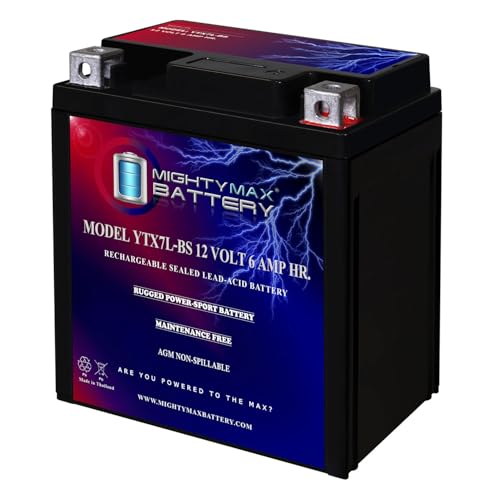
A 12V 6Ah motorcycle-style battery for a light or radio, and nothing bigger.
Mighty Max’s YTX7L-BS is a 12V 6Ah sealed lead-acid battery listed at 100 CCA, about 4.40×2.75×5.19 inches. It is spill-proof, built to take vibration, UL-certified, and covered by a one-year warranty in the product details. Six amp-hours is a small accessory reserve, not traction capacity.
Use it for a light or a radio after the main pack dies, and only for a short stretch. At 6Ah it sags fast if you leave a load on. It cannot stand in for the drive batteries, but it fits where a full-size AGM will not.
Match the fix to the failure. A 36V or 48V lithium kit is a real pack swap; Crown, the Leoch 6V, and the 8V Massimo are sealed lead-acid replacements for carts that still use that layout; the 12V AGMs and the little YTX7L-BS only cover accessories or a careful jump.
The Shuffle is the one option that never needed a battery. I would check voltage and tray size before ordering, then get the cart, or the rider, moving again.
How to drive your cart safely without a battery
Pushing or towing a cart is not the same as driving it on a full pack. These are the checks I would make before anyone leans on the bumper or clamps on a jump.
Engage the tow/neutral switch and turn the key off before pushing or towing the cart to avoid electrical drag.
Use a flat cart jack or dolly when moving the cart manually to protect your back and the turf.
If jump-starting from another cart, connect positive to positive and negative to negative, then start the donor cart first.
Keep speeds under 5 mph when rolling downhill to avoid overheating the motor or controller.
Never leave the cart unattended on a slope, use wheel chocks or park brakes if available.
If using a temporary 12V accessory battery, disconnect it after use to prevent deep discharge.
Check tire pressure and brakes before attempting to drive the cart even a short distance.
Don’t force the motor without power
If the cart will not go into tow or neutral, forcing it can damage the controller. Even when the wheels turn, the controller can still draw a little current and overheat. Confirm tow or neutral is actually engaged before you push or tow.
Avoid using car jumper cables
Automotive jumper cables are built for engine-cranking current. That is a lot for a golf cart’s 12V accessory side. I would use a cart-rated jump source, or a small deep-cycle 12V battery, instead of clamping on a car and hoping the lights survive.
When to upgrade instead of repair
A failed pack is annoying, and it is also when people decide between another lead-acid set and lithium. I would separate “the battery is tired” from “the controller is already failing.”
Lead-acid capacity fades, sometimes with little warning. If the pack is past about three years, or this is not its first replacement, lithium’s higher price can still be the cheaper stretch of ownership: less weight, faster charging, and cycle life the lithium listings put well above lead-acid.
Lossigy, for example, cites more than 4,000 cycles, about 8-10 times a lead-acid pack. A new battery will not repair a bad controller or tired wiring. I would look at those before spending on a kit.
Repair vs. upgrade decision guide
| Factor | Repair (lead-acid) | Upgrade (lithium) |
|---|---|---|
| Upfront cost | $150-$400 per battery | $800-$1,500 for kit |
| Lifespan | 2-4 years | 8-10 years |
| Weight | Heavy (60-100 lbs per battery) | Light (30-50 lbs per battery) |
| Charge time | 6-8 hours | 2-4 hours |
| Maintenance | Watering, equalization | None |
| Cold weather | Performance drops below 50°F | Cutoff below 32°F |
| Best for | Short-term fixes, tight budgets | Long-term performance, frequent use |
- Your current pack is more than three years old and has shown inconsistent performance
- You frequently need to replace individual cells or batteries in a multi-bank system
- Your controller displays error codes even after cleaning terminals and fuses
- You want faster charging and longer runtime between rounds
- You’re tired of watering, equalizing, and cleaning lead-acid batteries

- Marine Chargers and Backup Batteries: 9 Options Compared (2026) - October 27, 2026
- LTO Cells vs. SLA Generator Batteries: 5 Options Compared (2026) - October 27, 2026
- 12V/24V Backup Batteries and the EcoFlow DELTA Pro 3 (2026) - October 27, 2026