How Long Does The Lithium Battery Last?
You just pulled a device out of a drawer and the lithium battery inside is dead , or worse, you’re about to rely on one for a camping trip, a security camera, or a golf cart and you have no idea how long it will actually run.
Lithium batteries don’t have one single lifespan. Chemistry, device drain, temperature, and storage habits all move the number. This breaks down what determines the answer, then shows specific batteries that match different real-world lifespans.
Why Lithium Battery Lifespan Varies So Much
Recommended Products


The honest answer to how long a lithium battery lasts depends on which kind of lithium battery you mean. A coin cell in a watch and a LiFePO4 pack in a golf cart share chemistry, but almost nothing else about their service life.
Lithium batteries last anywhere from two years to over a decade, and the gap comes down to four things: chemistry, load, temperature, and how you store it. A lithium coin cell sips power and can sit for 10 to 12 years.
A rechargeable LiFePO4 pack powering a trolling motor cycles daily and lands closer to 10 years with thousands of charge cycles. Disposable AA lithiums sit somewhere in between, lasting longer than alkaline in high-drain gadgets like trail cameras. The device matters as much as the battery.
A high-drain flashlight drains a cell in hours. A remote control might run on the same cell for years. So the useful question is not how long a lithium battery lasts in general, but how long it lasts in your specific device and conditions.
Typical Lifespan By Lithium Battery Type
| Battery Type | Typical Service Life | Common Devices |
|---|---|---|
| Lithium coin cell (CR2032, CR2450) | 2-10 years | Watches, remotes, key fobs, glucose monitors |
| Disposable lithium AA/AAA | Up to 25 years storage; months in heavy use | Trail cameras, smoke detectors, flashlights |
| CR123A / CR2 photo lithium | 3-10 years in storage; months in active use | Security cameras, tactical lights, film cameras |
| LiFePO4 rechargeable (12V, 48V) | 8-15 years or 4,000-15,000 cycles | RV, solar, golf carts, trolling motors |
- Extreme heat above 140°F accelerates internal chemical breakdown and permanently reduces capacity.
- Deep discharging a rechargeable lithium pack below its cutoff voltage can kill cells or trip the BMS.
- Charging a LiFePO4 battery below freezing damages the cells unless the battery has low-temp cutoff protection.
- Leaving a device switched on in storage drains small coin cells far faster than the rated shelf life.
- Mixing old and new lithium batteries in one device causes uneven drain and premature failure.
Storage Life Vs. Runtime: Two Different Numbers
Recommended Products

Most people asking how long a lithium battery lasts are really asking two questions at once. How long will it sit on a shelf before I use it, and how long will it run once I do? Those are separate numbers, and confusing them leads to bad expectations.
Shelf Life
Shelf life is how long a battery holds a usable charge while sitting unused. Lithium chemistries beat alkaline here by a wide margin. Energizer rates its Ultimate Lithium AA at up to 25 years in storage, and Duracell rates its CR123A at 10 years.
Coin cells like the CR2450 typically hold power for up to 12 years. These numbers assume room temperature and no parasitic drain from a device. A battery sitting loose in a drawer will hit its rated shelf life.
The same battery installed in a smoke detector with a blinking LED will not, because the device slowly pulls current the whole time.
Runtime Under Load
Runtime is how long the battery actually powers your device once it is in use. This number is device-specific and often much shorter than shelf life.
A CR123A in a home security camera might last six months to two years depending on how often the camera triggers and whether it uses Wi-Fi. The same cell in a tactical flashlight might last an hour of continuous use.
For rechargeable LiFePO4 packs, runtime is measured in cycles , how many full charge and discharge cycles the battery survives before capacity drops noticeably. A 200Ah LiFePO4 battery rated at 15,000 cycles at 60% depth of discharge can serve daily for a decade.
Identify the exact battery type and chemistry , coin cell, disposable lithium, or rechargeable LiFePO4.
Check the manufacturer’s rated shelf life for storage and the rated cycle count for rechargeables.
Estimate your device’s average current draw, or check the device manual for expected battery life.
Adjust downward for heat, cold, and heavy daily use, which all shorten real-world lifespan.
Replace on a schedule rather than waiting for failure, especially for safety devices like smoke alarms.
Lithium Batteries That Match Different Lifespans
Recommended Products


Different devices need different lithium batteries, and each one has its own lifespan story. The picks below cover the range , from coin cells that sit for a decade to rechargeable packs rated for 15,000 cycles.
Match the battery to your device and your expected use, and the lifespan question answers itself.
|
1
|
Energizer Ultimate Lithium AA Batteries (8 Pack), 1.5V Lithium Double A Batteries |

Energizer’s longest-lasting AA with a 25-year storage rating directly answers the shelf-life half of the question.
The Energizer Ultimate Lithium AA 8-pack is the disposable lithium option for anyone tired of alkaline batteries dying in trail cameras, smoke detectors, or outdoor sensors.
Energizer rates these as the world’s longest-lasting AA batteries, and the 25-year storage claim means a spare pack can sit in a drawer for decades. They also perform from -40°F to 140°F, which matters if your device lives outside.
For the question of how long a lithium battery lasts, this is the shelf-life benchmark in AA format.
In high-drain devices like game cameras or GPS units, these outlast alkaline by a wide margin, often several times over. The trade-off is cost , they run noticeably more per cell than standard alkaline, so they make the most sense where replacement is inconvenient or the device is critical.
In a low-drain remote control, the extra lifespan is wasted. Buy them for the devices you do not want to think about for years.
|
2
|
Energizer 2025 Batteries (2 Pack), 3V Lithium Coin Lithium Batteries with 3-in-1 Child Shi |

A 3V coin cell with child-safe features, sized for small devices where lifespan is measured in years of standby.
The Energizer 2025 3V lithium coin battery 2-pack is built for small electronics , key fobs, medical devices, small remotes , where the battery sits in standby for most of its life. The headline feature is the 3-in-1 Child Shield: a Color Alert dye, a bitter coating, and child-resistant packaging.
For lifespan, coin cells like this typically hold power for years in a device and even longer on a shelf. The question of how long it lasts really depends on how often the device is triggered.
These fit devices that take the 2025 size specifically, which is less common than 2032, so check your device before buying. The child-safety features are genuinely useful in households with toddlers, since coin cell ingestion is a real hazard.
The limitation is simple: it is a small cell with limited capacity, so a high-drain device will chew through it faster than a CR123A would. For standby electronics, it lasts years.
|
3
|
Duracell CR123A 3V Lithium Battery, 6 Count, 10-Year Storage, High Power |
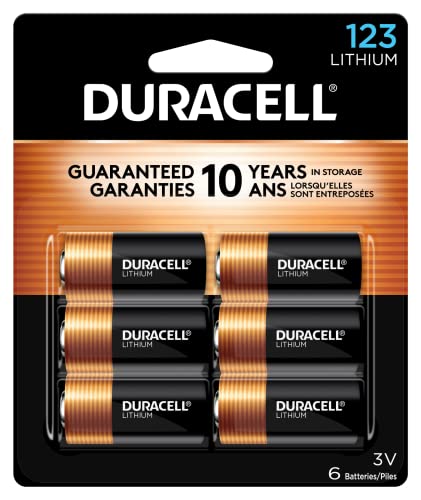
Duracell’s 10-year storage guarantee on CR123A answers the question for security cameras and tactical gear.
The Duracell CR123A 6-pack is the photo and security camera lithium battery, rated for 10 years in storage. That guarantee matters because CR123A cells often sit in a camera bag or emergency kit for years before use.
These power Ring and Nest cameras, Arlo systems, alarm sensors, and tactical flashlights , all devices where a dead battery is more than an inconvenience. Lithium chemistry gives these more energy density than alkaline in high-drain applications.
The wide temperature range makes them reliable in outdoor security cameras that see sub-freezing winters and hot summers. Law enforcement and security professionals use these for exactly that reason.
The honest limitation is price , CR123A cells cost more per unit than AA lithiums, and they are not interchangeable with CR2 or AA sizes. If your device takes CR123A, these are a safe long-life pick.
|
4
|
Amazon Basics 4-Pack CR2 Lithium Batteries, 3 Volt, Long Lasting Power, Reliable, Low Self |

A budget CR2 lithium 4-pack with low self-discharge, aimed at cameras and specialty devices that sit idle.
The Amazon Basics CR2 4-pack covers a less common size , CR2, not CR123A , used in some digital cameras, night-vision gear, and memory backup applications. Each cell holds 800mAh at 3 volts and is rated for a low self-discharge rate, meaning it keeps its charge during long idle periods.
That directly addresses the lifespan question for devices you use occasionally rather than daily. The frustration-free packaging is a small bonus.
These are not rechargeable, and Amazon Basics explicitly notes they are not interchangeable with CR123A, so verify your device’s required size first. They work in both high and low temperature environments, which suits outdoor photography and field gear.
The limitation is availability , CR2 is a niche size, so if your device takes it, stocking up makes sense. For occasional-use cameras, these last years on the shelf.
|
5
|
Energizer Ultimate Lithium AA Batteries (4 Pack), 1.5V Lithium Double A Batteries |

A smaller 4-pack of the same 25-year-storage AA lithium, ideal for testing lifespan in one or two devices.
The Energizer Ultimate Lithium AA 4-pack is the same battery as the 8-pack, just in a smaller count. It carries the same claims: world’s longest-lasting AA, 25-year storage life, and performance from -40°F to 140°F.
If you have one or two devices you want to test with lithium before committing to a larger pack, this is the low-commitment entry point. The lifespan answer is identical , years of standby, months of heavy use.
The 4-pack suits a single trail camera, a weather station, or a couple of smoke detectors. The per-battery cost is higher than the 8-pack, so if you know you like them, buy the larger count. These are leak-proof under standard use, which protects expensive electronics from corrosion.
The limitation is the same as any premium lithium AA: they cost more than alkaline and only pay off in high-drain or hard-to-reach devices.
|
6
|
12V 200Ah LiFePO4 Lithium Battery 200A BMS 2560Wh IP65 Low-Temp Cutoff | 15000 Cycles 10-Y |

A 15,000-cycle LiFePO4 pack with a 10-year rated lifespan is the rechargeable answer to the question.
The DUMFUME 12V 200Ah LiFePO4 battery is the rechargeable end of the lifespan question, and it answers with numbers: up to 15,000 cycles at 60% depth of discharge, or about a decade of daily use. It packs 2,560Wh into a single 58. 86-pound unit, replacing two 12V 100Ah batteries.
A 200A BMS guards against overcurrent, short circuits, and overheating. Low-temp cutoff stops charging below 32°F and allows discharge to -4°F, protecting cells in cold weather.
This is built for RVs, marine trolling motors, solar off-grid systems, and home backup , applications where you cycle the battery regularly and want a decade of service. It supports 4S4P connections for expansion.
The limitation is weight and upfront cost: at nearly 59 pounds, it is not a grab-and-go battery, and the initial price is far above a lead-acid equivalent. But over 15,000 cycles, the cost per cycle is far lower.
|
7
|
Energizer 2032 Batteries (4 Pack), 3V Lithium Coin Batteries |

A 4-pack of 2032 coin cells with child-safe features, for devices where lifespan is measured in years of standby.
The Energizer 2032 4-pack is the most common coin cell size, used in key fobs, motherboards, small remotes, and wearables. It carries the 3-in-1 Child Shield with Color Alert dye and bitter coating, and it performs from -22°F to 140°F.
For the lifespan question, a CR2032 in a low-drain device like a car key fob can last three to five years. In a high-drain wearable, expect closer to a year. The 4-pack gives you spares for the drawer.
These fit any device that takes a 2032, which is a wide range. The child-safety features are a genuine improvement over plain coin cells, especially in homes with young kids.
The limitation is capacity , a 2032 holds far less energy than a CR123A, so it is not suitable for cameras or flashlights. For standby electronics that need a battery every few years, this is the practical pick.
|
8
|
Energizer 2450 Lithium Coin Battery, 2 Pack | Child-Resistant Packaging; watch battery for |

A 12-year storage rating on the CR2450 makes it the long-shelf-life pick for medical and specialty devices.
The Energizer 2450 2-pack covers the CR2450 size, used in heart rate monitors, glucose monitors, keyless entry systems, and some toys. Energizer rates it to hold power for up to 12 years in storage, which is the direct answer to how long this battery lasts when unused.
It is a 3V lithium coin cell and replaces L52, DL2450, and 5029LC. Child-resistant packaging adds a safety layer for households with kids.
These suit medical devices and remotes where you want a battery that is ready whenever you grab it, even after years in a drawer. The 12-year storage rating is the standout number.
The limitation is the same as any coin cell: capacity is small, so a device that transmits frequently , like a glucose monitor with wireless sync , will drain it faster than the rating suggests. For standby use, it lasts a very long time.
|
9
|
Energizer 2032 Batteries (2 Pack), 3V Lithium Coin Batteries With 3-in-1 Child Shield |

A 2-pack of 2032 coin cells with child-safe packaging for devices where you replace the battery rarely.
The Energizer 2032 2-pack is the smaller-count version of the same coin cell, with the 3-in-1 Child Shield and the same -22°F to 140°F temperature range.
It fits the same devices , key fobs, remotes, small electronics , and answers the lifespan question the same way: years of standby in a low-drain device. If you only need one or two replacements, this pack avoids leaving extras in a drawer.
The 2-pack is the right size for a single car key fob replacement or a couple of small remotes. The child-resistant packaging is the same as the 4-pack, so safety is not compromised by the smaller count.
The limitation is cost per cell , the 4-pack is usually a better value if you have multiple devices. For a one-off replacement, though, this is convenient and safe.
|
10
|
48V Lithium Golf Cart Battery, with 18A Charger, Touch LCD Monitor, 200A BMS, 1000A(3-5) P |

A 48V golf cart battery rated for 10 years and 50 miles per charge answers the question for high-drain EV use.
The OGRPHY 48V 105Ah lithium golf cart battery is the high-capacity rechargeable answer, rated for a 10-year lifespan. It uses grade A LiFePO4 cells with UL certification and a 200A BMS that supports 10. 24kW sustained and 51. 2kW peak output. The 5.
37kWh capacity runs a 3kW motor for about 50 miles, enough for eighteen holes. It ships with an 18A charger and a touch LCD monitor, and it replaces traditional series lead-acid setups.
This is for golf cart owners and trolling motor users who want a decade of service without watering or replacing lead-acid batteries. The self-contained design simplifies installation, and the 5-year warranty backs the lifespan claim.
The limitation is upfront cost and weight , it is a substantial investment compared to lead-acid, and it requires a 48V system. Over 10 years, though, the cycle life and zero maintenance offset the price.
The picks span the full lifespan range: coin cells that sit for a decade, disposable lithiums rated for 25 years of storage, CR123A cells with a 10-year guarantee, and rechargeable LiFePO4 packs built for 15,000 cycles. The right choice depends on your device and how often you use it.
Match the battery type to the job, and the lifespan question becomes straightforward.
How To Make Any Lithium Battery Last Longer
Once you have the right battery, a few habits can push its real-world lifespan closer to the rated number. Most premature lithium battery deaths come down to heat, deep discharge, or storage mistakes , all avoidable.
- Store spare lithium batteries at room temperature, away from hot garages or direct sunlight.
- For rechargeable LiFePO4 packs, keep them at 50-60% charge if storing for months.
- Avoid charging LiFePO4 batteries below freezing unless the BMS explicitly allows it.
- Remove batteries from devices you will not use for months to stop parasitic drain.
- Use the correct charger for rechargeable lithium packs , wrong voltage damages cells permanently.
- Replace coin cells on a schedule in safety devices rather than waiting for failure.
Lifespan Killers By Battery Type
| Battery Type | Main Lifespan Killer | How To Avoid It |
|---|---|---|
| Coin cell | Parasitic drain in active devices | Remove when storing; expect shorter life in wearables |
| Disposable lithium AA | Heat above 140°F | Store indoors; avoid glove boxes in summer |
| CR123A / CR2 | Frequent high-drain use | Keep spares; match cell to device draw |
| LiFePO4 rechargeable | Deep discharge and cold charging | Use BMS cutoff; charge above freezing |
When To Replace A Lithium Battery Before It Dies
Waiting for a lithium battery to fully die is a bad strategy for critical devices. Several warning signs tell you the battery is near the end of its useful life, and acting early prevents failures at the worst moment.
Lithium batteries rarely fail instantly. They degrade gradually, and the signs show up before total failure. In disposable cells, you will notice devices behaving erratically , a camera missing triggers, a flashlight dimming faster, a remote needing a second press.
In rechargeable LiFePO4 packs, the BMS may start cutting off earlier, runtime per charge will drop, and the charger may take longer to reach full. For safety devices like smoke detectors, replace on the manufacturer’s schedule regardless of symptoms.
A lithium battery that is two years past its rated service life is a liability, not a bargain. Replacing early costs a few dollars; a failed security camera or dead smoke alarm costs far more.
Device performance drops noticeably , dimmer light, shorter runtime, missed triggers, or slower response.
The battery is past its rated service life or storage life, even if the device still works.
You see corrosion, swelling, or leakage on the battery or terminals, which means immediate replacement.
The device is critical for safety or security, and the battery has been in use for its full expected term.
A rechargeable pack no longer reaches full charge or the BMS cuts off earlier than it used to.
Matching Battery Type To Expected Lifespan
The fastest way to answer how long a lithium battery lasts is to pick the right type for your device first. The wrong chemistry in the wrong device will always underperform its rating.
Which Lithium Battery For Which Lifespan Need
| Your Need | Best Battery Type | Expected Lifespan |
|---|---|---|
| Set-and-forget safety device | Disposable lithium AA | 5-10 years in device |
| Outdoor camera or flashlight | CR123A lithium | 6 months to 2 years active |
| Small standby electronics | Coin cell (2032, 2450) | 2-10 years depending on drain |
| Daily rechargeable power | LiFePO4 pack | 8-15 years or thousands of cycles |
The table above maps the common scenarios, but the principle is simple: low-drain standby devices reward shelf life, while high-drain daily-use devices reward cycle life and energy density. A coin cell in a key fob will outlast a CR123A in a security camera by years, even though both are lithium.
A LiFePO4 pack in a golf cart will outlast both by a decade, but only if you cycle it properly and avoid deep discharges. Match the chemistry to the drain profile, and the rated lifespan becomes realistic rather than optimistic.
When in doubt, buy the battery the device manufacturer specifies , they designed the device around that chemistry’s discharge curve.
There is no single answer to how long a lithium battery lasts , it ranges from two years in a high-drain wearable to fifteen years in a properly cycled LiFePO4 pack. The type of battery and how you use it decide the number.
Today, check the devices in your home that rely on lithium batteries, note which ones are past their rated service life, and replace them before they fail. A spare pack in the drawer costs little and saves a lot of frustration.

- 10 Best Battery For Generator Ev Battery Bank Marine 2026 - October 27, 2026
- 10 Best Battery For Generator Ev Battery Bank Lto 2026 - October 27, 2026
- 10 Best Battery For Generator Ev Battery Bank Low Voltage 2026 - October 27, 2026