Carbon-Zinc Batteries: Low-Drain Uses and Alkaline Comparisons
I’ve watched shoppers grab carbon zinc batteries thinking they’re getting the same thing as alkaline, only to wonder why their digital camera dies in minutes or their remote acts sluggish.
Here’s the thing: these cells work beautifully in devices that sip power slowly , wall clocks, TV remotes, basic calculators , where their lower capacity simply isn’t a problem.
They’re built around a zinc anode and manganese dioxide cathode with an acidic paste electrolyte, which keeps costs down but means they can’t push as much current as alkaline alternatives. That’s fine when you know what you’re buying them for.
The trick is matching the chemistry to the device rather than defaulting to ‘stronger’ batteries everywhere.
How Carbon Zinc Chemistry Powers Low-Drain Devices
Carbon zinc cells work on straightforward electrochemistry that’s been around longer than most people realize , and that simplicity is exactly why they still show up in so many households.
While alkaline batteries get all the attention for their longer life and tighter voltage regulation, carbon zinc chemistry finds its place wherever devices draw very little current over extended periods.
The trade-off is clear: higher internal resistance means they struggle with anything that needs bursts of power, but for steady, low-drain applications they hold voltage reasonably well and cost a fraction of the alternatives.
Here’s how they actually make electricity: a zinc can acts as the anode while manganese dioxide forms the cathode, all suspended in either ammonium chloride or zinc chloride paste. Unlike alkaline cells that use a liquid electrolyte, this paste-based setup produces a reliable 1.
5 volts but with noticeably higher internal resistance. I’d expect voltage sag pretty quickly under heavier loads , say, in a digital camera or a motor , but low-drain devices like wall clocks barely register against that resistance. That’s why they perform fine there.
Manufacturing stays inexpensive because the materials are common and the assembly process avoids the more complex sealing needed in alkaline designs. For something like a TV remote that might sit idle for weeks between uses, paying extra for alkaline often just buys you unused capacity.
Carbon Zinc Versus Alkaline At A Glance
| Feature | Carbon Zinc | Alkaline |
|---|---|---|
| Best For | Clocks, remotes | Toys, flashlights |
| Capacity | Low | High |
| Cost Per Cell | Very Low | Moderate |
| Shelf Life | 2-3 Years | 5-10 Years |
| Leak Risk | Higher | Lower |
Carbon Zinc Options For Everyday Low-Power Needs
Below are the carbon zinc options I’d actually consider keeping stocked, chosen for how well they fit real-world usage patterns rather than just listing whatever’s cheap online. Pack sizes matter here , buying too few means constant reordering, but buying too many risks sitting on expired batteries you’ll toss anyway.
Each pick below matches a specific consumption rate, whether you’re re-powering a single remote or restocking an entire office building’s fleet of devices.
|
1
|
4pc Panasonic AA Batteries Super Heavy Duty Power Carbon Zinc Double A Battery 1.5v |

A four-pack is perfect if you only need to top off one or two devices occasionally without building up a drawer full of batteries that eventually expire.
Panasonic’s four-cell AA carbon zinc pack hits a sweet spot for people who just need immediate replacements without committing to a mountain of batteries they might forget about.
The super heavy duty label here means they’re using zinc chloride electrolyte, which holds up a bit better than basic ammonium chloride formulations.
What I appreciate is the guaranteed freshness date , nothing worse than ordering batteries online and getting cells that have already degraded on a warehouse shelf for months. At this quantity, the per-unit cost stays competitive even compared to grabbing random store-brand singles.
Panasonic’s been making batteries long enough that I’m willing to trust their consistency across such a small batch.
I’d shortlist this for travelers, college dorm rooms, or anyone who can’t reasonably store bulk quantities. These work reliably in TV remotes, basic calculators, and the kind of analog wall clocks you see in kitchens.
I would not reach for these in digital cameras or motorized toys though , voltage sag causes failures quickly there. Shelf life lags behind alkaline options, so I’d check expiration dates carefully when they arrive.
Don’t mix them with alkaline cells in the same device either; differing discharge curves cause uneven drain and raise leakage risk significantly.
|
2
|
Panasonic 5741 8PC AA Batteries Super Heavy Duty Power Carbon Zinc Double A Battery 1.5V, |

For households juggling several remotes, clocks, and sensors, an eight-pack strikes a reasonable balance between having enough on hand and not overcommitting.
This eight-pack from Panasonic lands in that middle ground between grabbing singles and ordering industrial quantities. Super heavy duty construction again means zinc chloride electrolyte, which gives slightly better discharge characteristics than standard carbon zinc grades.
The guaranteed-good dating helps ensure the cells arrive fresh rather than sitting in a warehouse for who-knows-how-long. Eight cells typically keeps three or four common household devices running simultaneously, which matches what most small households actually need.
Panasonic’s manufacturing tolerances tend to be consistent, so I’m less worried about weak cells mixed in with the batch.
I’d put this on my list for apartments or small homes with multiple remotes, wall clocks, and basic sensors scattered around. Provides enough reserve for seasonal stuff like holiday decorations without tying up money in surplus.
Cold weather performance drops noticeably though , keep that in mind if you’re using these in unheated spaces. Smoke detectors aren’t a good fit due to limited capacity and higher leak potential; I’d stick with recommended types there.
Rotate through stock every eighteen months or so to avoid corrosion damage in devices you’re not actively using.
|
3
|
PKCELL AAA Batteries 100 Pack, Triple A Batteries | 1.5V High-Performance Carbon Battery f |

Hotels, schools, and maintenance crews that constantly burn through AAA batteries in remotes, laser pointers, and small electronics need the sheer volume these provide.
PKCELL’s hundred-pack AAA carbon zinc batteries aim squarely at institutional buyers and property managers who need constant replenishment. Triple-A size covers those compact remotes, laser pointers, and small LED lights everywhere in commercial settings. The ‘high-performance’ labeling supposedly means optimized manganese dioxide ratios for steadier voltage under light loads.
Quality assurance across the full lot matters when you’re buying by the hundred , you don’t want a bad batch wiping out your entire stock. Single-use design prevents dangerous recharging attempts that compromise the zinc-can construction. Bulk pricing drops per-unit cost dramatically versus retail blister packs.
Perfect for hotels, schools, or maintenance crews servicing dozens of identical devices regularly. Ample quantity justifies dedicated battery storage organization systems. Individual cell testing is impractical here, so spot-check random samples when they arrive. Leak-resistant claims are worth verifying through periodic device inspections during routine maintenance rounds.
Shelf life runs roughly three years when stored cool and dry. Reserve these for everyday devices though , avoid deploying in mission-critical equipment where sudden failure carries real operational consequences beyond mere inconvenience.
|
4
|
Panasonic 20pc AA Batteries Super Heavy Duty Power Carbon Zinc Double A Battery 1.5v |

Twenty cells give you enough buffer for quarterly replacement cycles without forcing you into awkward half-used multipacks.
Panasonic’s twenty-pack AA carbon zinc offering bridges personal and light commercial usage tiers effectively. Super heavy duty spec indicates zinc chloride chemistry suitable for intermittent drain patterns typical in household electronics. Easy-open packaging reduces frustration during frequent access compared to heat-sealed industrial wraps.
Twenty cells sustain quarterly replacement cycles for typical family electronics inventories. Claims of long-lasting everyday usage align with real-world performance in timers and remote controls. Established brand consistency reduces the likelihood of duds within each production batch.
Appropriate for families managing gaming controllers, kitchen timers, and portable radios alongside remotes. Quantity allows keeping spare sets charged and ready without excessive capital tie-up. Performance degrades faster than alkaline in continuous-drain applications exceeding fifty hours total runtime.
Store upright in original packaging to minimize terminal contact risks during extended shelving. Check device compatibility labels before installation since some manufacturers void warranties for non-alkaline use. Solid choice for planned preventive maintenance routines rather than emergency reserves.
|
5
|
SONLUK AA Batteries 48 Pack – 1.5V Super Heavy Duty Carbon Zinc Double a Batteries, Mercur |
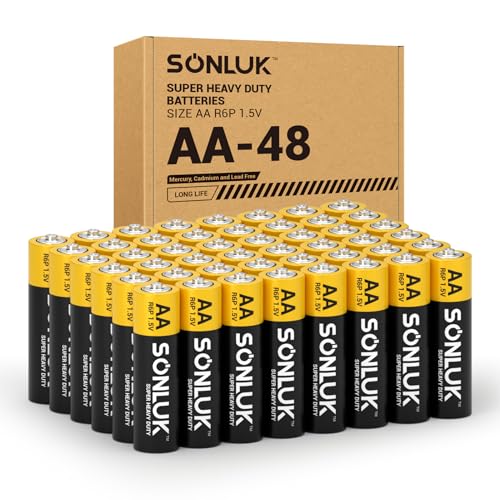
For eco-conscious households that want carbon zinc performance without heavy metals showing up in their trash.
SONLUK’s forty-eight pack AA carbon zinc batteries emphasize reduced heavy metal content alongside standard performance. Mercury-free, cadmium-free, and lead-free formulation meets stricter disposal regulations in many jurisdictions. Leak-protection engineering adds secondary sealing layers beyond basic zinc-can construction. Forty-eight cells cover semi-annual replacement needs for average suburban homes. Consistent 1.
5V output specifications undergo factory validation before shipment. Customer support commitments provide recourse for defective units within the bulk purchase.
Appeals to environmentally aware consumers unwilling to sacrifice functionality for sustainability credentials. Suitable for children’s toys where safe chemistry outweighs maximum runtime considerations. Eco-friendly composition doesn’t eliminate corrosion risk entirely; inspect devices biannually regardless. Bulk size requires organized storage to prevent accidental mixing with alkaline stocks.
Performance matches conventional carbon zinc despite green marketing; manage expectations accordingly. Ideal compromise for households transitioning toward responsible consumption without abandoning proven technology platforms.
|
6
|
16PC Panasonic AAA Batteries Super Heavy Duty Power Carbon Zinc Triple A Battery 1.5V |

Sixteen AAA cells provide targeted triple-A supply without forcing unnecessary AA purchases in mixed households.
Panasonic’s sixteen-pack AAA carbon zinc batteries address specific triple-A demand separate from double-A inventories. Heavy duty rating confirms zinc chloride electrolyte formulation for reliable low-current delivery. Guaranteed freshness dating prevents acquisition of aged stock with diminished capacity.
Sixteen cells service specialized collections like audio equipment or medical monitors requiring AAA exclusively. Carbon-zinc chemistry remains appropriate for precision instruments sensitive to alkaline voltage spikes. Compact packaging facilitates drawer storage alongside other small electronic accessories.
Essential for audiophiles maintaining wireless microphones or hearing aid testers using triple-A format. Quantity aligns with niche device counts avoiding surplus accumulation of wrong sizes. Voltage stability suffices for signal transmission but lacks headroom for amplification circuits.
Replace proactively every twelve months regardless of apparent remaining charge to prevent leakage damage. Do not substitute alkaline AAA cells temporarily as physical fit doesn’t guarantee electrical compatibility. Specialized solution for dedicated triple-A ecosystems rather than general-purpose backup supplies.
|
7
|
PKCELL AA Batteries 80 Pack, 1.5V Double A Batteries Carbon Zinc | Double AA Battery for R |

For systematic replacement programs where per-unit cost matters more than convenience.
PKCELL’s eighty-pack AA carbon zinc batteries optimize economics for systematic replacement programs. Value bulk positioning reflects significant discount versus smaller pack multiples. Leak-proof seal design incorporates additional barrier layers protecting device terminals during storage. Stable 1. 5V output undergoes strict quality control ensuring uniform performance across all eighty units.
Three-year shelf life permits forward purchasing during sales without immediate deployment pressure. Wide compatibility listing covers most standard household electronics excluding high-drain exceptions.
Designed for property managers, schools, or large families executing scheduled battery rotations. Economic advantage materializes only when entire pack gets used before expiration date. Storage conditions critically impact realized shelf life; avoid garages or attics with temperature swings. Spot-testing protocol recommended upon receipt to verify batch integrity before archiving remainder.
Single-use warning bears emphasis since attempted recharging destroys zinc cans catastrophically. Maximum savings realization requires disciplined inventory tracking preventing partial-pack abandonment.
|
8
|
Panasonic 5734 16PC AA Batteries Super Heavy Duty Power Carbon Zinc Double A Battery 1.5V, |

Sixteen AA cells hit a practical sweet spot between casual and committed stocking levels for organized households.
Panasonic’s sixteen-pack AA carbon zinc batteries hit sweet spot between casual and committed stocking levels. Super heavy duty classification ensures zinc chloride chemistry for dependable low-drain operation. Guaranteed-good dating provides confidence in received product freshness across all sixteen cells.
Black jacket color coding distinguishes carbon zinc from alkaline stocks visually preventing accidental mixing. Pack size corresponds neatly to twice-yearly replacement cycles for typical six-device households. Trusted manufacturer consistency reduces performance variance concerns inherent in budget alternatives.
Fits structured home maintenance calendars where battery changes coincide with seasonal tasks. Adequate buffer exists for unexpected failures between scheduled intervals without hoarding excess. Color differentiation aids elderly users or shared households managing multiple chemistry types safely. Capacity limitations remain unchanged despite premium branding; respect device drain specifications strictly.
Shelf degradation accelerates above room temperature; climate-controlled storage preserves full three-year potential. Practical choice for methodical planners valuing predictability over absolute lowest unit cost.
|
9
|
PKCELL AA AAA Batteries Combo Pack, Double A Triple A Batteries 120 Count | 60 AA and 60 A |

Combined AA/AAA variety pack eliminates guesswork when stocking diverse device fleets simultaneously.
PKCELL’s 120-count combo pack bundles sixty AA and sixty AAA carbon zinc batteries together. Variety approach acknowledges real-world device diversity eliminating separate SKU management complexity. Pre-charged readiness enables immediate deployment straight from shipping carton without conditioning delays. Leak-resistant engineering applies equally to both sizes maintaining consistent protection standards.
Mercury-free composition satisfies environmental policies governing workplace battery procurement. Massive count supports comprehensive facility-wide refresh projects completing in single purchasing transaction.
Streamlines procurement for offices, classrooms, or vacation rentals standardizing on carbon zinc chemistry. Balanced ratio assumes roughly equal AA/AAA consumption; adjust if your fleet skews heavily toward one size. Combined logistics simplify receiving inspection versus coordinating multiple delivery windows. Mixed storage increases misplacement risk; implement color-coded bins immediately upon unpacking.
Total volume demands dedicated shelving space inaccessible to children or pets. Optimal for organizations prioritizing administrative simplicity over granular size-specific optimization strategies.
|
10
|
4pc Panasonic AAA Batteries Super Heavy Duty Power Carbon Zinc Triple A Battery 1.5v |

Smallest practical AAA entry point for people who just want to test the waters first.
Panasonic’s four-pack AAA carbon zinc batteries provide smallest practical entry point for triple-A carbon zinc evaluation. Heavy duty specification maintains zinc chloride electrolyte consistency across Panasonic’s entire range. Guaranteed freshness dating applies identically to small packs preventing stale inventory issues.
Four cells enable testing carbon zinc suitability in one device before bulk adoption. Compact footprint allows glovebox or desk drawer emergency storage indefinitely. Brand recognition assures baseline quality even at minimal purchase threshold.
Useful for verifying device compatibility before investing in larger AAA carbon zinc quantities. Serves as emergency backup for critical single-device situations like presentation clickers. Limited quantity discourages inappropriate high-drain experimentation that could damage sensitive electronics. Shelf life monitoring becomes easier with fewer cells rotating through active storage.
Not economical for ongoing use; purely transitional or contingency positioning. Smart first step for skeptics wanting hands-on validation before wholesale chemistry switching decisions.
These carbon zinc options span emergency four-packs through institutional hundreds, covering virtually every consumption pattern you might actually encounter. Match pack size to verified annual usage rather than aspirational stocking goals. Remember that lower upfront cost only realizes value when cells get used before expiration.
Proper storage and rotation discipline matter more than brand selection for long-term satisfaction with this chemistry type.
Preventing Leakage Damage In Stored Electronics
Carbon zinc batteries carry higher leakage risk than alkaline alternatives due to zinc-can anode construction , something I’d address proactively rather than deal with after the fact.
- Remove batteries from unused devices after thirty days of inactivity to prevent corrosion buildup.
- Store spare cells upright in original packaging away from metal objects causing short circuits.
- Inspect installed batteries quarterly for white crystalline deposits indicating early-stage leakage onset.
- Never mix carbon zinc with alkaline cells as voltage differences accelerate corrosion in both.
- Clean corroded contacts immediately with vinegar-dampened cotton swab before inserting fresh batteries.
- Avoid storing batteries in extreme temperatures which accelerate chemical degradation and seal failure.
Zinc-can anodes gradually thin during discharge creating microscopic breach points for electrolyte escape. Ammonium chloride electrolytes are particularly aggressive toward copper contacts and steel springs. Devices left unattended for months accumulate invisible corrosion films increasing resistance permanently.
Even sealed carbon zinc cells vent hydrogen gas during normal operation requiring adequate ventilation. Storing batteries inside devices compounds risk since leaked electrolyte wicks into circuit boards irreversibly. Prevention costs nothing while remediation often exceeds device replacement value.
Establish calendar reminders tied to seasonal events ensuring consistent inspection habits form automatically over time.
Matching Battery Chemistry To Actual Device Drain
Misapplying carbon zinc batteries to high-drain devices wastes money through premature failure and potential damage. Conversely, overpaying for alkaline in low-drain applications just throws resources away unnecessarily.
Continuous Micro-Load Devices
Wall clocks, smoke detector backup circuits, and basic remote controls draw microamps continuously for months. These devices operate well below carbon zinc’s internal resistance threshold maximizing usable capacity. Monthly runtime exceeds five hundred hours yet total energy consumed remains minimal.
Carbon zinc excels here because self-discharge losses dominate over actual load consumption. Alkaline premium buys no meaningful advantage when parasitic drain eclipses functional demand. Verify device manuals specify acceptable carbon zinc use before installation to preserve warranty coverage.
Intermittent Pulse-Load Gadgets
Digital thermometers, bathroom scales, and garage door openers draw brief milliamp pulses then sleep completely. Carbon zinc handles these profiles adequately provided pulse duration stays under two seconds. Longer activations cause voltage collapse triggering false low-battery warnings prematurely.
Test new devices with carbon zinc first; upgrade to alkaline only if malfunction occurs. Many modern gadgets include voltage regulation compensating for carbon zinc limitations automatically. Manufacturer specifications sometimes conservatively recommend alkaline despite successful carbon zinc compatibility in practice.
Device Drain Classification Reference
| Device Type | Typical Drain | Carbon Zinc Suitable? |
|---|---|---|
| Analog Clock | <10 µA | Yes, Ideal |
| TV Remote | 5-20 µA | Yes, Good |
| LED Flashlight | 100-500 mA | No, Poor |
| Digital Camera | 200-800 mA | No, Avoid |
| Wireless Mouse | 1-5 mA | Marginal |
Carbon zinc batteries are affordable primary cells best suited for low-drain devices like clocks and remotes where their lower capacity matches actual demand without waste. Start by auditing your household devices to identify true low-drain candidates using the classification table above.
Purchase only enough carbon zinc cells to cover six months of verified usage for those specific devices. This prevents expiration waste while validating whether the chemistry truly meets your needs before committing to bulk quantities. Small test packs make this validation risk-free.

- Marine Chargers and Backup Batteries: 9 Options Compared (2026) - October 27, 2026
- LTO Cells vs. SLA Generator Batteries: 5 Options Compared (2026) - October 27, 2026
- 12V/24V Backup Batteries and the EcoFlow DELTA Pro 3 (2026) - October 27, 2026