How Long Should A Boat Battery Last?
Nothing kills a day on the water faster than a dead battery. If you’re out past the breakwater or drifting a quiet cove, losing power means losing your trolling motor, your fish finder, and sometimes your way back to the ramp.
How long your boat battery actually lasts comes down to its chemistry, how hard you run it, and whether you remember to plug it in during the off-season.
I put together this breakdown to look at what really drives battery lifespan and to shortlist ten options, from basic AGM units to long-haul lithium setups, that keep your electronics running trip after trip.
Factors Affecting Your Boat Battery Lifespan
A marine battery doesn’t just randomly quit one morning. Its lifespan is usually dictated by where you store it, how deep you drain it, and what kind of charger you hook it up to. Understanding those variables makes it much easier to predict when you’ll need a replacement.
Lifespan Comparison by Chemistry
| Battery Type | Typical Lifespan | Cycle Count |
|---|---|---|
| Flooded Lead-Acid | 2-3 Years | 300-500 |
| AGM Lead-Acid | 3-5 Years | 500-800 |
| LiFePO4 Lithium | 10+ Years | 3000-15000 |
Common Causes of Early Failure
Even a premium battery will die early if you treat it poorly. Spotting the common risks is the easiest way to stretch the time between replacements.
- Leaving batteries partially discharged for long periods of time.
- Exposing terminals to saltwater without regular cleaning and rinsing.
- Charging with a charger that exceeds the recommended amperage.
- Storing batteries in extreme heat or freezing temperatures.
- Allowing deep discharges to occur on standard lead-acid units.
Temperature swings are brutal on marine batteries. Extreme heat speeds up internal corrosion and bakes the electrolyte dry, while freezing weather spikes internal resistance and temporarily chokes your capacity. Lithium chemistries handle these shifts better than lead-acid, but they still have limits, especially when charging in the cold.
I’d always double-check that your onboard charger matches your battery’s specific chemistry, because mismatched voltage profiles cause permanent damage fast. And if you’re running traditional flooded or AGM units, make sure the battery box has enough ventilation so gases don’t build up under the console.
Picks To Extend Your Boat Battery Life
The chemistry you pick dictates your maintenance routine for the next several years. I’ve shortlisted ten options here, ranging from straightforward AGM workhorses to high-end LiFePO4 setups built for heavy cycling.
My read is that each one addresses a different piece of the boat battery lifespan puzzle, depending on how you use your vessel.
|
1
|
Newport 12V 50Ah Deep Cycle AGM Marine Battery – Rechargeable Sealed Lead Acid Battery for |

The Newport 50Ah AGM provides steady power for small watercraft needing reliable deep cycle performance.
If you’re outfitting a kayak, a jon boat, or a small skiff, the Newport 12V 50Ah Deep Cycle AGM Marine Battery is about as straightforward as it gets.
It’s a sealed lead-acid unit designed to push consistent power to a trolling motor or a few basic 12V accessories without demanding constant attention.
Because the AGM construction traps the electrolyte in glass mats, you don’t have to worry about topping off fluids or dealing with spills when the water gets choppy.
I would point anglers toward this one if they need something compact and easy to haul around. The sealed case means you can tip it into a tight storage hatch without worrying about leaks.
Just keep in mind that 50Ah won’t carry a large center console or a heavy draw of electronics for very long. It does its best work as a dedicated power source for a single trolling motor or a small cluster of lights and pumps.
|
2
|
Interstate Batteries Marine/RV Battery 12V 100Ah 925CCA 1110CA Group 31 AGM (31-AGM5) |
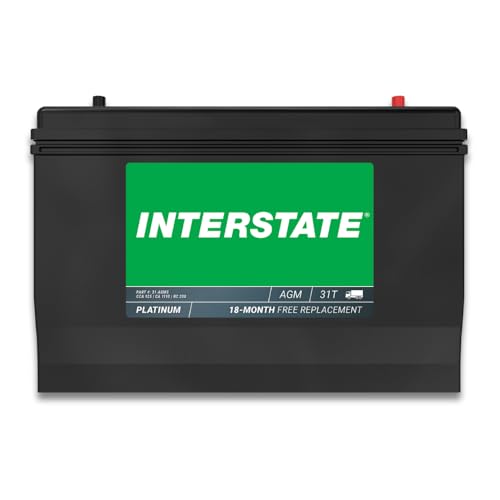
Interstate’s Group 31 AGM offers much longer service life than conventional flooded batteries.
The Interstate Batteries Marine/RV 12V 100Ah Group 31 AGM is built for people who run their boats hard. It uses thick pure-lead plates that tolerate continuous deep discharges far better than standard flooded designs.
That means you can power your windlass, stereo, depth finder, and trolling motor all day, recharge it, and do it again without watching the capacity degrade rapidly. It pulls double duty as both a cranking battery and a deep-cycle reserve.
I’d shortlist this for boaters who want serious cranking amps (925 CCA) alongside genuine deep-cycle endurance. Interstate claims this setup lasts two to three times longer than typical alloyed lead or flooded batteries, which aligns with what you’d expect from premium AGM tech.
The trade-off is weight, it’s a heavy block compared to modern lithium alternatives. But if you trust proven lead-acid architecture and need dual-purpose reliability, this is a strong anchor for your electrical system.
|
3
|
36V 100Ah Lithium Golf Cart Battery, 3 Pack 12V 100Ah LiFePO4 Battery | Built-in 100A BMS, |

This 3-pack of lithium batteries offers a massive 10-year lifespan for 36V systems.
When you’re wiring a 36V trolling motor, the DJLBERMPW 36V 100Ah pack (which is essentially three 12V 100Ah LiFePO4 batteries bundled together) changes the math on longevity.
LiFePO4 chemistry is famous for cycle life, and this setup pushes up to 15,000 cycles if you keep your depth of discharge around 60%.
A 100A BMS sits inside to cut power before you over-discharge, overheat, or short-circuit the cells, and there’s a low-temperature cutoff to protect the battery if you launch early on a freezing morning.
My read is that this package is strictly for users building out a 36V architecture for heavy-duty trolling motors or RV solar banks. The energy density means you get 3840Wh without the back-breaking weight of three lead-acid equivalents.
You absolutely need a charger designed for lithium profiles to hit that advertised 10-year lifespan, though. Don’t buy this expecting to drop a single 12V brick into a standard starting battery tray, it’s meant to be run as a complete system.
|
4
|
UPLUS BCI Group 24M Dual Purpose AGM Marine Battery 12V 79AH 550CCA | Starting and Deep Cy |

The UPLUS Group 24M combines starting and deep cycle power to save space.
Space in a boat is always at a premium, which is why I like the approach UPLUS takes with the BCI Group 24M Dual Purpose AGM. Instead of cramming in a separate starter battery and a house bank, this 12V 79Ah unit handles both jobs.
It delivers 550 CCA, which is enough to turn over outboards up to 350HP, while still offering 150 minutes of reserve capacity for your electronics once the engine is running.
If you’re trying to simplify your wiring diagram and shave off some weight, this is worth a look. The AGM build naturally resists vibration, so the pounding from trailer rides or rough chop won’t shake the internal plates apart as quickly as a flooded battery.
I wouldn’t expect it to match the extreme cycle counts of a dedicated lithium deep-cycle cell, but for weekend cruisers who want one reliable battery to do everything, it clears up a lot of room in the bilge.
|
5
|
12.8V 100Ah LiFePO4 Battery With Low Temp Protection,1280Wh 15000+ Deep Cycles, Lightweigh |

The BUKNUWO lithium battery provides real-time monitoring via a dedicated smartphone app.
Guessing how much juice you have left is stressful, which is exactly what the BUKNUWO 12. 8V 100Ah LiFePO4 tries to eliminate. It packs Bluetooth 5. 0 inside, letting you pull up state of charge, voltage, current, and temperature on your phone from up to 33 feet away.
At just 22 pounds, it’s roughly two-thirds lighter than a comparable lead-acid battery, yet it lets you actually use 95% of its 1280Wh capacity, whereas lead-acid forces you to stop at 50% to avoid damage.
I would recommend this to anyone who gets anxious about running out of power mid-trip. The 100A BMS handles the safety side, cutting off during thermal extremes or overcurrent events, while the app handles the peace of mind.
Like most lithium iron phosphate units, it supports thousands of cycles (up to 15,000 at a 60% depth of discharge). Just remember that if the boat sits for the winter, you should top it off every three to five months to keep the cells balanced and healthy.
|
6
|
GOKWH 12V 100Ah LiFePO4 Marine Battery with Bluetooth APP, 1280Wh Deep Cycle Trolling Moto |

GOKWH provides stable deep-cycle power with high energy density for fishing electronics.
Running a full spread of fishing electronics drains power fast, so the GOKWH 12V 100Ah LiFePO4 focuses heavily on stable output. It delivers 1280Wh using EV-grade cells, which means higher energy density than standard AGM blocks.
In fact, it weighs about a third of an equivalent 100Ah AGM and takes up 15% less space, while actually providing more usable energy. It also features Bluetooth monitoring so you can check your voltage and current without leaving the casting deck.
For tournament anglers or weekend fishermen running livewells, graph units, and trolling motors simultaneously, this is a highly efficient upgrade. The built-in BMS includes a low-temperature cut-off, which I consider essential if you fish in colder climates where charging lithium below freezing can permanently ruin the cells.
It also supports expansion up to 51. 2V if your power needs grow, making it a flexible foundation for a larger marine electrical system.
|
7
|
12V 100Ah LiFePO4 Battery, Lithium Battery Group 31 Smart 100A BMS, 15000+ Deep Cycles 10- |

This Group 31 lithium battery offers a massive 15,000 deep cycle capacity.
If you’re looking to rip out an old Group 31 lead-acid battery and drop in something vastly superior, this 12V 100Ah LiFePO4 model is built for exactly that swap. The core advantage here is the sheer cycle life, up to 15,000 deep cycles at a 60% depth of discharge.
LiFePO4 chemistry is inherently stable, meaning you don’t have to worry about the thermal runaway risks associated with older lithium-ion types, which matters when you’re bouncing across saltwater swells.
I see this as a direct answer for boaters tired of replacing heavy lead-acid batteries every few seasons. Because lithium maintains a flatter voltage curve, your electronics won’t dim or slow down as the battery drains, a common frustration with lead-acid.
You can also wire multiple units in parallel if you need a bigger house bank. It’s a straightforward, lightweight upgrade that fundamentally changes how much usable energy you get out of a standard Group 31 footprint.
|
8
|
Redodo 12V 100Ah Marine LiFePO4 Battery, Group 31, for Trolling Motor | 100A BMS, 4000+ De |

Redodo’s Group 31 lithium battery allows for 50% faster charging than lead-acid.
Turnaround time matters if you fish multiple days in a row, and the Redodo 12V 100Ah Marine LiFePO4 is engineered to accept a charge significantly faster than traditional lead-acid batteries.
Housed in a Group 31 case with an IP65 waterproof rating, it’s built to shrug off the spray and humidity that ruin lesser electronics. The 100A BMS keeps the 1280Wh output safe during heavy draws, making it a dedicated deep-cycle powerhouse for trolling motors and yacht house banks.
My read is that this battery shines for users who need quick dock charges between trips. Lead-acid batteries taper off painfully slow during the last 20% of charging; lithium doesn’t suffer from that bottleneck, getting you back to 100% much faster.
Keep in mind this is strictly a deep-cycle unit, I wouldn’t use it to crank a main outboard engine. But for keeping your accessories humming all day and recharging quickly overnight, it does the job efficiently.
|
9
|
HumsiENK 12V 160Ah (150Ah) Plus LiFePO4 Lithium Battery, 150A BMS 2048Wh | Trolling Motors |
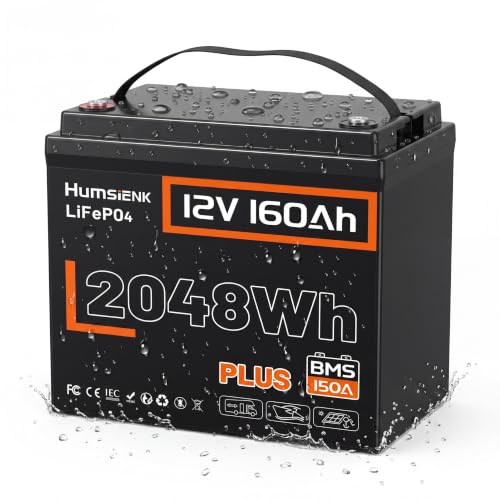
The HumsiENK 160Ah battery provides extra capacity for high-power marine loads.
Standard 100Ah batteries fall short when you start adding refrigerators, inverters, or AC units to the mix. The HumsiENK 12V 160Ah Plus LiFePO4 steps into that gap by delivering 2048Wh of energy.
To handle that extra load safely, it upgrades the protection to a 150A BMS, allowing you to pull more continuous current without tripping the safety shutoff. It’s essentially 60% more capacity packed into a similar footprint.
I would point liveaboard boaters or anyone running extended off-grid setups toward this one. When you’re anchoring out for days, that extra 60Ah makes the difference between running your fridge comfortably and rationing power.
The waterproof casing holds up well in harsh marine environments, but you’ll definitely need a charger capable of pushing enough current to fill a 160Ah bank in a reasonable timeframe. It’s a heavy hitter for serious electrical demands.
|
10
|
GRENERPOWER 48V(51.2V)25Ah Lithium LiFePO4 Battery For RV/Boat/Solar System | Group 24 Bat |

The GRENERPOWER 48V battery is a specialized solution for high-voltage systems.
Most recreational boats run 12V or 36V architectures, but specialized vessels and advanced solar setups often require 48V. The GRENERPOWER 48V 25Ah LiFePO4 fits that exact niche. Built in a compact Group 24 size, it houses a 50A BMS capable of supporting a 2560W power output.
This isn’t a general-purpose marine battery; it’s a targeted energy storage block designed for high-voltage stability and long-term cycling.
Don’t buy this expecting to drop it into a standard 12V bass boat. I’d only shortlist this if you’re actively building or maintaining a 48V marine or RV platform. Where it excels is cycle life, pushing up to 15,000 cycles thanks to the LiFePO4 chemistry.
By stepping up to 48V, you can run thinner gauge wiring for high-wattage appliances, which saves weight and reduces voltage drop over long cable runs. It’s a specialized tool for a specific electrical architecture.
Picking between a rugged AGM and a high-tech LiFePO4 cell comes down to how you use your boat and how much you want to spend upfront versus over time. I’ve tried to include options here for every setup, from small kayaks to liveaboard yachts.
Matching the battery’s cycle life and discharge limits to your actual daily habits is the real secret to maximizing your boat battery lifespan.
Maintaining Your Battery for Maximum Longevity
Buying the right battery is only half the equation. What you do once it’s wired into your boat determines whether it hits its maximum lifespan or dies three years early.
Clean all terminal connections regularly to prevent saltwater corrosion buildup.
Check voltage levels frequently if you are using lead-acid batteries.
Use a high-quality charger specifically designed for your battery chemistry.
Store batteries in a cool, dry place when the boat is inactive.
Ensure all connections are tight to prevent electrical arcing or heat.
How you charge your battery matters more than almost anything else. If you’re running lead-acid or AGM, never leave it sitting in a discharged state after a weekend trip; sulfation starts immediately and permanently eats away your capacity.
For lithium, make sure your charger profile is set correctly and respect the low-temperature cutoffs, forcing current into a freezing LiFePO4 cell causes irreversible plating. I’d also suggest pulling the battery box lid off twice a year to check your terminals and wiring.
A loose connection or a bit of green corrosion creates resistance, generates heat, and tricks your charger into shutting off early. Catching those small issues is usually what separates a battery that lasts three years from one that lasts ten.
When to Replace Your Boat Battery
Batteries rarely die without warning. If you pay attention to how your electronics behave, you can usually spot a failing cell before it leaves you stranded at the ramp.
Reduced Capacity
The earliest tell is a sudden drop in runtime. If your trolling motor used to push you through six hours of fishing but now taps out by noon, the internal chemistry is degrading. The battery simply can’t hold its rated amp-hours anymore.
Once you notice that kind of shrinkage, I’d start shopping for a replacement rather than risking a long paddle home.
Slow Charging or Voltage Drops
Another red flag is sluggish charging. If your battery takes noticeably longer to reach full capacity on a charger you know works fine, internal resistance is climbing. You might also see your voltage sag drastically the second you turn on a heavy load like a windlass or a stereo amplifier.
Those dips mean the chemical structure inside is breaking down. Swapping it out proactively beats waiting for it to fail completely while you’re navigating a busy channel.
Replacement Indicators
| Symptom | Likely Cause | Urgency |
|---|---|---|
| Rapid discharge | Capacity loss | High |
| Terminal corrosion | Poor contact | Medium |
| Swollen casing | Internal damage | Critical |
Realistically, a boat battery will last anywhere from three to ten years, depending entirely on its chemistry and your charging habits. Lead-acid and AGM units sit on the shorter end of that spectrum, while LiFePO4 models routinely push toward a decade or more if you treat them right.
The easiest way to extend your boat battery lifespan is to avoid draining it to zero, keep the terminals scrubbed clean, and store it properly during the off-season.
If you’re currently nursing a heavy, aging lead-acid block that struggles to hold a charge past lunch, my advice is to look closely at the lithium options above. The upfront cost is higher, but the math on cycle life usually pays for itself within a few seasons.

- 10 Best Battery For Generator Ev Battery Bank Marine 2026 - October 27, 2026
- 10 Best Battery For Generator Ev Battery Bank Lto 2026 - October 27, 2026
- 10 Best Battery For Generator Ev Battery Bank Low Voltage 2026 - October 27, 2026