How Long Should A Deep Cycle Battery Last?
A deep cycle battery rarely fails because a calendar date arrived. It usually gives up when repeated deep drains, heat, and sloppy charging eat away at the plates or cells. In my experience tracking these banks, lead-acid setups often fade within three to six years of hard use.
Lithium iron phosphate packs, however, can stretch past a decade if you keep the depth of discharge moderate. The number you should actually expect depends heavily on chemistry, how deep you drain it, and your recharging habits.
I’ll break down realistic service life below, then look at specific batteries whose cycle claims actually match those ranges.
How Long Deep Cycle Batteries Last
Most owners just want a year count, not a chemistry lecture. The honest answer splits by type. Flooded lead-acid and AGM deep cycle batteries usually deliver three to seven years. Lithium iron phosphate often reaches eight to fifteen years. But cycle ratings matter more than the sticker year.
A battery cycled daily dies sooner than one used only on weekends. Heat, storage state, and charge voltage can move that window by years.
Typical Service Life By Chemistry
| Chemistry | Years In Service | Cycle Range | What Shortens It |
|---|---|---|---|
| Flooded lead-acid | 3 to 5 years | 200 to 500 cycles | Deep drains and heat |
| AGM deep cycle | 4 to 7 years | 400 to 800 cycles | Chronic undercharge |
| LiFePO4 lithium | 8 to 15 years | 3000 to 15000 cycles | Cold charging damage |
Depth of discharge decides whether a deep cycle battery lasts its advertised years. Lead-acid chemistry hates living below half charge; each trip under 50 percent removes a chunk of remaining cycles. AGM handles deeper drains better than flooded cells, yet still ages fast if you park it empty.
Lithium iron phosphate is built for deep use. Many makers rate 4,000 cycles at full discharge and far more at 60 or 80 percent. That gap explains why one 100Ah bank dies in four summers while another still holds voltage after ten.
Count cycles against how you actually use the bank. A weekend camper might see 40 deep cycles a year, while a daily solar house bank can see 300. The same cell chemistry then lasts a decade in one case and three years in the other.
Temperature stacks on top: heat above 90 degrees speeds plate corrosion in lead-acid and accelerates calendar aging in lithium.
What A Lifespan Claim Really Means
Marketing numbers look huge until you read the depth of discharge attached to them. A claim of 15,000 cycles at 60 percent depth is not the same as 15,000 full drains. Years of service also assume proper charge voltage and storage above freezing for lithium charge events.
Use the data above as a sanity check before you trust a label.
- Match the cycle count to the stated depth of discharge, not the biggest number on the box.
- Treat calendar years as a ceiling that heat, storage, and daily cycling can cut in half.
- Expect flooded and AGM deep cycle batteries to need replacement inside a decade of regular use.
- Expect quality LiFePO4 to outlast lead-acid several times if cold charging is blocked.
- Ignore cycle math that assumes you never go below 80 percent if you actually run to empty.
- Ask whether the rating is at 60, 80, or 100 percent depth before comparing two batteries.
A warranty is not the same thing as how long a deep cycle battery should last. Many AGM marine batteries carry a one to three year replacement window, even though the plates can work longer with gentle use.
Lithium sellers often print ten years because the cells can reach that if you stay inside voltage and temperature limits. Real life trims both numbers. Leaving an AGM at partial charge for months sulfates the plates. Charging lithium below freezing without a cutoff plates lithium metal and kills capacity.
Vibration on a boat or cart loosens connections and looks like a dying battery when the cells are fine. My practical target is simple: plan on four to six years for a worked AGM deep cycle battery, and about ten years for a LiFePO4 bank.
That assumes a few hundred cycles a year and no charging in the cold. Replace sooner if capacity falls under 80 percent of what you need.
Deep Cycle Batteries That Should Last
The batteries below show how lifespan claims actually look on the shelf. Lithium Group 31 packs advertise 8,000 to 15,000 cycles and about ten years. AGM options from Interstate trade huge cycle counts for cranking power and a shorter calendar life.
A 35Ah pack and a 160Ah pack age on different schedules; they do not deliver the same years of usable energy. Cycle ratings can look similar and still mislead, so read each claim against your drain depth.
|
1
|
12V 100Ah LiFePO4 Lithium Battery Group 31 Deep Cycle for RV Trolling Motor | 100A BMS, 12 |

Fifteen thousand cycles at 60 percent depth puts a ten-year deep cycle life in reach.
This 12V 100Ah LiFePO4 is a Group 31 drop-in rated at 1280Wh with a 100A smart BMS. The maker quotes 15,000-plus cycles at 60 percent depth of discharge, over 8,000 cycles at 80 percent, and a 10-year service life.
That is the long end of what a deep cycle battery should last under moderate daily use. The low-temperature cutoff blocks charging below 32°F, which protects calendar life in winter. It weighs about 24 pounds in a Group 31 box.
I would use it for an RV house bank, trolling motor, or small solar storage. Choose it when you want the bank to outlast the vehicle. Series and parallel wiring up to 4S4P can scale toward larger off-grid systems.
Voltage stays flatter than lead-acid as the pack drains, so runtime feels longer near the end. It is an energy battery, and cold charging still depends on that cutoff working. A bad charger set for lead-acid voltages can still shorten the ten-year target.
|
2
|
Interstate Batteries Marine/RV Battery 12V 100Ah 925CCA 1110CA Group 31 AGM (31-AGM5) |
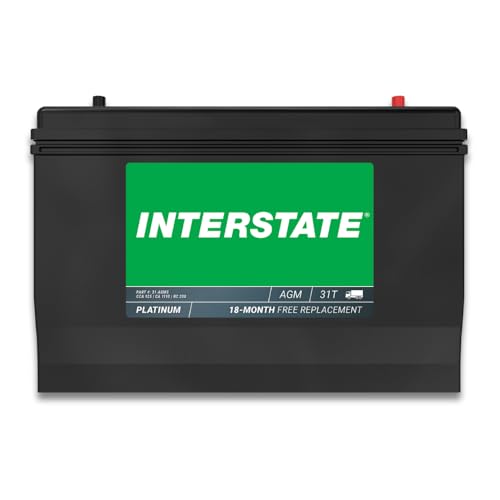
Thick-plate AGM design targets multi-year marine deep cycling, not a ten-year lithium span.
Interstate’s 31-AGM5 is a 12V 100Ah Group 31 AGM built as a marine and RV dual-purpose battery. It lists 925 cold-cranking amps, so it can start loads and then deep cycle accessories.
Interstate says service life runs about three times a conventional flooded battery and about twice an alloyed lead AGM. That points to roughly four to seven years of mixed boat use. It is not a 10,000-cycle lithium claim; thick plates are meant to survive repeated discharge and recharge.
This fits a boat that needs cranking plus house loads, or an RV that wants one Group 31 bank. Separate start and deep cycle batteries are optional here. Expect fewer total cycles than the LiFePO4 packs in this list. Sulfation still punishes long storage at partial charge.
Interstate notes it is not for automotive or mobility devices. The honest limit is calendar life; even with thick plates, hard heat use will not match a ten-year lithium rating.
|
3
|
Interstate Batteries 12V 35Ah SLA AGM Deep Cycle Battery Insert Terminal |

A 35Ah mobility AGM should last through heavy wheelchair cycles, not a decade.
The DCM0035 is a 12V 35Ah AGM deep cycle in a U1 or GT9L size with insert terminals. Interstate built it for wheelchairs, scooters, and similar deep-discharge gear. The brand calls out longer life and more cycles under heavy demand, backing this model with a 12-month performance warranty.
That warranty is the clue for how long it should last in hard daily use. I would plan on one to three years of mobility service, longer if cycles stay shallow.
Daily wheelchair use can mean a deep cycle almost every day, so this small AGM reaches end of life faster than a weekend trolling battery. Spill-proof AGM construction removes watering, which helps lifespan if the charger is correct. Size is 7. 68 by 5. 16 by 6.
42 inches, so it only replaces U1 mobility batteries. At 35Ah it stores far less than a 100Ah Group 31. A 12-month warranty signals a shorter service window than the lithium packs.
|
4
|
12V 100Ah LiFePO4 Lithium Battery, Group 31 Built-in 100A Smart BMS, 15000+ Deep Cycles Li |

The same 8,000-cycle at 80 percent figure supports about a ten-year deep cycle span.
This listing is another 12V 100Ah LiFePO4 in Group 31 size. It is again rated 1280Wh with a 100A BMS and low-temperature charge cutoff. The lifespan language matches the first lithium pack: 15,000-plus cycles at 60 percent depth, over 8,000 at 80 percent, and a 10-year service life.
Those numbers describe moderate daily cycling across a decade. Charge time is about five hours on a 14. 6V 20A lithium charger, and weight stays near 24 pounds.
Treat this as a twin to the first Group 31 lithium. Shop it when you want the same lifespan class. It suits RV, marine trolling, and off-grid storage. You can series or parallel up to four by four. Flat voltage to empty is the practical gain over AGM.
Nothing in the feature list shows a longer cycle life than the other 100Ah units, so expect the same years, not a bonus decade.
|
5
|
12V 100Ah LiFePO4 Battery Group 31 Deep Cycle Lithium Battery for RV Marine | 100A BMS, 12 |

IP65 sealing plus a ten-year rating suits outdoor banks that must keep cycling.
This 12V 100Ah Group 31 LiFePO4 lists a 100A BMS, 1280Wh, and expansion to 4S or 4P. The title adds an IP65 claim and a 10-year lifespan beside 15,000-plus cycles. Dimensions are about 12. 9 by 6. 69 by 8.
5 inches at 24 pounds, making it 60 percent lighter than a comparable lead-acid. Charging is specified from 0 to 45°C and discharge from -20 to 60°C. That window helps a deep cycle battery reach a long outdoor life.
Pick this version when the bank lives in a boat locker, RV bay, or dusty shed. The listing says lead-acid loses life below 50 percent depth, while this lithium does not. You should still avoid sitting at empty for weeks. A 14.
6V 20A charger is listed at about five hours, or use solar with a controller. This feature list does not split 60 and 80 percent cycle counts clearly, so verify that split before you bank on 15,000 cycles.
|
6
|
HumsiENK 12V 160Ah (150Ah) Plus LiFePO4 Lithium Battery, 150A BMS 2048Wh | Trolling Motors |
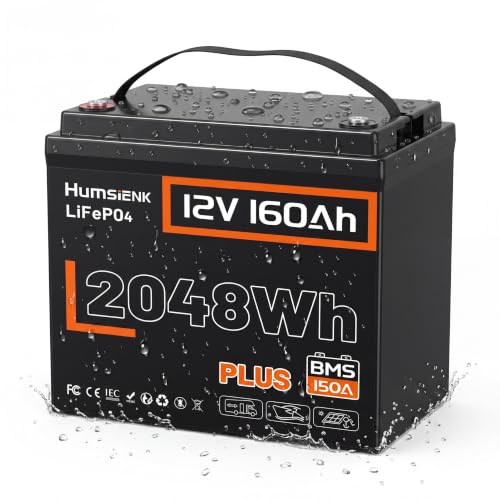
Six thousand cycles at 80 percent depth on 2048Wh stretches daily-use years.
HumsiENK’s 12V 160Ah LiFePO4 is the capacity step up, listed at 2048Wh with a 150A BMS. Continuous output is about 1920 watts. The lifespan line is 6,000-plus cycles at 80 percent depth and more than 10 years. The title also mentions 15,000-plus deep cycles.
Higher watt-hours can mean fewer parallel batteries for the same daily drain, simplifying a bank you expect to last a decade. It weighs 41. 23 pounds, with a size of about 10. 07 by 7. 66 by 9. 99 inches.
This fits RV refrigerators, solar storage, and trolling setups that outgrow a 100Ah battery. IP65 and discharge down to -4°F support outdoor installs, and low-temperature protection is called out as well. Expansion to 4S4P targets large storage, up to a stated 32. 76kWh.
The honest limit is cycle transparency: 6,000 cycles at 80 percent is a strong, specific number, while the 15,000 figure is less clearly tied to a depth of discharge. Budget the decade on the 80 percent rating.
|
7
|
CHITOLI 12V 100Ah TM LiFePO4 Battery, Built in100A BMS, 4000-15000 Deep Cycles, 10-year Li |

Cycle counts at 100, 80, and 60 percent depth make the ten-year claim checkable.
CHITOLI’s 12V 100Ah TM is a Group 24 LiFePO4 at about 22. 57 pounds, so it is not a Group 31 case. Cycles are listed as 4,000-plus at full depth, 6,000 at 80 percent, and 15,000 at 60 percent, alongside a 10-year life claim.
That spread shows how deep cycle life should be read: full drains still last thousands of cycles. A 14. 6V 20A charge takes about five hours. It is for storage, not engine starting.
Group 24 fit matters if your box is the smaller size used in many RVs and boats. A smart BMS covers overcharge, over-discharge, over-current, and short circuit. CHITOLI states a 5-year warranty beside the 10-year life claim, and that gap is worth noticing. Warranty years are not service years.
Buy it for the cycle table, but treat year ten as conditional on gentle depth and correct charging.
|
8
|
48V 100Ah Lithium Golf Cart Battery, 4 Pack 12V 100Ah LiFePO4 Solar Battery | Built-in 100 |

Four 12V packs in series target a 48V cart bank rated up to ten years.
This is a four-pack of 12V 100Ah LiFePO4 batteries sold as a 48V 100Ah golf cart bank. Combined energy is 5120Wh. Each unit has a 100A BMS and low-temperature cutoff.
Cycle life runs about 4,000 times at full depth up to 15,000 at 60 percent, with service life listed up to 10 years. The title also says 8,000 deep cycles, so check the depth note. For a cart used most weekends, a decade is a fair planning figure.
The pack targets Club Car style carts, RV banks, marine use, and off-grid storage. Series the four batteries and balance them before hard use. The maker suggests a 14. 6V 20A charger per 12V unit.
A storage note says charge every three to five months if the bank sits unused; that habit protects how long the bank should last. Four separate batteries can drift, and the weakest unit ages first. IP ratings disagree between IP65 and IP66, so ignore sealing as the life story.
|
9
|
ExpertPower 12V 35Ah Lithium LiFePO4 Deep Cycle Rechargeable Battery | 2500-7000 Life Cycl |

A compact 35Ah LiFePO4 still claims 2,500 to 7,000 cycles and ten years.
ExpertPower’s 12V 35Ah LiFePO4 targets scooters, marine gear, and light solar. The brand cites 4,000 to 7,000 cycles, while the title says 2,500 to 7,000. Both sit beside a 10-year expected lifetime. That far outlasts a 12-month AGM of the same amp-hour class.
A built-in BMS covers overcharge, deep discharge, heat, cold, and shorts. Four in series reach 48V at 35Ah, and four in parallel reach 12V at 140Ah.
Choose this when space is tight but you still want lithium calendar life. It can replace a 35Ah AGM you now swap every year or two. Lower capacity means you hit deep discharge sooner on a large load. The published range of 2,500 to 7,000 cycles already admits that spread.
At 35Ah you hold about a third of a 100Ah pack, so a heavy trolling motor will not see ten years unless daily drain stays modest.
Lithium entries cluster around a ten-year claim, with cycle math that only holds if depth of discharge matches the label. The HumsiENK 160Ah and the four-pack 48V bank buy more watt-hours, not magically more years. Interstate’s Group 31 AGM is the realistic multi-year lead-acid choice.
The 35Ah AGM is a short-horizon mobility battery, while ExpertPower’s 35Ah lithium shows how that small size lasts longer. Match the year count to chemistry first.
Habits That Cut Years Off Service
Buying a long-cycle battery does not lock in the year count. Daily habits decide whether you land near the low end or the high end of the range. Charge voltage, storage charge, heat, and how often you hit empty matter more than the logo.
These checks apply to both AGM and LiFePO4, with different failure modes. Skip them and a ten-year label becomes a four-year disappointment.
Set the charger to the chemistry on the label, using about 14.6 volts for these LiFePO4 packs and an AGM profile for Interstate.
Stop discharge around 20 percent on lithium and around 50 percent on AGM when you can, because deeper drains spend cycles faster.
Store the bank near half to full charge, and top off every three to five months if a golf cart or RV sits unused.
Keep lithium from charging below freezing unless the BMS cutoff is confirmed, since cold charge is a fast way to lose years.
Log resting voltage and a full-load test each season so a weak cell shows up before the whole bank is blamed.
Heat is the quiet killer of deep cycle life. An RV bay or boat compartment above 95 degrees speeds corrosion in AGM plates, and the same heat raises calendar aging in lithium cells. Shade, venting, and airflow around the case buy years.
Partial-charge storage is the matching AGM problem: a battery left at 70 percent all winter sulfates, then fails a spring load test and gets called defective. Lithium prefers not to sit for months at 100 percent in heat; a storage charge around half to 80 percent fits most idle periods.
Top it off every few months, as the golf-cart pack suggests. Loose terminals and undersized cables also fake a short life. Mixed old and new batteries make one unit work harder, hitting its cycle limit first and pulling the bank down. Fix connections before you replace cells.
When Replacement Beats Another Season
A deep cycle battery should be replaced when it no longer covers the job, not when a round year number arrives. Capacity fade near 20 percent is the usual line for lithium. AGM often shows the end as voltage sag under load long before the case looks old.
These signs keep you from nursing a bank that already failed its service target.
Test remaining life with a known load, not a glance at resting voltage. Charge fully with the correct profile, then rest the battery. Run a steady load you can measure in amp-hours and compare what you get with the rated 35, 100, or 160Ah.
About 80 percent capacity means useful deep cycle life is nearly over; the battery can still work but is due for replacement. AGM that sags hard under modest load is done for deep work. Lithium that shuts off early may be a BMS guarding a weak cell.
Do not parallel a new battery with a tired one; the old unit limits charge and ages the new battery. Replace the set, or match age and capacity. Write the result down so next season has a baseline.
Signals It Is Time To Swap
| Sign | AGM Meaning | Lithium Meaning |
|---|---|---|
| Voltage sags under load | Plates are tired | Cell or BMS limit |
| Runtime down about 20% | Near end of life | Plan a replacement |
| Will not take full charge | Sulfation likely | Check charger profile |
| Case hot or swollen | Stop using it | Stop and test BMS |
| Needs watering care | Wrong battery type | Not applicable |
- Replace an AGM deep cycle battery once runtime no longer covers a normal outing, even if the case looks fine.
- Replace lithium near 80 percent of rated capacity, because that is the usual end of rated cycle life.
- Retire any battery that swells, overheats, or will not accept the correct charge voltage.
- Swap the whole series string on a 48V cart if one 12V unit is far weaker than the others.
- Recycle lead-acid at a battery center, and use the seller’s lithium return path rather than household trash.
A deep cycle battery should last about four to seven years in AGM form. LiFePO4 often runs about eight to fifteen years when use stays in rating. Depth of discharge and charging decide which end of that range you get. Count your real cycles before you trust a 15,000-cycle headline.
Today, write down chemistry, amp-hours, and how often you drain the bank. Multiply cycles per year by the depth you actually use. If that math lands short of the years you need, choose lithium with a stated depth rating.
If you already own AGM, set the charger profile and a storage top-off this week; that single habit often adds a season.

- Marine Chargers and Backup Batteries: 9 Options Compared (2026) - October 27, 2026
- LTO Cells vs. SLA Generator Batteries: 5 Options Compared (2026) - October 27, 2026
- 12V/24V Backup Batteries and the EcoFlow DELTA Pro 3 (2026) - October 27, 2026