What Is Reserve Capacity On A Battery?
A dead alternator turns a running car into a ticking clock. That’s exactly when reserve capacity matters most. The spec sits quietly on every battery label, yet most drivers ignore it completely. Reserve capacity tells you how long a fully charged battery can power essential electronics alone.
It measures survival time in minutes, not just starting strength. Understanding this number changes how you buy your next battery. This breakdown explains what the rating actually means and why it dictates real-world reliability. Nine specific batteries follow to show how different reserve capacities perform in practice.
Why Battery Reserve Capacity Keeps Your Car Running
Recommended Products


Reserve capacity answers one critical question about your vehicle’s electrical system. It reveals how long the battery survives without help from the alternator. This section breaks down the exact measurement and why it matters for daily driving.
Reserve capacity measures the time a fully charged battery delivers twenty-five amps before voltage drops below 10. 5 volts. Think of it as an endurance rating rather than a burst-power metric. Cold cranking amps tell you if the engine will turn over on a freezing morning.
Reserve capacity tells you if the headlights and fuel pump keep working after the alternator fails. Manufacturers test this under strict conditions to produce a standardized minute count. A battery rated at 120 minutes sustains that twenty-five-amp draw for two full hours.
Drivers rarely think about this number until their charging system quits mid-drive. At that point, the reserve capacity becomes the only thing standing between a safe stop and a stranded vehicle. Higher numbers mean more time to reach a repair shop or pull over safely.
Modern vehicles demand more from batteries because computers, sensors, and screens constantly draw power even while cruising.
Reserve Capacity Versus Other Battery Ratings
| Rating Type | What It Measures | Why It Matters |
|---|---|---|
| Reserve Capacity (RC) | Minutes at 25 amps before 10.5V drop | Survival time during alternator failure |
| Cold Cranking Amps (CCA) | Burst power at zero degrees Fahrenheit | Ability to start a cold engine |
| Amp Hours (Ah) | Total energy storage over twenty hours | Overall capacity for deep-cycle use |
How Driving Habits Drain Battery Reserve Faster
Recommended Products


Not every driver uses reserve capacity equally. Stop-and-go traffic and heavy accessory loads drain the battery differently than highway cruising. Knowing your specific electrical demands helps determine how much reserve you actually need.
Aftermarket Electronics Pull Constant Current
Adding dashcams, amplifiers, or auxiliary lighting increases the baseline electrical draw on your battery. Every extra amp reduces the effective reserve capacity during an alternator failure. A battery rated for 120 minutes might only last 80 minutes with heavy aftermarket accessories running.
Drivers who modify their vehicles must account for this parasitic drain. The factory reserve capacity rating assumes a stock electrical configuration. Upgrading the battery to a higher RC rating compensates for added equipment. Ignoring this math leaves you vulnerable to sudden power loss on the road.
Start-Stop Systems Stress The Battery Differently
Modern engines shut off at red lights to save fuel, relying entirely on battery power to run climate control and infotainment systems. Each restart demands significant current, which chips away at the available reserve. Batteries built for start-stop vehicles carry higher reserve capacity ratings specifically to handle this cycling.
Standard flooded batteries degrade quickly under these repeated shallow discharges. Absorbed glass mat designs handle the constant switching far better. If your vehicle features automatic start-stop technology, matching the original reserve capacity specification is non-negotiable. Dropping to a lower RC rating causes premature failure and potential stalling issues.
Batteries That Prove What Reserve Capacity Means
Recommended Products


Reading about reserve capacity makes sense conceptually, but seeing actual ratings puts the numbers in perspective. The following nine batteries span different sizes, chemistries, and reserve capacities. They serve as concrete examples of how this specification varies across applications.
Compare their minute ratings against your own vehicle’s requirements to understand where each fits.
|
1
|
Mighty Max Battery MM-H6 Start and Stop Car BCI Group Size 48 12V 70 AH, 120RC, 760 CCA Re |

Its 120-minute reserve capacity provides a clear example of mid-range endurance for modern AGM start-stop vehicles.
The Mighty Max MM-H6 is a Group 48 AGM battery delivering 70 amp-hours and 760 cold cranking amps. Its standout specification here is the 120-minute reserve capacity rating. That number means this sealed battery sustains a 25-amp load for two full hours before dropping below 10. 5 volts.
Built for start-stop vehicles, it handles repeated shallow discharges without degrading quickly. The absorbed glass mat design prevents spills and resists vibration damage. It represents a solid middle ground for drivers needing reliable backup power.
This battery fits sedans and small SUVs requiring BCI Group 48 dimensions. Drivers with moderate accessory loads benefit most from its two-hour endurance window. The rugged internal construction tolerates harsh temperatures well. However, larger trucks or heavily modified audio systems might exhaust that 120-minute reserve faster than expected.
Always verify terminal orientation before purchasing, as group size compatibility goes beyond just physical dimensions. It serves as a dependable replacement for factory AGM units.
|
2
|
Mighty Max Battery MM-G35 Start and Stop Car BCI Group Size 35 12V 55Ah, 100RC, 650 CCA Re |

A 100-minute reserve capacity shows the lower end of acceptable backup time for smaller compact cars.
The Mighty Max MM-G35 targets smaller vehicles with its BCI Group 35 footprint and 55 amp-hour rating. It produces 650 cold cranking amps alongside a 100-minute reserve capacity. That 100-minute figure translates to one hour and forty minutes of runtime at a 25-amp draw.
Like its larger siblings, it uses a sealed AGM design to prevent leaks and resist vibration. The lower reserve capacity reflects the reduced electrical demands of compact platforms. It still meets the baseline requirement for surviving an unexpected alternator failure.
Compact car owners replacing a failing factory battery will find this unit straightforward to install. The 100-minute reserve capacity works perfectly for vehicles without heavy aftermarket electronics. Drivers running multiple dashcams or high-wattage stereos should look elsewhere.
Pushing past its designed electrical limits shortens both the reserve runtime and overall lifespan. It carries ISO certification and CE safety standards, ensuring consistent manufacturing quality. This remains a practical choice for basic daily commuters seeking affordable AGM reliability.
|
3
|
Odyssey Battery ODP-AGM31M Performance Series AGM Battery |

An exceptional 190-minute reserve capacity demonstrates maximum endurance for heavy-duty marine and truck applications.
The Odyssey ODP-AGM31M stands out immediately with its massive 190-minute reserve capacity. Paired with 925 cold cranking amps and 1750 pulse hot cranking amps, this Group 31 battery delivers extreme performance. That 190-minute rating means over three hours of sustained 25-amp output before voltage drops critically low.
It features both SAE posts and stainless steel stud terminals for versatile connections. The pure lead plates inside enable faster recharging and deeper discharge recovery than standard alloys. This is a premium option built for demanding environments.
Marine vessels, heavy-duty trucks, and off-grid setups leverage this enormous reserve capacity best. When the engine stops, the 190-minute buffer keeps navigation lights and radios running significantly longer than average. The dual terminal design simplifies wiring in complex installations.
Its primary limitation is physical size and weight, making it unsuitable for standard passenger cars. Buyers must ensure their battery tray accommodates the Group 31 dimensions. For those needing maximum survival time, few batteries match this specification.
|
4
|
Powerstar 170Ah 8V Deep Cycle Battery – Replaces Trojan T-875 (Set of 6) |

Rated at 295 minutes at 25 amps, this deep-cycle set illustrates how reserve capacity scales for golf carts.
The Powerstar 170Ah set includes six 8-volt flooded deep-cycle batteries designed primarily for 48-volt golf carts. Unlike automotive starter batteries, these prioritize sustained energy delivery over quick bursts. Each unit provides 295 minutes at a 25-amp draw, representing a vastly different approach to reserve capacity.
The 170 amp-hour rating at the 20-hour rate confirms their endurance focus. They replace Trojan T-875 configurations directly. Flooded lead-acid chemistry requires routine watering and ventilated charging spaces to maintain performance over time.
Golf cart owners and solar storage enthusiasts rely on this type of extended reserve capacity daily. Repeated deep discharges are exactly what these GC8-sized batteries handle best. The embedded low-profile terminals use 5/16-inch bolt connections for secure cable attachment.
Their main drawback involves maintenance; neglecting water levels destroys the plates rapidly. Measuring roughly 10. 3 by 7. 1 by 10. 8 inches, they fit standard battery compartments easily. This six-pack delivers serious runtime for electric utility vehicles and ride-on equipment.
|
5
|
Banshee H8 Group 49 AGM Car Battery, 12V 95Ah 850 CCA, 160 Minute Reserve Capacity, Automo |

Its 160-minute reserve capacity highlights the upper tier of passenger vehicle backup power for large luxury cars.
The Banshee H8 is a Group 49 AGM battery engineered for larger vehicles with substantial electrical appetites. It delivers 95 amp-hours, up to 900 cold cranking amps, and a robust 160-minute reserve capacity. That 160-minute rating ensures nearly two and a half hours of 25-amp operation during an alternator failure.
The sealed spill-proof design allows flexible mounting positions, excluding upside-down installation. High discharge output and deep recovery capabilities keep power steady under stress. It targets vehicles where standard batteries simply cannot meet the demand.
Luxury sedans and full-size SUVs requiring Group 49 dimensions benefit most from this 160-minute endurance. Drivers who frequently use heated seats, large displays, and powerful audio systems need this extra buffer. The generous reserve capacity prevents voltage drops that trigger warning lights during heavy accessory use.
One limitation is verifying exact terminal polarity before ordering, as fitment mistakes cause immediate return hassles. Confirming dimensions against the factory battery tray remains essential. Overall, it provides excellent insurance against sudden charging system failures.
|
6
|
Mighty Max Battery MM-H7 Start and Stop Car BCI Group Size 94R 12V 80AH, 140RC, 850 CCA Re |
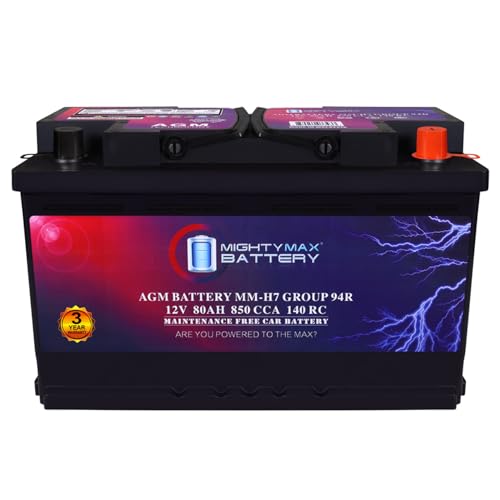
A 140-minute reserve capacity bridges the gap between standard commuter needs and heavy-duty performance requirements.
The Mighty Max MM-H7 fills the BCI Group 94R category with 80 amp-hours and 850 cold cranking amps. Its 140-minute reserve capacity places it comfortably above entry-level options without reaching extreme heavy-duty territory. This translates to two hours and twenty minutes of sustained 25-amp power delivery.
The AGM construction resists shock and vibration, crucial for vehicles driven on rough roads. Deep discharge recovery ensures the battery bounces back after powering accessories with the engine off. It meets strict ISO and CE manufacturing standards.
Mid-size trucks and European vehicles often specify Group 94R batteries like this one. The 140-minute reserve capacity suits drivers who tow occasionally or run moderate auxiliary equipment. It provides a noticeable safety margin over 100-minute rated alternatives.
However, buyers must confirm their specific vehicle accepts the 94R footprint and terminal layout. Installing it in an incompatible tray risks damaging the casing. For those needing reliable start-stop functionality paired with solid endurance, this model strikes a practical balance.
|
7
|
OPTIMA® Batteries High Performance D34/78 YELLOWTOP® Sealed AGM Battery | Dual Purpose Car |

With 120 minutes of reserve capacity, it shows how spiral-cell technology maintains steady voltage under dual-purpose loads.
The Optima Yellowtop D34/78 combines starting power and deep-cycle capability in a distinctive sealed AGM package. It produces 750 cold cranking amps from its 55 amp-hour C20 capacity. The stated reserve capacity reaches 120 minutes, ensuring two hours of reliable 25-amp output. SpiralCell technology uses 99.
99 percent pure lead to deliver consistent power and resist vibration fifteen times better than flat plates. Dual SAE and GM terminals add installation flexibility. It charges faster than conventional flooded designs due to its low internal resistance.
Off-road vehicles and trucks with winches lean heavily on this dual-purpose engineering. The 120-minute reserve capacity supports auxiliary lighting and compressors during engine-off staging periods. Vibration resistance prevents internal plate damage on washboard trails.
Its main trade-off involves total capacity; 55 amp-hours falls short of dedicated deep-cycle batteries for prolonged camping trips. Weighing 43. 5 pounds, it remains manageable for most engine bays. Maintenance-free operation eliminates the need to check fluid levels entirely.
|
8
|
Mighty Max Battery MM-H5 Start and Stop Car BCI Group Size 47 12V 60 AH, 100RC, 680 CCA Re |

A 100-minute reserve capacity proves sufficient for lighter passenger cars that prioritize starting amps over extended runtime.
The Mighty Max MM-H5 serves the BCI Group 47 market with 60 amp-hours and 680 cold cranking amps. It matches the 100-minute reserve capacity found in smaller group sizes, tailored for efficient modern compacts.
That 100-minute rating guarantees one hour and forty minutes of 25-amp electrical support if the alternator stops. Sealed AGM technology prevents acid spills and enables deep discharge recovery. Rugged internal construction withstands temperature extremes and road vibrations effectively.
It carries the same ISO-certified build quality as the larger Mighty Max models.
Owners of smaller hatchbacks and crossovers requiring Group 47 fitment will find this battery highly appropriate. The 100-minute reserve capacity aligns perfectly with factory electrical loads on fuel-efficient platforms. Adding high-draw aftermarket accessories could strain this endurance limit quickly.
Drivers should avoid using it as a primary house battery for RV setups. It excels strictly as a reliable starter battery with adequate emergency backup time. Verifying terminal orientation ensures a hassle-free drop-in replacement process every time.
|
9
|
Mighty Max Battery MM-G35 Group Size 35 12V, 55Ah, 100RC, AGM, 650 CCA, Replacement Batter |
Targeted at a specific Corolla application, its 100-minute reserve capacity shows how OEM replacements match factory specs.
This Mighty Max MM-G35 variant shares the 55 amp-hour and 650 cold cranking amp specs of the standard model. It explicitly lists compatibility with the 1997 Toyota Corolla 1. 8-liter engine. The 100-minute reserve capacity mirrors the original equipment requirements for that era of compact cars.
Sealed AGM construction offers a significant upgrade over the flooded battery likely installed at the factory. It resists vibration and recovers deeply after accessory use. Manufacturing occurs in an ISO-certified facility meeting CE safety standards.
Restoring older compact cars benefits greatly from modern AGM technology packaged in familiar group sizes. The 100-minute reserve capacity provides more than enough buffer for a 1997 Corolla’s simple electrical system. Vintage vehicles lack the heavy computer loads that drain modern batteries quickly.
One limitation is availability; buyers must double-check their specific year and engine code before ordering. Assuming fitment matches, this battery breathes new life into aging daily drivers. It eliminates the mess associated with maintaining old flooded cells.
These nine batteries illustrate how reserve capacity spans from 100 minutes in compact cars to nearly 300 minutes in deep-cycle sets. Matching the correct rating to your vehicle’s electrical demands ensures reliable performance. Choosing too little leaves you stranded, while choosing too much wastes money and space.
The right number depends entirely on what your vehicle requires daily.
Matching The Right Reserve Capacity To Your Vehicle
Recommended Products


Knowing what reserve capacity means is only half the equation. Applying that knowledge to your specific vehicle prevents costly mistakes. This section covers how to read your requirements and select the correct rating without guessing.
- Always match or exceed the factory-specified reserve capacity rating printed on your original battery label.
- Calculate total aftermarket accessory draw to determine if you need a higher reserve capacity than stock.
- Never install a battery with lower reserve capacity in a vehicle equipped with automatic start-stop technology.
- Check the physical group size first, as higher reserve capacity batteries often feature larger external dimensions.
- Consult your owner manual for the minimum acceptable reserve capacity required by the onboard computer systems.
- Consider climate factors, since extreme heat accelerates chemical degradation and reduces effective reserve capacity over time.
Finding the correct reserve capacity starts with inspecting your current battery. Most manufacturers print the RC rating directly on the top or side label alongside cold cranking amps. If the label faded, checking the owner manual provides the baseline specification.
Exceeding that number generally improves reliability, provided the physical dimensions still fit the battery tray. Downsizing creates immediate problems. Modern engine control modules monitor voltage constantly. A battery with insufficient reserve capacity triggers false warning lights during normal accessory use. Vehicles with start-stop technology suffer the most from undersized ratings.
The engine shuts off at intersections, forcing the battery to carry the entire electrical load repeatedly. If the reserve capacity falls short, the computer disables the start-stop feature entirely to protect the system. Upgrading to a higher rating restores intended functionality.
Always confirm terminal placement matches your cables before finalizing any purchase based purely on specifications.
How Reserve Capacity Degrades Over Time
A battery rated for 120 minutes today will not deliver that same endurance forever. Chemical aging reduces available capacity gradually. Understanding this degradation helps you plan replacements before an emergency forces your hand.
Every charge and discharge cycle slightly diminishes a battery’s total reserve capacity. Lead sulfate crystals form on the internal plates during use. Proper recharging dissolves most of these crystals, but some harden permanently over months and years. This process, called sulfation, shrinks the active surface area available for chemical reactions.
A battery originally rated for 140 minutes might only sustain 100 minutes after three years of daily driving. Heat accelerates this degradation significantly. Engine bay temperatures in summer push internal chemistry harder, consuming the plates faster. AGM batteries resist sulfation better than flooded designs, extending their useful reserve capacity lifespan.
Deep discharges cause the most damage. Letting the battery drain completely before recharging permanently removes capacity that no amount of charging restores. Keeping the state of charge above fifty percent preserves the original reserve rating much longer.
Test the resting voltage monthly using a digital multimeter to catch early signs of capacity loss.
Drive the vehicle for at least twenty minutes after jump-starting to allow the alternator to recharge fully.
Disconnect auxiliary accessories like dashcams when parking for extended periods to prevent parasitic drain.
Clean terminal corrosion promptly using a wire brush and baking soda solution to maintain optimal current flow.
Use a smart trickle charger during winter storage to prevent deep discharge cycles from destroying internal plates.
Reserve capacity on a battery is the measured number of minutes it can sustain a 25-amp load before voltage drops too low to power essential systems. It dictates how long your vehicle survives an alternator failure. Check the sticker on your current battery today to find its specific RC rating.
Compare that number against the options listed above if you notice dimming headlights or slow cranking. Replacing a degraded battery before it fails completely saves you from an expensive roadside tow. Keep that rating matched or slightly upgraded for peace of mind.

- 10 Best Battery For Generator Ev Battery Bank Marine 2026 - October 27, 2026
- 10 Best Battery For Generator Ev Battery Bank Lto 2026 - October 27, 2026
- 10 Best Battery For Generator Ev Battery Bank Low Voltage 2026 - October 27, 2026