AA Battery Voltage by Chemistry: Alkaline and Rechargeable Cells
A dead remote or a flickering flashlight usually sparks this question. Most people grab whatever battery fits the slot without checking specs. But mixing voltages can damage sensitive electronics or cause devices to underperform. Understanding what powers your gadgets prevents wasted money and broken gear.
A standard alkaline AA battery delivers 1. 5 volts when fresh off the shelf. Rechargeable versions operate differently, typically outputting 1. 2 volts. This difference matters more than most consumers realize. Below is a breakdown of how voltage works across different chemistries.
Ten specific AA batteries follow as practical examples of these electrical standards in action.
Why AA Battery Voltage Matters For Your Devices
Voltage determines how much electrical pressure pushes current through a circuit. Not every device handles the same pressure equally. Knowing the baseline helps prevent hardware issues.
Every electronic device expects a specific range of electrical pressure to function correctly. A standard alkaline AA cell provides exactly 1. 5 volts when brand new. As the battery discharges, that number slowly drops toward 1. 0 volt. Devices like TV remotes keep working fine at lower voltages.
However, high-drain electronics such as digital cameras or motorized toys need that full 1. 5V push. If the voltage drops too low, the device simply shuts off. Mixing old and new batteries creates an imbalance in the circuit. The weaker cell forces the stronger ones to work harder.
This mismatch generates excess heat and shortens overall battery life. Always replace all cells in a device at the same time. Matching brands ensures consistent voltage delivery across the entire battery compartment. Understanding this basic electrical behavior protects expensive gadgets from premature failure.
Voltage Differences By Chemistry Type
| Battery Chemistry | Nominal Voltage | Peak Fresh Voltage |
|---|---|---|
| Alkaline | 1.5V | 1.6V |
| Lithium Primary | 1.5V | 1.7V |
| NiMH Rechargeable | 1.2V | 1.4V |
| Nickel Cadmium | 1.2V | 1.3V |
How Alkaline And Rechargeable Cells Compare Electrically
Consumers often assume all AA batteries deliver identical power. The chemistry inside the casing dictates the actual voltage output. Choosing the wrong type leads to poor performance.
AA Batteries That Deliver Reliable Voltage Output
Understanding the theory behind voltage is only half the equation. Seeing how manufacturers package and guarantee that 1.5V or 1.2V output makes the concept concrete. These ten options represent real-world answers to the voltage question.
|
1
|
ACDelco 40-Count Double AA Batteries, Maximum Power Super Alkaline Battery for Home and Of |

ACDelco explicitly lists 1.5 volts in its specs, confirming the standard alkaline voltage output directly.
The ACDelco 40-Count pack provides standard alkaline cells rated at exactly 1. 5 volts. This bulk option targets households needing reliable power for everyday gadgets. Each battery uses super alkaline chemistry to maintain that nominal voltage under moderate loads. The reclosable packaging keeps unused cells organized while preserving their charge.
ACDelco engineers these specifically for common items like wireless mice and flashlights. The stainless steel coating helps prevent leaks during long storage periods. Buyers get forty individual units ready to deliver consistent electrical pressure right out of the box.
These work best for families stocking up for multiple low-to-medium drain devices. The ten-year shelf life means the 1. 5-volt potential remains intact for years. Users should note these are strictly non-rechargeable single-use cells. Attempting to recharge them compromises the internal alkaline structure.
The large quantity suits offices or homes with many remote controls and clocks. Keeping them in a cool, dry place preserves the promised voltage output. Do not mix these with older partially drained batteries in the same device.
|
2
|
Duracell Alkaline Powerboost AA4 Battery, 4 Count |
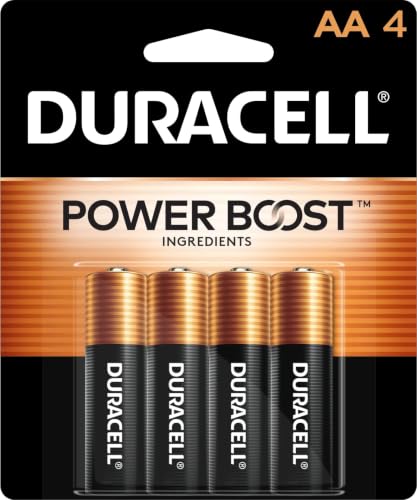
Duracell CopperTop engineering targets the precise 1.5V level required by most business and household electronics.
This four-pack of Duracell Alkaline Powerboost AA batteries delivers the expected 1. 5 volts per cell. Duracell engineers the CopperTop line to provide exact voltage levels for daily electronics. Each battery features an individual date code to track freshness over time.
The formulation guarantees reliable operation even in extreme temperatures ranging from -4F to 129F. Duracell omits added mercury from the alkaline chemistry entirely. The small count makes sense for testing a specific device before buying larger quantities. Every cell pushes that standard 1. 5V electrical pressure immediately upon installation.
My read is that small packs make sense if you only need to power one or two critical items. The ten-year freshness guarantee ensures the voltage does not degrade in storage. Businesses often buy these for essential equipment like barcode scanners or presentation clickers.
One limitation is the higher cost-per-battery compared to bulk packaging options. Temperature resistance proves valuable for outdoor gear exposed to seasonal extremes. The Powerboost ingredients help sustain the 1. 5V output longer during heavy discharge cycles. Keep the date codes visible to rotate stock efficiently over time.
|
3
|
Energizer AA Batteries Alkaline Power, 32 Count Alkaline Double A Battery Pack |

Energizer confirms dependable alkaline power, maintaining the industry-standard 1.5 volts for emergency and daily use.
Energizer packages thirty-two alkaline AA batteries designed to deliver consistent 1. 5-volt performance. This mid-sized bulk pack balances quantity with manageable storage requirements. The brand positions these cells for both daily electronics and emergency preparedness kits. Energizer incorporates up to ten percent recycled steel into the battery casing.
This environmental step does not compromise the standard 1. 5V alkaline output. Devices like smart home sensors and VR controllers rely on this exact voltage specification. The ten-year storage rating protects the chemical integrity inside each sealed cell.
Hurricane kits and emergency supplies demand batteries that hold their voltage for years. Energizer meets this need with stable alkaline chemistry rated for long-term readiness. Gamers using wireless controllers will appreciate the steady 1. 5V delivery during sessions. However, high-drain continuous use depletes alkaline cells faster than rechargeable alternatives.
The thirty-two count covers multiple devices without taking up excessive drawer space. Recycled materials appeal to environmentally conscious consumers tracking their household footprint. Always verify device compatibility before assuming standard alkaline voltage suffices for specialized gear.
|
4
|
EBL AA Batteries 20 Pack Non-Rechargeable 1.5V Alkaline Double A Batteries | Upgraded 2X P |
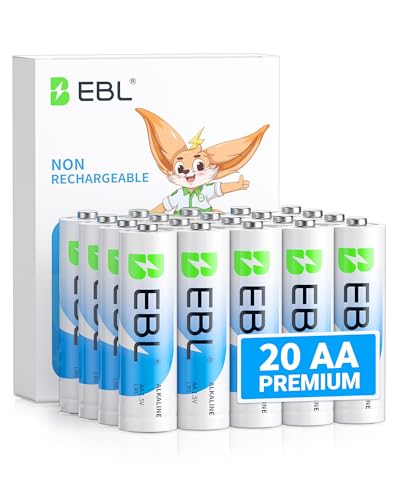
EBL highlights upgraded 2X power while strictly adhering to the 1.5V alkaline standard consumers expect.
The EBL 20-Pack offers non-rechargeable alkaline batteries producing the standard 1. 5 volts each. EBL markets an upgraded formula claiming twice the power of basic competitors. Despite the power boost claim, the nominal voltage remains fixed at 1. 5V.
The company achieves longer runtime by increasing internal capacity rather than altering voltage. A twelve-year shelf life exceeds many mainstream brands by several years. Mercury-free and cadmium-free construction aligns with modern environmental safety standards. These cells target flashlights, toys, and clocks requiring steady alkaline electrical pressure.
I would shortlist these for budget-conscious shoppers who want premium-style 1. 5V performance without paying top-tier brand prices. The extended twelve-year storage window makes them excellent candidates for backup drawers. EBL promises leak resistance to protect expensive device contacts from corrosive damage.
One honest limitation involves the lack of independent third-party testing data here. Marketing claims about doubled power rely on internal comparisons rather than universal benchmarks. Still, the fundamental 1. 5-volt specification matches exactly what household electronics require. Store them away from direct sunlight to maximize the advertised shelf longevity.
|
5
|
Amazon Basics 20-Pack AA Alkaline Batteries, 1.5 Volt, 10-Year Leak-Free Shelf Life, for E |

Amazon Basics clearly prints 1.5 Volt on the packaging, removing any guesswork about electrical output.
Amazon Basics ships twenty alkaline AA batteries explicitly rated at 1. 5 volts per cell. This straightforward offering removes ambiguity for consumers verifying voltage requirements. The ten-year leak-free shelf life protects stored inventory from chemical degradation. Amazon designs these for broad compatibility across game controllers, toys, and digital cameras.
Frustration-Free Packaging allows quick access without struggling against rigid plastic clamshells. Each battery delivers the standard alkaline voltage curve expected by modern electronics. The twenty-count size fits neatly into standard kitchen junk drawers for easy access.
Households running through batteries moderately will find this pack size highly practical. The 1. 5-volt output powers everything from wall clocks to wireless keyboards reliably. Users must remember these are single-use cells incapable of accepting a recharge. Amazon directs buyers needing reusable options toward their separate NiMH product line.
Leak-free engineering reduces anxiety about damaging expensive remote controls during storage. The simple branding focuses entirely on functional voltage delivery rather than flashy marketing. Replace all twenty cells simultaneously when powering multi-battery devices for balanced performance.
|
6
|
Amazon Basics 36-Pack AA Alkaline Batteries, 1.5 Volt, 10-Year Shelf Life, for Everyday an |

This larger Amazon Basics pack maintains the identical 1.5 Volt specification needed for professional environments.
Stepping up to thirty-six cells, this Amazon Basics pack still guarantees 1. 5 volts each. The larger quantity targets professionals or large families consuming batteries rapidly. Amazon maintains the same alkaline chemistry found in their smaller retail packages. Every battery outputs the standard 1.
5V required by industrial and household devices alike. The ten-year shelf life applies uniformly across all thirty-six units in the box. Easy-to-open packaging streamlines deployment in office settings or maintenance closets. Consistent voltage delivery ensures predictable performance across dozens of different electronic tools.
Office managers stocking supply rooms benefit from the higher unit count significantly. The 1. 5-volt standard works universally with conference room clickers and wireless peripherals. Like the smaller pack, these remain strictly non-rechargeable single-use alkaline cells. Storing thirty-six batteries requires slightly more physical space than compact alternatives.
Professional environments demand reliability, which this standardized voltage output provides consistently. Avoid leaving loose batteries in metal containers where terminals might short together. The bulk pricing structure lowers the cost-per-volt compared to convenience store purchases.
|
7
|
Amazon Basics 8-Pack AA Alkaline High-Performance Batteries, 1.5 Volt, 10-Year Shelf Life, |

An eight-pack isolates the 1.5 Volt spec for users who just need to verify voltage quickly.
Sometimes buyers only need a few cells to test a device or confirm voltage. This Amazon Basics 8-Pack delivers exactly 1. 5 volts per alkaline battery. The small quantity prevents waste when experimenting with unfamiliar electronics. Amazon includes the standard ten-year shelf life even on this minimal count.
Game controllers and digital cameras run properly on this verified 1. 5V output. The packaging may vary depending on fulfillment center inventory at purchase time. Compact sizing makes this ideal for travel bags or small toolboxes requiring spares.
Travelers carrying portable electronics appreciate the lightweight nature of an eight-cell pack. Verifying that a gadget accepts standard 1. 5V alkaline power costs very little here. The limitation is obvious: eight batteries disappear quickly in high-consumption households. Frequent users should upgrade to the industrial or larger consumer packs instead.
Amazon specifically notes these are unsuitable for continuous professional-grade applications. Single-use chemistry means discarding them responsibly once the voltage drops below usable levels. They serve perfectly as diagnostic tools for troubleshooting dead electronic equipment.
|
8
|
Rechargeable AA Batteries with Charger, High Capacity 2800mAh Ni-MH Double A Battery, 4 Co |

This set demonstrates the alternative 1.2V output typical of NiMH rechargeable chemistry versus standard alkaline.
Not every AA battery outputs 1. 5 volts, and this rechargeable set proves it. These NiMH cells deliver a nominal 1. 2 volts paired with 2800mAh capacity. The package includes four batteries plus a dedicated four-slot charging unit. High-capacity 2800mAh ratings compensate for the lower voltage by providing sustained current.
Cameras, game controllers, and smart home devices utilize this rechargeable chemistry effectively. The included charger features intelligent protection against over-voltage and short circuits. It even attempts to repair cells damaged by excessive discharge previously.
My take is that users confused by why some devices feel weaker on rechargeables now understand voltage differences. The 1. 2-volt output sits below the 1. 5V alkaline standard discussed earlier. However, high-drain devices often perform better due to the massive 2800mAh reserve.
The charger adds bulk, making this kit less ideal for minimalist travel. Portable design helps, but carrying the charging brick requires extra bag space. Over time, recharging saves money compared to repeatedly buying disposable 1. 5V cells. Ensure your specific device tolerates 1. 2V input before switching permanently from alkalines.
|
9
|
Amazon Basics 200-Pack AA Industrial Alkaline Batteries, 1.5 Volt, 5-Year Storage Shelf Li |

Industrial bulk packaging confirms facilities rely on the standard 1.5 Volts for hundreds of operational devices.
Facilities managing hundreds of devices require absolute certainty about voltage specifications. This Amazon Basics 200-Pack guarantees 1. 5 volts from every single alkaline cell. Packaged in bulk trays, these batteries skip retail aesthetics for pure utility. The five-year storage shelf life reflects higher turnover expectations in commercial settings.
Maintenance teams use these for door locks, sensors, and handheld diagnostic tools. Mercury and cadmium-free formulations meet corporate environmental compliance requirements easily. Two hundred units ensure uninterrupted 1. 5V power distribution across entire building floors.
Industrial buyers prioritize volume and voltage consistency over extended residential shelf life. Five years in storage suffices when maintenance crews cycle through inventory monthly. The sheer weight of two hundred batteries demands dedicated storage shelving. Residential users will find this quantity absurdly excessive for normal household needs.
Professional applications like hotel room remotes or warehouse scanners justify the bulk purchase. Each cell maintains the strict 1. 5-volt alkaline standard required by commercial equipment. Proper inventory rotation prevents older stock from losing voltage potential before deployment.
|
10
|
DURACELL Coppertop AA Batteries, 16 Count, 12-Year Shelf Life, Long-Lasting |

Duracell Coppertop pairs the expected 1.5V output with proprietary Power Boost ingredients for sustained voltage delivery.
Duracell Coppertop represents perhaps the most recognized name delivering standard 1. 5-volt AA power. This sixteen-count family pack organizes cells in a convenient reclosable container. Duracell extends the storage guarantee to twelve years for long-term confidence. Exclusive Power Boost ingredients aim to stabilize that 1. 5V output under load.
The batteries work with hundreds of everyday items from smoke detectors to Wii controllers. Strict manufacturing standards back every cell with a defect guarantee. Families trust this specific voltage profile for critical home safety devices.
Sixteen cells strike a balance between bulk savings and reasonable home storage. The reclosable packaging prevents loose batteries from rolling around in utility drawers. Smoke detectors and baby monitors absolutely require reliable 1. 5-volt alkaline performance. One consideration is the premium price point compared to generic store brands.
Consumers pay for the Duracell name and the associated quality assurance. The twelve-year guarantee means emergency kits stay voltage-ready through multiple seasons. Verify that specialized medical equipment accepts standard alkaline voltage before installing these.
These ten options illustrate how manufacturers approach the standard AA voltage question differently. Whether delivering 1. 5 volts via alkaline chemistry or 1. 2 volts through NiMH, each serves distinct needs. Bulk counts suit facilities, while small packs help troubleshoot specific gadgets.
The underlying voltage specification remains the critical factor guiding every purchase decision above.
Reading Voltage Labels Before Installing New Batteries
Manufacturers print voltage information in specific locations on packaging. Learning where to look prevents accidental mismatches. Checking labels takes seconds but protects expensive electronics from incorrect electrical pressure.
Locate the front panel of the battery packaging where primary specifications appear printed clearly.
Search for the number followed by a V symbol indicating either 1.5V or 1.2V output.
Cross-reference this number with the battery compartment label inside your specific electronic device.
Confirm whether the device manual specifies alkaline or rechargeable chemistry before final installation.
- Never mix 1.5V alkaline cells with 1.2V rechargeable cells in the same device.
- Always install batteries facing the correct polarity direction marked inside the compartment.
- Remove batteries from devices you plan to store unused for several months.
- Check expiration dates printed on cells to ensure maximum voltage potential remains available.
- Dispose of swollen or leaking batteries immediately regardless of remaining voltage capacity.
What Happens When AA Voltage Drops Too Low
Batteries rarely fail instantly. They experience gradual voltage decline as internal chemicals deplete. Recognizing the symptoms of dropping voltage helps determine when replacements become necessary.
A fresh alkaline AA battery starts near 1. 6 volts before settling at its 1. 5V nominal rating. As devices draw current, chemical reactions consume zinc and manganese dioxide inside the casing. This consumption causes measurable voltage drop over hours or weeks depending on drain rate.
Most electronics function normally until voltage falls below roughly 1. 1 volts per cell. At that threshold, motors slow down, screens dim, and wireless signals weaken noticeably. Microprocessors inside smart devices may reset unexpectedly when voltage fluctuates near minimum limits. Leaving deeply discharged batteries inside equipment risks chemical leakage.
The internal pressure builds as depleted materials break down structurally. Corrosive potassium hydroxide escapes through weakened seals and destroys copper contact springs. Removing batteries promptly after devices stop functioning prevents permanent hardware damage. Regular voltage checks using a multimeter provide early warning before total failure occurs.
A standard alkaline AA battery produces 1. 5 volts, while rechargeable NiMH versions output 1. 2 volts. Check your device manual to confirm which chemistry it supports best. Grab a cheap digital multimeter today and test the batteries currently sitting in your drawer.
Measuring actual voltage takes seconds and reveals which cells still hold useful charge. Stop guessing when gadgets act sluggish. Knowing the exact electrical pressure inside your batteries prevents hardware damage and saves money. Match the voltage to the task, and your electronics will run reliably every single time.

- Marine Chargers and Backup Batteries: 9 Options Compared (2026) - October 27, 2026
- LTO Cells vs. SLA Generator Batteries: 5 Options Compared (2026) - October 27, 2026
- 12V/24V Backup Batteries and the EcoFlow DELTA Pro 3 (2026) - October 27, 2026