Smoke Detector Battery Formats: Size Charts and Model Checks
You pull the cover off a chirping smoke detector and freeze , the battery inside isn‘t the AA you grabbed from the kitchen drawer. It’s a squat rectangular block, or maybe two AAs, or something else entirely. The answer depends on the detector, not on a universal standard.
Most smoke alarms run on one of three battery types, and the model number on the back tells you which. This guide explains how to identify yours, why the type matters, and which batteries are worth buying once you know the size.
Why Smoke Detectors Don’t All Take The Same Battery
Smoke detector battery size isn’t standardized because detectors are built around different sensors, power demands, and price points. Knowing why the sizes vary helps you identify yours correctly the first time.
Smoke detectors use different batteries because their internal designs differ. Ionization and photoelectric sensors draw power differently, and manufacturers balance cost, size, and backup duration. A basic battery-only alarm might run on a single 9V because that format delivers steady voltage for years.
A compact detector with a smaller footprint might use two AA batteries to fit a slimmer housing. Some newer models use AA or AAA batteries because they’re cheaper to replace and easier to find.
The size isn’t arbitrary , it’s tied to how much space the alarm has and how long the manufacturer expects the battery to last. That’s why two detectors on the same hallway shelf can take completely different batteries.
Common Smoke Detector Battery Types At A Glance
| Battery Type | Typical Detector Style | Common Lifespan |
|---|---|---|
| 9V alkaline | Standard round or square alarms | 6-12 months |
| AA alkaline | Compact and newer models | 6-12 months |
| AAA alkaline | Slim or mini detectors | 6-12 months |
| 10-year lithium | Sealed, disposable alarms | Full alarm life |
How To Confirm Your Detector’s Battery Size
Guessing the battery size wastes a trip to the store and leaves your home unprotected longer. These steps help you confirm the exact size before you buy anything.
Twist or lift the detector off its mounting bracket, or open the front battery door if it has one.
Remove the old battery and read the label , it will say 9V, AA, AAA, or list a model number.
Check the sticker inside the battery compartment for the manufacturer’s recommended battery type.
Write down the detector’s model number (usually on the back) so you can look up the manual if needed.
Buy the same size and chemistry , don’t substitute a different size even if it fits loosely.
- Never force a battery that doesn’t seat easily , a wrong-size battery can damage contacts.
- Match the chemistry the manufacturer specifies; alkaline and lithium are not interchangeable in every alarm.
- If the old battery is a 9V, buy 9V , AA batteries won’t fit the same terminals.
- Keep the detector’s manual or a photo of the battery compartment on your phone for future replacements.
- When in doubt, take the old battery to the store and compare it side by side.
Batteries And Alarms That Answer The Size Question
Once you know whether your detector takes a 9V, AA, or AAA, the next step is buying the right battery , or replacing an old alarm entirely.
These picks cover the most common 9V smoke detector batteries, plus a few complete detector options if your unit is due for an upgrade.
|
1
|
Amazon Basics 8-Pack 9V Long-Lasting Alkaline Batteries for Smoke Detector, Electronics & |

An 8-pack of 9V alkalines covers multiple detectors and gives you spares for the next replacement cycle.
If your detector takes a 9V, this Amazon Basics 8-pack is a straightforward answer. Each battery is a standard 9V alkaline with a 5-year shelf life, so you can store the extras without worrying they’ll degrade before you need them.
The packaging is frustration-free, which matters when you’re replacing batteries at 2 a. m. because of a chirp. Eight batteries is enough for several detectors plus a backup stash.
These work well for smoke detectors, garage door openers, and radios , any device that takes a 9V. The main limitation is that they’re single-use, not rechargeable, so you’ll repurchase every year or two. If you have just one detector, a smaller pack might be more sensible.
For households with three or more 9V alarms, the bulk pack saves repeat trips.
|
2
|
First Alert Battery Smoke Alarm | SMI100, 1-Pack |

A complete battery-operated alarm that takes a 9V, so you skip the size guesswork entirely.
The First Alert SMI100 is a battery-operated smoke alarm that runs on a 9V battery , the most common size for standalone detectors. It uses Precision Detection sensing to reduce nuisance alarms from cooking, and the front-access battery compartment makes replacements easy without removing the whole unit.
If your current detector is old or you’re not sure what size it takes, this replaces the question with a known answer.
This single-pack suits a hallway, bedroom, or small apartment where one alarm covers the space. The end-of-life warning tells you when the whole unit needs replacing, not just the battery. One limitation: it’s a 1-pack, so covering a full house means buying multiple units.
It’s best for someone replacing one detector at a time or adding coverage to a single room.
|
3
|
DURACELL Coppertop 9V Battery, 6 Count, Smoke Detector Battery |
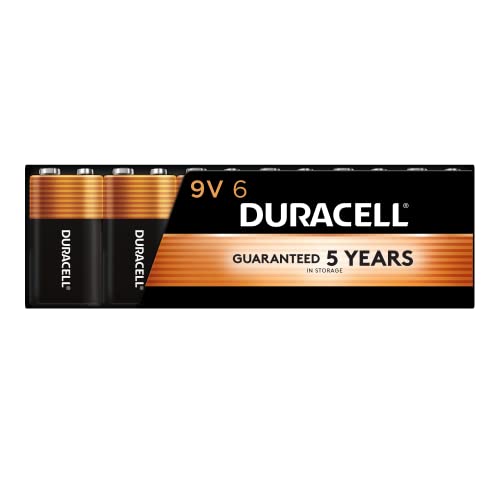
Six 9V Coppertop batteries , the exact size most smoke detectors use, with a 5-year storage guarantee.
Duracell Coppertop 9V is the battery most people picture when they think ‘smoke detector battery.’ This 6-count pack gives you enough for several detectors plus spares. The 5-year storage guarantee means the extras stay fresh until the next annual replacement.
Duracell markets these specifically for smoke detectors, carbon monoxide detectors, and security sensors, so the intended use matches yours.
These are alkaline, single-use batteries , not rechargeable , and they’re priced higher than generic brands. The trade-off is brand reliability and the storage guarantee. For a homeowner with four or five 9V detectors, this pack covers a full replacement round with one or two left over.
If you only have one detector, a 2-pack makes more sense.
|
4
|
Duracell Coppertop 9V Battery, 2 Count, Smoke Detector, Long-lasting |
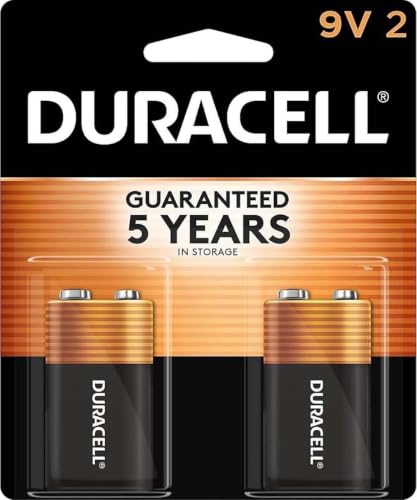
A 2-pack of 9V Coppertops sized for a single detector replacement without leftover batteries.
This is the same Duracell Coppertop 9V battery as the larger pack, just in a 2-count size. If you have one smoke detector and want a spare on hand, this is the right quantity.
The 5-year storage guarantee applies here too, so the second battery won’t go bad before you need it. It’s a simple, no-waste answer to the 9V question.
Two batteries cover one detector now and one replacement later. The limitation is cost per battery , buying in bulk is cheaper per unit. But if you live in a small apartment with a single alarm, this avoids a drawer full of unused 9V batteries.
It’s also a good size for keeping one in a kitchen drawer as an emergency spare.
|
5
|
First Alert Battery Smoke Alarm | SMI100, 2-Pack |

Two 9V battery-operated alarms , a matched pair for homes that need coverage in two spots.
The SMI100 2-pack gives you two identical battery-operated smoke alarms, each running on a 9V battery. Precision Detection sensing reduces false alarms from cooking, and the front-access compartment makes battery swaps quick.
If you’re replacing two old detectors or adding coverage to a second hallway, this pack keeps the battery size consistent across both units.
Two alarms cover a typical apartment or a small house with a central hallway and one bedroom. The end-of-life warning works per unit, so you’ll know when each needs replacing.
The limitation is that both units use the same 9V battery , fine if you already stock them, but you’ll need to buy batteries separately. It suits someone standardizing on 9V across their home.
|
6
|
First Alert Battery Smoke Alarm | SMI100, 3-Pack |

Three 9V battery alarms for whole-home coverage without mixing battery sizes.
The SMI100 3-pack extends the same 9V battery-operated design across three detectors. This is the practical choice for a house that needs alarms in a hallway, living area, and bedroom , all using the same battery size.
Precision Detection reduces cooking nuisance alarms, and the front battery door means you won’t need to unmount each unit during annual replacements.
Three alarms cover most single-floor homes or apartments with multiple bedrooms. The consistent 9V requirement simplifies your battery shopping , one size fits all three. The limitation is upfront cost compared to buying one at a time, and you still need to supply the 9V batteries.
It’s best for someone replacing a full set of aging detectors at once.
|
7
|
PKNOVA 9V Batteries Carbon 9 Volt Battery for Smoke Detector 9V 6F22 Square Battery, Long- |

A 4-pack of 9V carbon batteries positioned specifically for smoke detectors at a budget price.
PKNOVA’s 4-pack of 9V carbon batteries is aimed directly at smoke detectors and similar devices. Carbon zinc chemistry is cheaper than alkaline, and these are double-sealed to reduce leakage risk.
The low self-discharge design helps them hold charge in storage, and they’re rated for temperature swings from -4°F to 140°F , useful in garages or unheated hallways.
Carbon zinc batteries typically don’t last as long as alkaline in smoke detectors, so you may replace them more often. That’s the trade-off for the lower price. They suit budget-conscious buyers with multiple detectors or anyone who wants a spare set without spending much.
If you want maximum lifespan between replacements, alkaline is the better pick.
|
8
|
Kidde Compact Smoke Detector, AA Battery-Powered, 10SDR | 4-Inch Smoke Alarm with LED Stat |

A compact AA-battery alarm , the answer if your detector takes AAs instead of 9V.
The Kidde 10SDR is a compact smoke detector powered by two AA batteries, which are included. If you’ve been searching for battery size and your old unit took AAs, this is a direct replacement path.
It detects smoke with over 25% faster response, sounds an 85-decibel alarm, and uses sensing technology to reduce false alarms from cooking or steam.
This suits small spaces , apartments, bedrooms, or hallways , where a compact footprint matters. The 10-year limited warranty covers the unit, though the AA batteries need annual replacement. The limitation is that it’s a single detector, so larger homes need multiple units.
It’s ideal for someone who prefers AA batteries because they’re cheaper and easier to find.
|
9
|
Energizer Alkaline Power 9V Batteries (8 Pack), Long-Lasting | Smoke detector battery for |

An 8-pack of Energizer 9V alkalines with a 5-year storage life for smoke detector use.
Energizer Alkaline Power 9V batteries come in an 8-pack and are explicitly listed for smoke detectors, radios, clocks, and handheld meters. The 5-year storage life means you can buy once and have replacements ready for years.
Energizer includes up to 4% recycled materials, which is a small but real sustainability angle. For a home with several 9V detectors, this pack covers multiple replacement cycles.
These are alkaline, single-use batteries , not rechargeable , and the 8-pack is more than a single-detector household needs. The strength is the storage life and brand reliability. If you have three or more 9V smoke detectors, this pack makes annual replacements simple.
For one detector, a smaller pack avoids unused batteries sitting in a drawer.
|
10
|
XUNIUZERO 9V Batteries 6F22 Square Battery (4 Pack) for Smoke Detector Alarm System, Wirel |

A 4-pack of environmentally friendly 9V batteries designed for smoke detector use.
XUNIUZERO’s 4-pack of 9V batteries is built for smoke detectors and similar devices. The carbon zinc cells contain no mercury, cadmium, or lead, and the steel shell is corrosion-resistant with a leak-proof design.
They’re rated for the same -4°F to 140°F temperature range as other utility 9V batteries, so they hold up in varied home conditions.
Like other carbon zinc 9V batteries, these won’t last as long as premium alkalines, so expect more frequent replacements. The environmental angle and leak-resistant shell are the main draws. This pack suits someone with a couple of 9V detectors who wants a greener option without paying premium prices.
It’s not the best choice if you want maximum time between battery changes.
Whether you land on a 9V, AA, or AAA battery, the goal is the same: match the size your detector was built for and replace it on schedule. The picks above cover the most common 9V path, plus AA-powered and complete-alarm options if your unit needs replacing.
Now that you know the size, here’s how to use that battery correctly and avoid the mistakes that shorten detector life.
Replacing The Battery Without Disabling Your Detector
Knowing the battery size is only half the job. How you install and maintain it determines whether your detector actually protects you. These practical steps and habits keep the alarm working between replacements.
Test the detector first by pressing the test button , if it sounds, the unit works and only the battery is suspect.
Remove the old battery and dispose of it according to local rules; many hardware stores accept used batteries.
Insert the new battery of the correct size, matching the polarity markings inside the compartment.
Press the test button again to confirm the new battery powers the alarm correctly.
Write the replacement date on the battery or the detector’s sticker so you know when the next swap is due.
- Replace smoke detector batteries at least once a year, even if the alarm hasn’t chirped.
- Test every detector monthly using the test button , it takes seconds and catches dead batteries early.
- Never paint over a detector or block its vents; that interferes with smoke sensing.
- Keep spare batteries of the correct size on hand so a chirp doesn’t leave you unprotected overnight.
- If a detector chirps soon after a fresh battery, the unit itself may be failing , replace the alarm.
When The Battery Size Question Signals A Bigger Problem
Sometimes the battery isn’t the real issue. If you’re replacing batteries constantly or can’t find the right size, the detector itself may be the problem. Here’s how to tell when to stop swapping batteries and start shopping for a new alarm.
A smoke detector that eats batteries every few months is telling you something. Alkaline 9V batteries should last six to twelve months in a standard alarm. If yours dies in weeks, the detector’s sensor or circuitry may be drawing excess power, or the battery compartment contacts may be corroded.
Corrosion is common in humid bathrooms and kitchens, and it can prevent a correct-size battery from making solid contact. Cleaning the contacts with a dry cloth sometimes helps, but a detector that’s more than ten years old should be replaced regardless.
Smoke sensors degrade over time, and a unit that can’t reliably detect smoke isn’t protecting anyone , no matter how fresh the battery is.
Replace The Battery Or Replace The Alarm?
| Symptom | Likely Cause | What To Do |
|---|---|---|
| Chirps every 30-60 seconds | Low battery | Replace with correct size |
| Chirps after fresh battery | Unit malfunction | Replace the alarm |
| Battery dies in weeks | Excess draw or corrosion | Clean contacts or replace unit |
| Detector is 10+ years old | Sensor degradation | Replace the alarm |
| Can’t find matching battery | Obsolete model | Upgrade to a standard size |
If you’ve confirmed your detector takes a 9V and you’re still unsure which brand to buy, the practical answer is any reputable alkaline 9V with a long shelf life.
Duracell, Energizer, and Amazon Basics all make batteries marketed for smoke detectors, and the differences between them are minor for this use. What matters more is replacing on schedule and testing monthly.
A cheap battery replaced on time protects you better than a premium battery you forget about for three years. When in doubt, buy a multi-pack so you always have the right size ready when a detector starts chirping.
Most smoke detectors take a 9V battery, but some compact models use two AA or AAA batteries , so check the label inside your detector before buying.
The fastest next step is to twist your detector off its bracket, read the battery label or the sticker inside the compartment, and note the size. Then buy a pack that matches, install one battery, and press the test button to confirm it works.
That five-minute check keeps your home protected and ends the guesswork for the next replacement.

- Marine Chargers and Backup Batteries: 9 Options Compared (2026) - October 27, 2026
- LTO Cells vs. SLA Generator Batteries: 5 Options Compared (2026) - October 27, 2026
- 12V/24V Backup Batteries and the EcoFlow DELTA Pro 3 (2026) - October 27, 2026